SpaceX\’s Falcon 1 launch vehicle just completed its second successful launch. Falcon 1 carried RazakSAT, a Malaysian Earth Observing satellite, into orbit.



SpaceX\’s Falcon 1 launch vehicle just completed its second successful launch. Falcon 1 carried RazakSAT, a Malaysian Earth Observing satellite, into orbit.
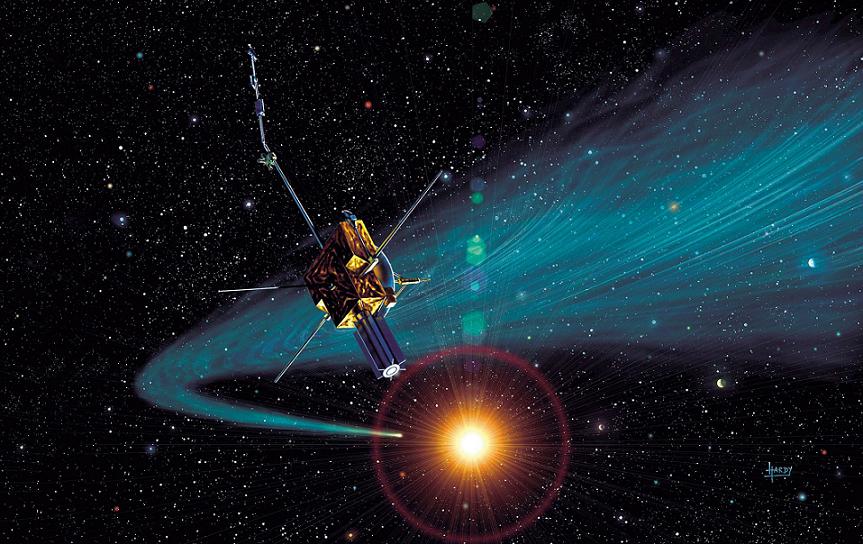 |
| Credits: ESA – D. Hardy |
On June 30, 2009, the Ulysses mission came to an end, one year after the predicted mission end date. Ulysses is one of the longest space missions to date, and holds the record for the longest running ESA operated spacecraft, with a total mission duration of 6,842 days (18 years, 8 months, and 24 days).
A joint venture of NASA and ESA, Ulysses was launched on October 6, 1990, from the STS-41 Space Shuttle Discovery mission. Being an Out-Of-The-Ecliptic (OOE) mission, the Ulysses mission studied the Sun at all latitudes. The initial gravity assist at Jupiter on February 8, 1992, injected the spacecraft in an orbit around the Sun with an inclination to the ecliptic of 80.2 degrees.
Besides studying the north and south poles of the Sun, Ulysses also made observations on Jupiter and the comets Hyakutake and McNaught-Hartley.
The spacecraft is box-shaped, 3.2×3.3×2.1 m in size. Three external features of the spacecraft are the High Gain Antenna (HGA), which is a 1.65 m diameter parabolic dish, the Radio-isotope Thermoelectric Generator (RTG), and the two 35 m antennae for the Unified Radio and Plasma (URAP) instrument. The HGA was used for communicating with ground-based stations in both X-band and S-band radio frequency bands.
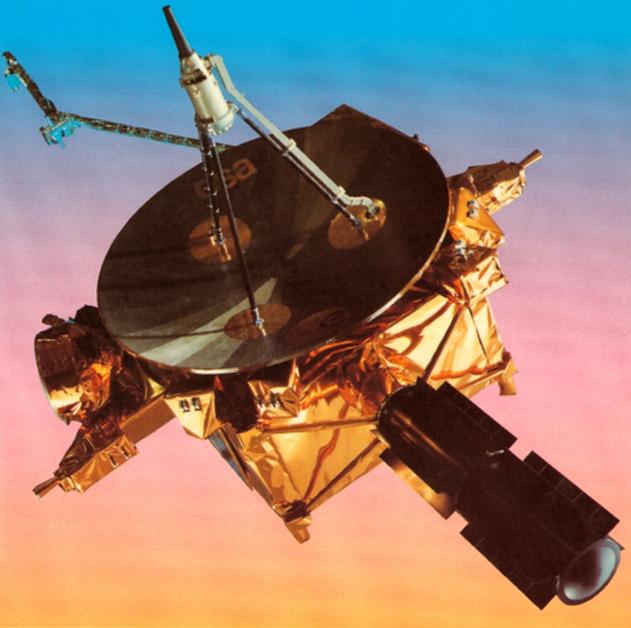 |
| Credits: ESA |
If you are passionate about spacecraft design, an overview of the Ulysses spacecraft, with subsystem schematics and descriptions of all units, is available.
The link contains presentations of the Attitude and Orbit Control Subsystem, the Telemetry, Tracking, and Command Subsystem, the Data Handling Subsystem, and the Power and Thermal Subsystem. It is 1980s technology, but very tasty food for an engineer’s brains.
During its long-duration mission, Ulysses made observations above and below the poles of the Sun. Fundamental scientific discoveries and contributions to our understanding of the Sun and the heliosphere were made. Due to the characteristics of its orbit, Ulysses was able to perform direct measurements of interstellar dust and gas.
You can find out more about Ulysses on ESA’s and NASA’s websites.
Planetary Radio released an interview with Nigel Angold, the ESA Ulysses Mission Operations Manager. Find out how engineers kept the Ulysses spacecraft alive for so long. I invite everyone to listen to it.
The Soil Moisture and Ocean Salinity (SMOS) mission, which is the second Earth Explorer Opportunity mission to be developed as part of ESA’s Living Planet Program, will provide global maps of moisture over the Earth’s landmasses and salinity over the oceans. These observations will improve our understanding of hydrology and ocean circulation patterns.
 |
| Credits: NASA |
Carnival of Space #110 – the Phobos-Grunt, Liberty and Pants-on-Fire Edition – is hosted by Wayne at Kentucky Space.
This week you can read about the Apollo Moon Program, automated Moon rovers, a new Russian interplanetary mission, space-based solar power, and much more.
On June 27, 2009, 6:51 PM EDT, the GOES-O weather satellite launched aboard a Delta IV launch vehicle from Cape Canaveral Air Force Station. GOES-O became GOES-14 on July 7, 2009, when it reached its planed geostationary orbit (35,900 km).
 |
| Credits: David Seal |
Carnival of Space #109 is hosted by Jennifer Ouellette at Twisted Physics.
The Carnival of Space presents Fred Hoyle as the scientist of the 1950s, the Leviathan of Parsontown, conflicting findings regarding Saturn, the Tunguska mystery, and much more.









 Subscribe to blog posts using RSS