


 |
| Credits: NASA/JPL |
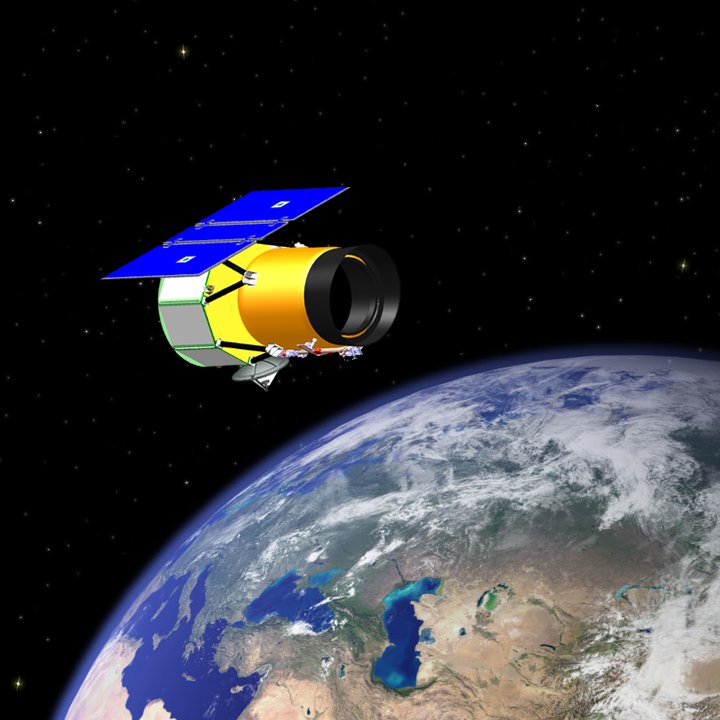
Wide-field Infrared Survey Explorer or WISE is a NASA-funded scientific research project that will provide an all-sky survey in the mid-infrared wavelength range.
WISE will collect data that will allow scientists to compile an all-sky infrared image atlas and catalogue of over 300 million infrared sources. WISE will be able to measure the diameters of more than 100,000 asteroids that glow in the mid-infrared, and make observations of the coldest and nearest stars, regions of new star and planet formation, and the structure of our own galaxy.
WISE will only operate for seven to thirteen months. WISE will explore the entire Universe from a 523×523 km, 97.4-inclined orbit above the ground. The spacecraft will orbit in a Sun-synchronous orbit, so the solar panel will always be pointed at the Sun.
The cryostat will run for thirteen months. After a one-month in-orbit checkout period, the telescope will operate for six months. An additional pass of the sky (that would take another six months) is possible, if funded to do so by NASA.
 |
| Credits: UCLA/JPL |
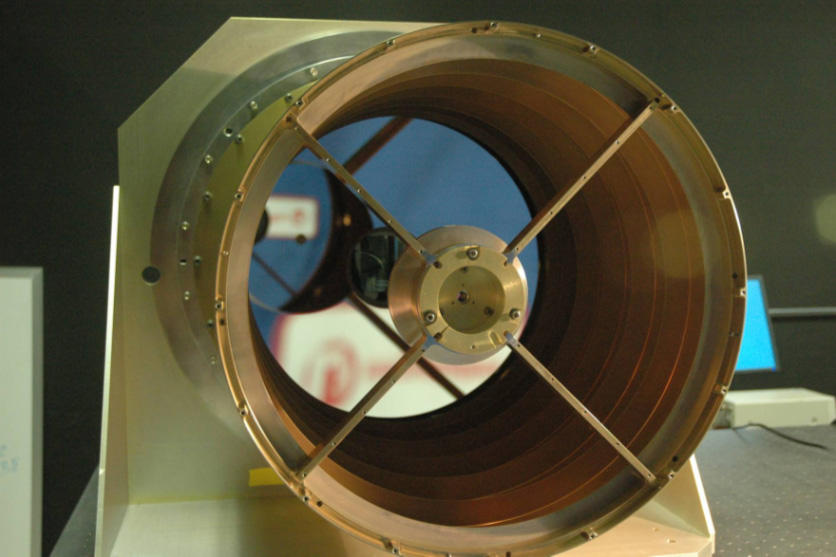
The spacecraft is 2.85 m long, 2.0 m wide, and 1.73 m deep. The spacecraft does not carry propellant. The telescope will make all pointing adjustments using reaction wheels and torque rods. Star trackers, sun sensors, a magnetometer, and gyroscopes will be the sensors used by the attitude control subsystem. The TDRSS (Tracking and Data Relay Satellite System) satellites will relay commands and data with ground stations.
The field of view is 47 arc minutes and it comes from a small telescope diameter (only 40 cm) and large detector arrays. The telescope has four infrared sensitive detector arrays, 1024×1024 pixels each. For the near-infrared bands, there are Mercury-Cadmium-Telluride (MCT) detectors, while for the mid-infrared bands, Arsenic-doped Silicon (Si:As) detectors are used.
 |
| Credits: UCLA/JPL |
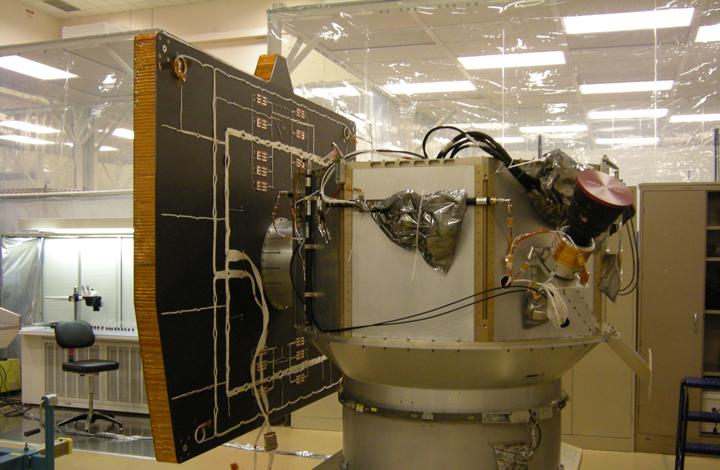
The optics instruments have to be cooled to very low temperatures in order to lower noise detection. The MCT detectors operate at 32 K, while the Si:As detectors will be cooled to less than 8 K.
The WISE launch is scheduled for November 2009. WISE will launch aboard a Delta II launch vehicle from Vandenberg Air Force Base, in California.
The WISE team consists of UCLA (University of California at Los Angeles), JPL (Jet Propulsion Laboratory), SDL (Space Dynamics Labs in Utah), BATC (Ball Aerospace & Technology Corporation), IPAC (Infrared Processing and Analysis Center), and UCB (University of California at Berkeley).
For more information about the WISE mission, you can visit the WISE mission homepage at the Space Science Laboratory, University of California, Berkeley, website.

 Subscribe to blog posts using RSS








