


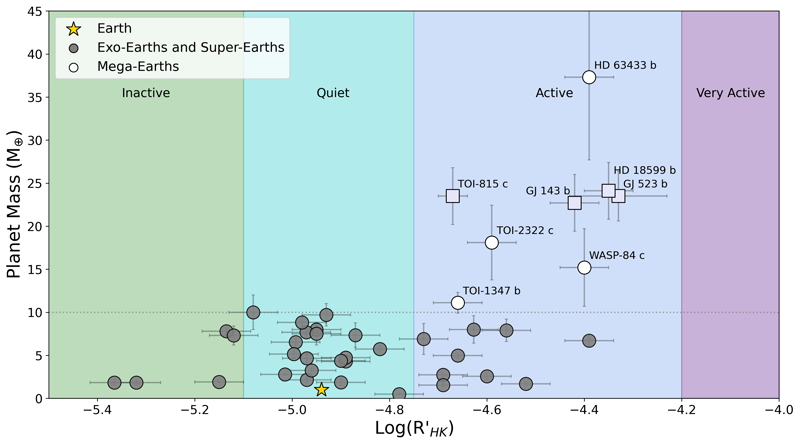
A planet heavier than Neptune but the size of Earth should not, by the rules of how planets form, be a rock. Anything above roughly ten Earth masses is supposed to grab gas from the protoplanetary disk and become a sub-Neptune or larger. Yet a small catalog of worlds has long carried the label “Mega-Earth,” rocky objects sitting above that ten-Earth-mass line, and that label itself colors what people assume about planet formation at the upper end of rocky worlds. A paper published today by Casey Brinkman and Nicolas Cowan at McGill’s Trottier Space Institute argues that the entire category may be a measurement artifact (Brinkman & Cowan 2026, arXiv:2610.12600, reported on by Astrobiology.com the same day). Every candidate Mega-Earth in the literature, the authors show, orbits a magnetically active star. Active starspots and plages mimic and inflate the radial-velocity signal of an orbiting planet, and the chance that all of these outliers would land on active hosts by coincidence is below one percent. The implication is uncomfortable but specific. The Mega-Earths were never there. The detection technique was just seeing starlight flicker, and the label stuck because the underlying objects were just hard enough to disprove.
The category was supposed to mark the upper edge of rocky planet formation. When Xavier Dumusque and colleagues at the Harvard-Smithsonian Center for Astrophysics used the HARPS-N spectrograph on La Palma in 2014 to weigh Kepler-10c, the result landed at seventeen Earth masses packed into a radius only 2.35 times Earth’s (Harvard Gazette, June 2014). That density, on the order of seven grams per cubic centimeter, was consistent with a compressed rocky interior under extreme pressure. The team coined the term “Mega-Earth” (Wikipedia: Mega-Earth) on stage at the Boston meeting of the American Astronomical Society, and Dimitar Sasselov called Kepler-10c the “Godzilla of Earths.” The discovery paper was published in The Astrophysical Journal in June 2014. Subsequent surveys added more candidates with apparent masses between ten and forty Earth masses and radii sitting inside the rocky planet regime, and at various points the literature has listed six to eight such worlds, depending on which mass-radius cuts are applied. Each one pressed against a theoretical limit set by collisional mantle stripping and post-formation erosion that no primordial rocky planet should be able to cross.
What jumps out of the resulting scatter plot is that every white-circle Mega-Earth candidate lies on the active side, while the gray-circle population of ordinary rocky and sub-Neptune-mass planets spans inactive through quiet. The four Mega-Earths the authors identify, WASP-84 c, TOI-1347 b, TOI-2322 c, and HD 63433 b, all orbit stars with log R prime HK above negative four point seven five. Three additional planets sit close to the Mega-Earth density regime: GJ 523 b, TOI-815 c, and HD 18599 b. All seven orbit active stars. The probability of that alignment by chance, given how many inactive and quiet-host rocky systems exist in the same sample, comes out below one percent. The authors also note that a previously Mega-Earth-classified world, HD 119130 b, was already re-measured by another group and found to have an inflated mass caused by constructive interference between the planet’s orbital signal and the star’s rotational modulation.
The mechanism behind the contamination is well known but tricky to remove. Starspots and the brighter magnetic regions called plages move across the disk of a rotating star and produce Doppler shifts in the integrated starlight that are indistinguishable, in many pipelines, from the reflex motion of a planet. Starspots suppress local convection and produce false radial-velocity signals at the star’s rotation period. Plages do the same at somewhat different amplitudes. When a planet’s orbital period happens to land near an integer or half-integer multiple of the star’s rotation period, the two signals can constructively interfere and inflate the inferred planet mass by a factor of two or more. That is the situation for several of the candidate Mega-Earth hosts, whose TESS light curves show clean rotational modulation at periods from roughly four to fourteen days. The full radial-velocity datasets that yielded the published masses came from public archives including the NASA Exoplanet Archive, which compiled discovery spectra from HARPS, PFS, and TESS follow-up campaigns. Gaussian-process regression, the tool most often used to handle stellar activity in radial-velocity fits, is only as good as its kernel choices and its priors. When the kernel is too smooth, the process absorbs genuine planetary motion as activity noise. When it is too wiggly, activity noise leaks into the planetary model and inflates the mass.
What the paper does not do is rule out rocky planets above ten Earth masses on theoretical grounds. The runaway gas accretion argument sets ten Earth masses as the threshold above which a core cannot avoid grabbing gas during formation, but it is a threshold, not a wall. Collisional mantle stripping after disk dispersal or photoevaporation of a once-larger planet’s envelope can, in principle, leave a bare rocky remnant. The authors are explicit that those pathways remain possible, just unproven. The Mega-Earth label, in their framing, has been applied to planets whose mass measurements cannot yet distinguish between a real ultra-dense rocky world and a noisy radial-velocity fit around an active star. Re-observing these systems with ESPRESSO on the Very Large Telescope, with HARPS on the TESS-Keck Survey infrastructure, or with NIRPS at La Silla, all of which have the spectral resolution to see activity-induced line-profile variations directly, would settle the question. Several of the candidate Mega-Earths have already been on those queues. The paper, which appeared on the arXiv preprint server on 8 October 2026 and is now in the resubmission cycle for The Astrophysical Journal Letters, lands in a catalog of corrections that have repeatedly eaten specific claimed populations of extreme exoplanets. Stellar contamination has eaten mini-Neptunes hiding inside hot-Jupiter mass measurements, cold Jupiters past ice lines that were artifacts of magnetic cycles, and small-radius planets that turned out to be diluted binaries. Each time, the underlying detection method is sound for inactive host stars and quietly wrong for active ones. Adding Mega-Earths to that list is, in a way, an expected move. The catalog of rocky worlds stays grounded. The Ultra-Massive Rocky Planet threshold, if it exists at all, moves somewhere more difficult to measure from the ground, perhaps requiring JWST transmission spectroscopy of these same systems to constrain atmospheric mass, or years of radial-velocity monitoring as activity cycles rotate through minimum phases. For now the simple chart is enough: a horizontal line at ten Earth masses, with seven suspected outliers sitting on the active side and zero on the quiet side. Pattern recognition cut the question in half.
 Subscribe to our RSS feed









There are no comments.
Add A Comment