OrbitalHub

Where curiosity reaches escape velocity.

Domain is for sale. $50,000,000.00 USD. Direct any inquiries to contact@orbitalhub.com.

Archive for November, 2026

November 19, 2026

A Robot Built Its First Truss in Orbit

Posted by


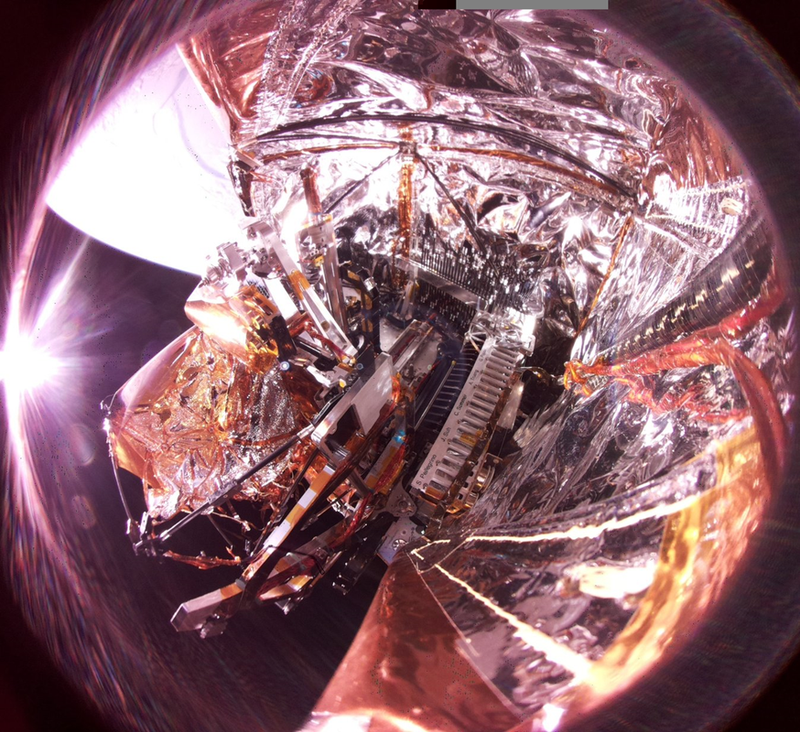
The ASTRA truss builder in low Earth orbit, Earth's cloud-covered limb behind it and the gold Kapton surface and composite truss bays in the foreground

Image source: Caltech/Momentus.


Gold kapton, black composite tubing, and a crowded little mechanism: from a distance the ASTRA payload looks less like a satellite than a workbench that got photographed by accident. That is roughly what it was. On the morning of March 30, 2026, the hardware rode a SpaceX rideshare out of Vandenberg Space Force Base, and for six months it worked in low Earth orbit on a task no machine had performed there before: joining a structure together out of loose parts, with no astronaut and no spacewalk anywhere near it. The machine was Caltech’s Autonomous In-Space Tensioned Reflector Assembly, and the structure it was building was the perimeter truss of a 1.4-meter reflector antenna (Caltech, November 5, 2026).

Every large structure ever flown has been shaped by the inside of a rocket fairing. A mirror too big to launch has to be a mirror that folds. Astro deployable structures, the Shuttle-era solar wings, the space station’s photovoltaic arrays: each trades stiffness and precision for a package small enough to pass through a payload shroud barely five meters wide. The other answer is to fly the pieces up separately and let people put them together, which is how the Shuttle assembled the space station and how Hubble was upgraded. Both routes have a ceiling, and the ceiling is the rocket. DARPA set out to attack that gap in 2022 with a program whose name is a mouthful: Novel Orbital and Moon Manufacturing, Materials, and Mass-efficient Design, or NOM4D. Its stated ambition is to ferry raw materials from Earth for in-orbit manufacturing, so that structures are designed for the environment they will live in rather than for ground test and launch survival (DARPA program page).

Program manager Andrew Detor put the scale question bluntly in the agency’s November 5 announcement: “By ‘very large,’ I mean hundreds of meters or kilometers in scale. Nothing approaching that scale can be achieved today” (DARPA, November 5, 2026). Caltech’s own reference architecture for a robotically assembled observatory is a 100-meter segmented primary, carried on more than 300 deployable truss modules that robots would build in Earth orbit before the system flew out to the Sun-Earth L2 point (Lee et al., Journal of Astronomical Telescopes, Instruments, and Systems, 2016).

The demonstration hardware came from Sergio Pellegrino’s group at Caltech, which manages NASA’s Jet Propulsion Laboratory, and rode to orbit hosted by Momentus aboard the company’s Vigoride 7 vehicle, which carried ten payloads of its own on SpaceX’s Transporter-16, a rideshare that delivered 119 payloads to sun-synchronous orbit (Caltech, November 5, 2026; NASASpaceflight, March 30, 2026). The payload itself was roughly one cubic meter. Inside it were two truss bays already built and folded for launch, an arm-like manipulator, and motorized dispensers holding the struts and joints needed for everything that followed (Caltech, November 5, 2026).

Operations began with releasing launch restraints, then pushing the two prebuilt bays out of the builder, then asking the machine to assemble a third bay from parts it had never touched. Commands came from the ground, sent by Charles Sommer, Alan Truong, and graduate student Tara Venkatadri, and the only way to know whether any of it had worked was to download photographs from the payload’s eleven cameras and compare them against what should have happened (Caltech, November 5, 2026). Anomalies were plentiful. The workaround was to re-create the failure on a flight-spare copy of ASTRA sitting in Pellegrino’s lab, solve it there, and send the revised recipe up. There were only about seven or eight contact windows a day, each roughly fifteen minutes long, so the machine spent twenty-two hours of every twenty-four on its own. Six months in, the antenna was not finished. The truss was designed for eleven bays, and the demonstration had added one.

Two design decisions explain why it worked. The first is the manipulator. DARPA describes it as a gantry robot able to move along three linear axes, and that constraint does more work than it first appears (DARPA, November 5, 2026). A free-flying arm in orbit has to hold its own pose against a moving vehicle, and place a part accurately while reacting against the very structure it is building. Bolted to a rail, the arm inherits its position from the machine carrying it, and a hard control problem collapses into repeatable Cartesian motion. The gantry is not clever. It is a decision to spend the complexity on the joints instead of on the arm.

The second decision is the surface itself. The reflective layer ASTRA deploys is a perforated polyimide film, Kapton, co-invented with a group at the University of Pennsylvania led by Igor Bargatin, and it functions as two cable nets prestressed against one another by springs (Caltech, November 5, 2026). That geometry matters because a tensioned net holds its shape through tension rather than through stiffness. For a cable spanning a distance L under a distributed load q, the out-of-plane sag runs roughly as δ = qL²/(8T), with T the tension per unit length. Halve the tension and the sag doubles; a structure needing less prestress can therefore be built with less material holding it up. Knitted metallic mesh, the standard in furlable reflectors, asks a lot of prestress. Perforated film asks less, so the truss behind it can be lighter. In a program whose premise is that a kilometer of structure must stay affordable to launch, shaving prestress is not a detail. It is the budget.

Scale the demonstration up and the numbers get interesting. Eleven bays span the perimeter of a 1.4-meter aperture, a circumference of roughly 4.4 meters, or about two and a half bays per meter of edge. Carry that density to a 100-meter aperture and you need some 800 meters of truss, a few hundred bays, which is the scale the RAMST reference design assumes (Lee et al., 2016). Put the aperture against the diffraction limit, θ ≈ 1.22λ/D, and a 100-meter mirror working at 500 nanometers resolves roughly 1.3 milliarcseconds, against about 50 milliarcseconds for Hubble. That is the prize, and it is why the concept splits the observatory into parts: the primary mirror, an optics and instrumentation unit a few hundred meters away, a control unit beyond that, and a spider-like six-armed robot, a hexbot, that assembles the truss and then walks across it to install the mirror segments.

What ASTRA established is narrower than the headline and more useful. One bay, built autonomously, in six months, with a human verification loop running about two hours a day, proves the process rather than the product. The complementary half of NOM4D runs in parallel: the other Phase 3 team, at the University of Illinois Urbana-Champaign, uses a station module to harden carbon tubes in orbit, making the material up there instead of merely putting it together (Caltech, November 5, 2026). ASTRA’s mission winds down in December, with the team already pointing at the next round of simplification: fewer failure modes, less ground support, shorter sequences.

The open question is whether the limit on building in orbit is dexterity or bandwidth. ASTRA suggests bandwidth. The robot could pick and place, but every fifteen-minute window had to carry diagnosis, redesign, and a retest, and better hardware does not erase that arithmetic. The fairing has always been the ceiling on what we can put in space. The next twenty years will test whether a gantry, a box of tubes, and a few thousand contact windows a year can lift it.
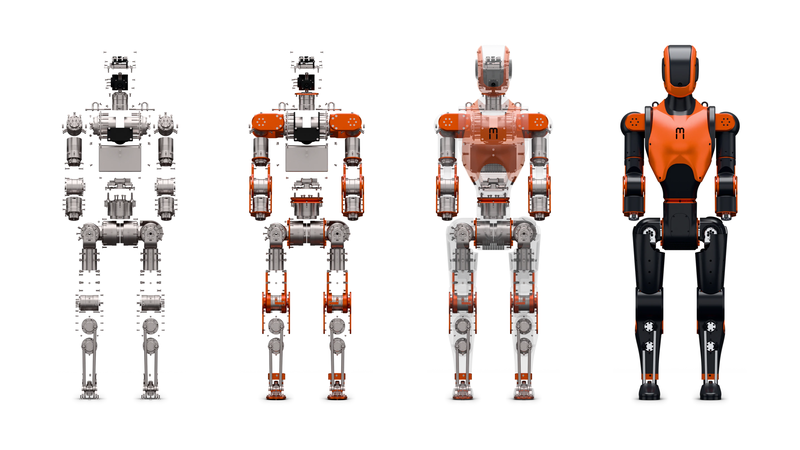


Four-panel comparison of AT 2016blu before and during its March 2026 outburst, with the two upper panels showing Chandra X-ray data from 2001 and 2002 and from 24 to 27 March 2026, and the two lower panels showing KAIT optical images from 14 and 25 March 2026, the position of the star marked by a white arrow in every panel (NASA/CXC/University of Virginia/M. Aghakhanloo et al., NSF/KAIT, public domain via Wikimedia Commons)


For fifteen years, a star in a spiral galaxy 30 million light-years away has been doing something that in visible light looks exactly like a supernova. It flares, brightens by several magnitudes, then after a few weeks it settles back down and carries on. It has done this at least 27 times since 2012, roughly every 113 days, and every single time it is still there afterwards, intact and ready to do it again. What is actually going on took until this year to pin down.

The star is AT 2016blu, in the outer spiral arm of NGC 4559. It is a luminous blue variable, a hot unstable star of at least 33 times the Sun’s mass. It is also a blue straggler, meaning it is heavier than the other massive stars around it rather than fainter. A star like that carries a small helium core inside a large hydrogen-rich envelope, which keeps it on the blue side of the Hertzsprung-Russell diagram and lets it end its life as a hydrogen-rich progenitor without ever passing through the Wolf-Rayet stage. NASA’s account of the discovery describes AT 2016blu as one of the most extreme members of a class astronomers call supernova impostors, because the eruptions mimic a star tearing itself apart right down to the brightness, without the star actually coming apart.

Impostor is the right word. A true supernova is a one-way door. The core collapses, the star comes apart, and the light curve never returns to where it started. AT 2016blu brightened by more than a magnitude on 22 March 2026, peaked at magnitude 16.6, then faded back toward where it had been. Between 2012 and June 2026 the team behind the new work counted 27 such events, with a period of roughly 113 days, although some of the smaller peaks line up better with a shorter cycle of about 38.5 days. That cadence is the giveaway. Nothing a star does to itself should repeat on a schedule.

The 113-day clock had no obvious explanation. For most of a decade the honest answer was that nobody knew, and every candidate was unsatisfying. A single unstable star erupting on a schedule is hard to account for. Pair it with a second massive star and you can get colliding winds, but the X-ray brightness that setup produces is thousands of times too low. The natural fix was a compact object, a black hole or a neutron star, which can feed on the star’s wind and make a bright X-ray source, yet there was no X-ray detection of AT 2016blu anywhere in the Chandra archive before 2026.

That missing detection was the puzzle. When the team re-examined the 2001 and 2002 archival exposures, stacking them to about 23 kiloseconds, they found nothing at the optical position of AT 2016blu. The 2026 detection is not a marginal source that has been sitting in the archive for a decade waiting to be noticed. It is new.

Getting it took coordination. AT 2016blu was monitored daily by the Katzman Automatic Imaging Telescope at Lick Observatory, by the Las Cumbres Observatory Global Supernova Project, and by more than 30 amateur observers recruited through an AAVSO alert notice issued in 2024. When the star rose past magnitude 16.6 in March 2026, the monitoring triggered a Chandra Target of Opportunity, and Chandra caught the star at five epochs across 24 to 27 March, accumulating about 100 kiloseconds in total.

Those five observations produced the numbers that make this a result rather than just an observation. Stacking the data gives an X-ray luminosity of log L_X around 38.64 erg per second, with a photon index of about 0.2 to 1.2, which is a very hard spectrum. The full paper lays out why accretion onto a compact object is the only one of the standard explanations that survives. Intrinsic shocks in the wind give soft X-rays below 10^31 erg/s, seven orders of magnitude too faint. Colliding winds in a massive binary reach 10^31 to 10^34, still four orders short. Shells of gas ejected at successive close approaches would shock too gently, because the wind velocities measured from the hydrogen alpha line are too similar from one ejection to the next. What is left is accretion, which can produce hard emission well above 10^37.

There is a more direct argument, and it comes from the archival data. Before the outbursts began, the same position in the same detector showed nothing. In March 2026 the source is at least 100 times brighter in X-rays than the 2001 and 2002 data allow. The X-rays are not a permanent fixture of this star. They arrive with the eruptions, which is the behaviour of a feeding event rather than of a stellar atmosphere. The team also checked whether the new source could be an unrelated background quasar that happened to land on the same spot, and put the odds of that at roughly six in a hundred thousand.

The accretion rate is where the result gets uncomfortable. The basic calculation, using the X-ray luminosity and a standard efficiency, gives a rate of at least 8 x 10^-8 solar masses a year. But the optical eruption is about a hundred times more luminous than the X-rays, roughly 10^7 solar luminosities against 10^5. If the optical light is also powered by accretion, then about 99 percent of the energy is absorbed in the surrounding gas and reradiated as visible light, and the true rate is closer to 8 x 10^-6 solar masses a year. That is more than two orders of magnitude above the Eddington limit for a 1.4 solar mass neutron star.

Accretion at that rate onto a neutron star should not be possible. It points instead to a black hole, though the authors stay careful, because neutron stars have been caught punching far past their Eddington limits in extreme cases. The companion is not the only loose end. The mass-loss rate from the star can be estimated from the orbit and the wind, and it comes out near 3 x 10^-3 solar masses a year, comfortably enough to feed even the boosted rate, but that number is very sensitive to the wind speed and the orbital eccentricity, and neither is well constrained. Phys.org’s write-up covers the wider framing.

The team cannot say which compact object it is, because the data do not allow it. A neutron star would show coherent pulsations, but the counts in these observations are too low to search for them at the timescales needed. A type I X-ray burst would settle it instantly, except bursts last seconds to hours and the five epochs sit a day apart, so one could easily fall between them. XMM-Newton has the sensitivity to hunt for pulsations, but it cannot resolve the star from a much brighter neighbour nearby, the ultraluminous X-ray source NGC 4559 X7, so the bigger collecting area ends up swamped by the wrong object. A dynamical mass measurement would decide the matter, and the radial velocities from the hydrogen alpha line do not follow the orbital phase well enough to extract one.

The paper appeared this week in The Astrophysical Journal, volume 1011, issue 2, page 252.

AT 2016blu is now the first X-ray detection of a supernova impostor of this kind, and the first luminous blue variable known to have a compact companion. One other impostor, SN 2010da, shows X-ray emission consistent with accretion, but its donor is a red supergiant, a star expected to end its life in a real supernova. An LBV donor is a different proposition, because single-star models keep failing to explain the strange behaviour of luminous blue variables, and a binary companion is a plausible answer to why some of them misbehave. The paper brings three families usually studied apart into one frame, impostors, ultraluminous X-ray sources, and high-mass X-ray binaries. If AT 2016blu really is a black hole draining a blue straggler, then some of the eruptions that astronomers have spent decades reading as a star’s death rattle were a feeding event instead.


Four side-by-side renders of the Asimov 1 humanoid at successive build stages, from a bare actuator frame through increasingly covered shells to the finished orange and black robot (Menlo Research)


Open-source humanoids have mostly meant open-source marketing with a closed product underneath. Asimov 1, a 1.2 metre, 35 kilogram biped from Menlo Research, is the exception. The mechanical CAD, electrical design, simulation models, firmware, reinforcement-learning training code and the Python SDK are all public. What that has started to produce is outside work. On Sunday morning a developer with no connection to the company published a runtime safety experiment he had built on the project’s own simulation model, complete with pre-registered results, and filed it as an issue. An open pull request against the LeRobot robot learning framework would add Asimov 1 locomotion through the Menlo SDK’s UDP transport, exposing 25 measured joint positions along with the robot’s IMU and camera feeds. The official repository lists 25 actuated degrees of freedom, a 7075 aluminium and MJF-printed nylon structure, a Raspberry Pi 5 handling media and networking, and a Radxa CM5 running motion control, with 1,532 stars and 249 forks at the time of writing.

The project’s own team has been widening the published surface at the same time. The training framework that produces the walking policy is a standalone Isaac Lab extension running proximal policy optimisation with adversarial motion priors, and on 7 November it gained a new physics option that lets the locomotion tasks run on MuJoCo Warp through Isaac Lab’s Newton backend while keeping PhysX as the default. Three days earlier a merged pull request added printable accessory parts including TPU shoe soles and a dummy hand set, the kind of small addition that only makes sense once the rest of the design is already public. What the Sunday issue shows is what the published surface now makes possible. A stranger could load the published MuJoCo model, read the published joint gains, and test a safety layer of his own design against it.

The reason the project exists is more prosaic than any of that, and it explains the design choices. Menlo’s own handbook describes a team that bought a commercial humanoid to run their own software on, deployed a walking policy to it for the first time, and watched the machine lose control and drive its leg into the floor, shattering a small metal part in the ankle. The company then stood still for two months waiting for one replacement component to arrive. From that experience came the rule that a robot you cannot repair yourself will hold you back, and eventually the decision to build their own: legs first, then a torso, then a whole body, with the designs published as they went.

What the open-sourcing buys in practice is concrete and slightly unusual. The hardware sits under CERN’s Open Hardware Licence version 2 in its strongly reciprocal variant, and the April announcement put the onboard software under GPL-2.0 while the training code carries a BSD-3-Clause licence, so a builder can commercialise a derivative of the training stack without inheriting the copyleft terms of the firmware. The documentation shows two compute stacks rather than one. The first is a head unit holding the Pi 5 with a media board that handles the buzzer and brownout protection. The second is a robot processing unit carrying the Radxa carrier board, the CM5 and the power distribution board, with the carrier plus module forming the motion control board. The joints talk over six CAN buses, five at 1 Mbps and one at 500 kbps, and the repository’s specification table lists a 5 kilogram squat load and 18 kilogram peak lateral raises on each arm.

The walking policy is where the open-sourcing matters most, because a walking controller is normally the one thing a humanoid vendor keeps to itself. The released policy ships as an ONNX file under a permissive licence, and according to CircuitDigest it runs at 50 Hz, reading 78 values every 20 milliseconds and emitting target positions for 23 joints, with the neck held locked during locomotion. The training repository exposes the reward definitions and the joint-specific actuator settings, so the penalties for foot slipping, abrupt action changes and self-collision are all readable, along with the torque limits, stiffness, damping, friction and actuator delay for each joint. The simulator also varies foot friction, starting joint positions and actuator gains, and injects disturbances and noisy observations to keep the learned gait from depending on one idealised world. Humanoids Daily walks through the published configuration. Training runs on a single GPU with 4,096 parallel environments, and the menlo-sdk package puts walking, joint control, state, camera and audio behind a Python interface whose every command passes through the same arbiter and safety layer on the robot as the gamepad.

The safety experiment in that Sunday issue is the clearest evidence that the openness is real rather than promotional. The author, who describes himself as working on a runtime guardian that sits between a planner and the motors, loaded the published MuJoCo model unmodified, fixed the pelvis on a stand, and added position actuators using the project’s own PD gains. He ran eight scenarios across twenty random seeds each with the guardian on and off over identical command streams, with the metrics and the video rule fixed in advance. The results were blunt: in the scenario where a planner reaches into a seated mannequin’s torso, contact went from 20 runs out of 20 to none, and peak simulated contact force went from 157 newtons to zero. For the fast swing toward a head it was 20 out of 20 down to none and 810 newtons down to zero. Fuzzing went from 16 out of 20 to none. The check itself cost a median of 0.46 milliseconds per control step with a 99th percentile of 2.8 milliseconds, running on single-threaded Python on a laptop rather than the CM5 that would actually sit on the robot. The caveats he lists sit alongside those numbers: the pelvis was fixed so balance is untested, the hands are not modelled, and the guardian has no table keep-out, which is why the arm still hit the table in 18 of 20 fuzzing episodes even with it on.

The questions he raised in that issue are still open in the repository, namely whether joint velocity limits are published anywhere, since the MJCF carries position and torque limits but no velocity ones, and where in the stack a command filter would sit so that a safety layer can be added without cutting torque on a block mid-motion. Meanwhile the hardware side is already shipping: the first batch of DIY kits went out in late August at 20,000 dollars delivered, a price the team reached after finding that standalone actuators of this class cost upwards of 30,000 dollars when bought one at a time at low volume, and then negotiating a group buy that pulled prices near factory cost. An integration into someone else’s robot learning framework is the kind of thing that used to need a vendor’s cooperation, and the LeRobot pull request needs none. Whether strangers can use it without asking permission is the practical test of an open platform, and on that measure Asimov 1 is already past the interesting part. In the same issue the author also asked which licence covers the simulation directory, and offered to contribute a small out-of-tree adapter if the answer is workable.


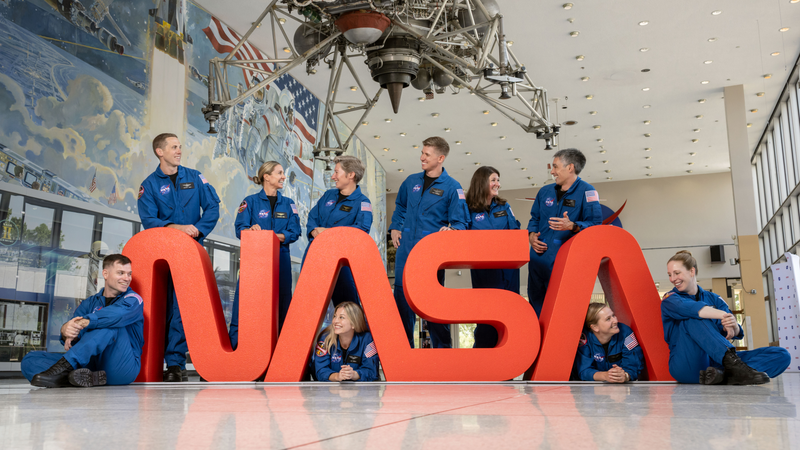
The 2025 astronaut candidate class poses with NASA's red letters in the Johnson Space Center atrium.

The ten chosen from the 2024 application pool, photographed at Johnson’s atrium in September 2025. Image source: NASA/JSC, jsc2025e075919_alt.


On Saturday, November 7, 2026, at a Kennedy Space Center air show partly about lunar exploration, NASA opened applications for its next class of astronauts. The window shuts at 11:59 p.m. Eastern on December 3; the class will be named in the fall of 2027 (NASA, November 2026). Administrator Jared Isaacman framed it in the language of current agency plans: the people selected could walk on the Moon, live at the Moon Base, and help build the systems that carry crews to Mars. Underneath that language sat an arithmetic problem NASA has never solved. The last time it opened this door, in 2024, more than 8,000 people walked through it and ten came out. NASA has selected 370 people to train as astronauts since the 1960s, and 32 are active today.

Thirty-two is a thin roster to run a program that includes a lunar outpost, a commercial station economy in low Earth orbit, and a road to Mars. It is also a number no press conference can raise, which makes the machinery underneath worth reading. Applicants must be US citizens and hold a master’s degree in engineering, biological science, physical science, computer science or mathematics, or meet that requirement another way: two years of work toward a doctorate, a medical degree, or enrollment in a nationally recognized test pilot school finished by July 2027. Three years of related professional experience follow. Pilots may substitute flight time, and the menu is oddly exact: 750 hours as pilot in command in a high-performance jet, 1,500 total fixed-wing hours including 750 as pilot in command, or 1,000 rotary-wing hours including 300 as pilot in command.

The schedule after that is fixed. Applications are read from December 2026 through April 2027, a first group comes to Johnson Space Center in spring 2027 for interviews and assessments, a second group comes in summer 2027 for final interviews, and the class is announced in the fall of 2027 (NASA astronaut selection timeline). The winners then spend two years learning to spacewalk, operate the station and fly T-38 jet trainers.

Everything so far is a paper filter. The one that bites is the long-duration astronaut flight physical, and NASA’s medical technical brief explains why it is built the way it is. During selection, applicants are screened for a list of disqualifying health conditions defined in OCHMO-STD-100.1 and are eliminated with no waiver considered at all. Waivers only enter the picture after selection (OCHMO-MTB-002, October 2026). That arrangement looks arbitrary until you see where it came from. NASA wrote its first minimal medical standards for astronaut selection in 1977, borrowed from Air Force, Navy, Department of Defense and FAA rules. Across the shuttle era, screening grew from a one-page medical sheet read by one flight surgeon into a 30-plus-page history backed by test data and presented to a selection board. The disqualifying list is revised continuously, because conditions that once ended careers have become treatable or waivable.

The clearest case of the standard being rewritten by data is eyesight. Until 2007 NASA astronauts could not have laser eye surgery, and before that rule changed, roughly half of all rejected candidates had been turned away for needing glasses or contact lenses (OCHMO-MTB-002). Soft lenses and wavefront-guided LASIK and PRK widened the acceptable parameters, and the requirement for uncorrected distant acuity has been relaxed ever since. Vision matters more than that history suggests, because of a hazard nobody had identified when those rules were written.

Spaceflight-associated neuro-ocular syndrome was first described in 2011, from seven astronauts who had spent months aboard the ISS. Five had developed a hyperopic shift of +0.50 to +1.75 diopters, and six showed optic disc edema, choroidal folds, flattening of the back of the eye or thickened retinal nerve fiber layers on optical coherence tomography (Eye, 2026). The same review now reports at least one feature of the syndrome in 81 percent of NASA astronauts, and in a questionnaire of three hundred astronauts, 60 percent of long-duration crew reported subjective vision changes. Among fourteen astronauts and cosmonauts, acuity fell by an average of 0.75 lines on the eye chart a day after return. NASA specialists published a consensus guide on diagnosing and managing it this year.

The name hides how ordinary the mechanism is. On Earth, intracranial pressure sits near 11 mmHg lying flat and turns slightly negative standing up, because posture shifts the pressure in the dural sinuses. In microgravity that hydrostatic gradient disappears. Venous pressure stops depending on position, so intracranial pressure in orbit should land above the upright value on Earth and close to the supine value instead (npj Microgravity, 2026). Hold a crew at that pressure for months and the optic nerve elongates, pressing on the rear of the eye and producing globe flattening, choroidal folds and disc edema. A 2021 follow-up on three of the original seven astronauts found the hyperopic shift, the flattening and the change in axial length still present up to twelve years later.

Measuring it in orbit is hard. Lumbar puncture is not feasible in space and implanted sensors need neurosurgery, so the least invasive option is a lumbar catheter wired to a telemetric device. A bench test of six Miethke M.scio sensors with a Medtronic catheter set found that system reading about 2.62 mmHg low against a reference column (npj Microgravity, 2026).

The gap between what a standard can clear and what an instrument can resolve is where the waiver process operates. Once someone is an astronaut, a condition that would have ended an application can be waived at recertification, on the recommendation of NASA’s Aerospace Medical Board. The Chief Health and Medical Officer signs the final disposition. The board weighs one diagnosis against the physics of the job, and NASA’s list of factors is specific: fluid shifts and bone loss in microgravity, decompression sickness and barotrauma under pressure change, extra loads on the spine at launch and landing, and time far from medical care (OCHMO-MTB-002). Waivers on the list include a recovered hip fracture, mild sleep apnea and a history of elevated intracranial pressure. For atrial fibrillation, NASA bypasses the FAA’s certificate process, treats with ablation and clears a crewmember for flight six months later.

What happens next is fairly predictable. The class of 2027 reports in the winter of 2027/28 and trains for two years, so the crewed lunar landing NASA has been discussing for 2028 will be crewed from the 2024 pool, not the 2026 one (The Guardian, November 2026). The class being hired now would fly in the 2030s, and a class every three years is a trickle for a program meant to keep people on the Moon. The limiting factor is the supply of people who clear the medical standard, and how quickly that standard absorbs what the crews bring back. SANS was an obscure finding in 2011 and a consensus-guideline subject by 2026, because enough astronauts flew long enough, and lived long enough afterward, to make the data legible. The same runs in reverse: every year at a lunar outpost generates measurements nobody has yet, and the document that decides who flies gets edited to fit them. The people who get to go will have been chosen by a standard that began as a 1977 Air Force checklist and has been rewritten every time the ship, the mission or the human body outgrew it.


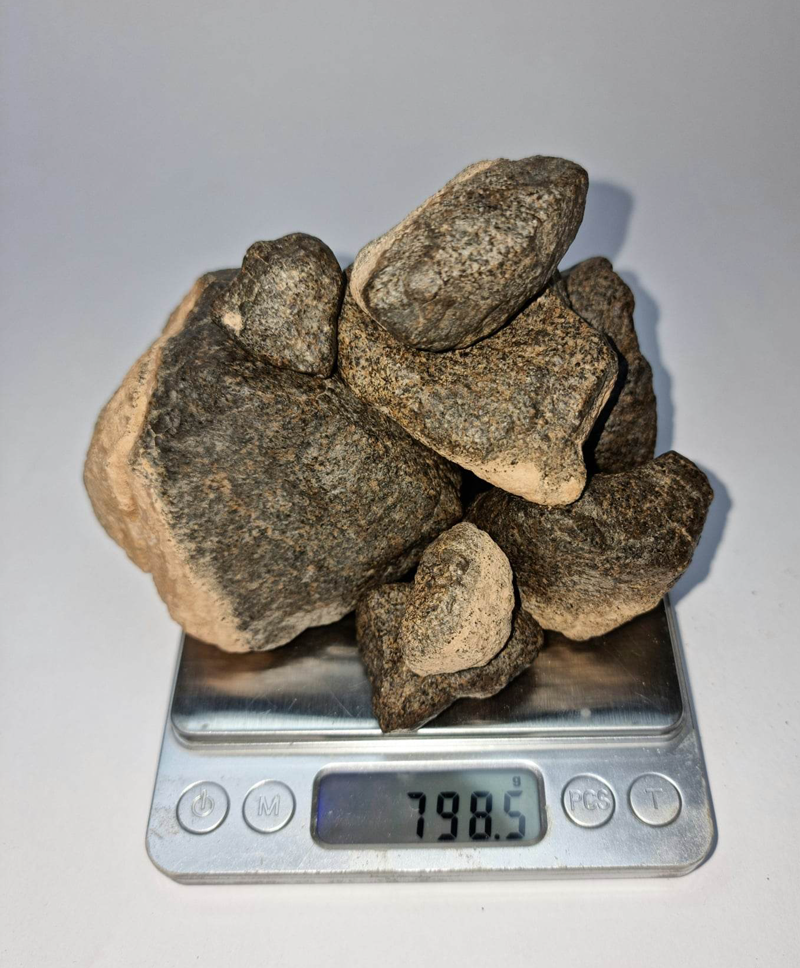
The eight fragments of the Martian meteorite Teghaza 001 stacked on a digital laboratory scale whose display reads 798.5 grams

The eight fragments of Teghaza 001 stacked on a digital scale reading 798.5 grams. Credit: University of New Mexico, via the UNM newsroom.


In September 2022, meteorite hunters working the salt flats of northern Mali picked up eight stones that did not belong. Together they weighed 798.5 grams, the largest piece about 442 grams and roughly ten centimetres across, and they were filed under the name of the plain they came from. To the eye they looked ordinary. Then a handful of zircon crystals turned them into a result: a paper in Science describes Teghaza 001 as a slowly cooled igneous rock that formed at least 4.1 billion years ago, the oldest Martian igneous rock anyone has handled. NASA calls it one of the most ancient Martian meteorites found on Earth, and one reviewer of the paper thought it worked like a Rosetta Stone for the planet, as Space.com reported.

For most of the history of Martian meteorite study, the samples have been the wrong age. The three great classes of Martian meteorite, the shergottites, nakhlites and chassignites, all formed 2.4 billion years ago or later, and many of the known rocks are only a couple of hundred million years old. The planet they came from does not look like that. Mars has no global plate tectonics, so unlike Earth it does not recycle its ancient crust. Its surface preserves terrain that formed more than three billion years ago, and the Science paper notes that the size and density of impact craters show most of it is that old. The meteorites are a heavily biased sample of a very ancient world, and until spacecraft bring rock back they are the only physical pieces of Mars anyone can hold.

Two rocks had already broken out of that bias, and neither is much use as a comparator. Allan Hills 84001, found in Antarctica in 1984, is close to a single mineral, a pyroxene-rich rock crystallised at 4.1 billion years ago, so it says little about how a Martian crust is assembled. Northwest Africa 7034, the breccia nicknamed Black Beauty, is a jumble of fragments pressed together about 2.1 billion years ago, some of whose pieces are older than 4.3 billion. Teghaza 001 is a single coherent rock of one igneous type, and its mineralogy points to highlands terrain that no Mars sample has ever come from. NASA counts roughly 435 known Martian meteorites in total, and the Meteoritical Bulletin entry records Teghaza 001 as found in September 2022 in northern Mali near Teghazza.

The rock travelled the usual route for a rare specimen, from a hunter in the desert to the Institute of Meteoritics at the University of New Mexico, where Carl Agee, the institute’s director, studies how planetary interiors differentiate. Agee picked out features in Teghaza 001 that were wrong for a Martian meteorite, odd textures and an unfamiliar mineral mix, though the chemistry was vaguely reminiscent of Black Beauty. He and Karen Ziegler took it apart under the microscope, using the university’s electron microprobe and oxygen isotope laboratory, and one finding stood out: domains rich in manganese oxide. That compound sits on the checklist the rovers work from as a marker of environments that could support microbial life, though nothing about the rock itself implies biology.

The break came with the zircon crystals. Yang Liu, a planetary scientist at JPL and the paper’s lead author, was inclined to pass on the sample, according to NASA’s account, which describes it as looking like the commonest kind of Martian meteorite, a shergottite. The unusual textures and minerals, and then the zircons, changed her mind. Zircon is a workhorse for dating rocks because it traps uranium and excludes lead while it crystallises, so the ratio of lead to uranium left behind reads out as an age. François Tissot of Caltech had been developing an in-situ rubidium-strontium method that analyses single mineral grains on the surface of a sliver of rock smaller than a fingernail, leaving the bulk of the sample untouched for whoever works on it next. He said his group is “one of very few labs in the world” able to run the technique, and the first to apply it to a meteorite this old.

Two numbers came out. Uranium-lead dating of the zircon crystals gave about 4.11 billion years, and a separate rubidium-strontium analysis gave a consistent but less precise 4.24 billion years, according to the Sci.News summary of the paper. Neither is the rock’s birth date. Daybreak Wire reports that the authors’ 2025 conference abstract put lead-lead ages on ten zircons at 4122 plus or minus 27 million years, six of them concordant on uranium-lead and four reversed, and read the spread as sodium alteration resetting the clocks. NASA’s release says the rock had been altered by Martian water around 4.1 billion years ago, which means it was already there when that happened and formed earlier still. The paper’s title claims only that the meteorite formed at least 4.1 billion years ago, which is the honest form of the statement.

The same work narrowed down where on Mars the sample came from, matching 13 candidate sites in the southern highlands, northwest of the Hellas impact basin, where orbital mineralogy resembles the meteorite’s own. Nobody will ever know which one.

A zircon’s clock is the ratio of lead to uranium, and both melting the crystal and any later soaking by fluid wipe that ratio clean, so the crystal starts counting again from zero. A date that lands on an alteration event therefore tells you the rock was already there when the alteration happened, and says nothing about how much older it is. The thin section shows what the rock has been through. In reflected light, a slice of Teghaza 001 resolves into a mosaic: brighter iron-titanium oxide grains, medium grey pyroxene, and darker shocked plagioclase, the last created by the extreme pressures of the impact that sent the stone on its way to Earth. Some of the fine-grained carbonate, sulfate and clay minerals in the picture formed on this planet rather than on Mars, as desert weathering worked on the rock after it landed.

The chemistry is where the water shows up. Bulk and mineral-specific oxygen isotope measurements reported in the Science paper show the rock reacting with fluids enriched in oxygen-18, the heavy isotope, either in the crust or with the magma itself. A companion paper in Science Advances measured water and the deuterium to hydrogen ratio in igneous calcium phosphates, and found the signal of two waters mixing: deuterium-poor magmatic water, and a deuterium-rich component carrying an imprint of the ancient Martian hydrosphere, assimilated by magma that rose through already altered basaltic crust. The authors set a minimum bound on the deuterium to hydrogen ratio of the Martian hydrosphere at 4.1 billion years ago at about twice the value for Earth’s seawater. That is the signature of a planet that has lost hydrogen to space, which fits models of rapid atmospheric escape from a young Mars. The same paper notes that magmatic water on Mars carries the same deuterium ratio across magmas of different ages and different mantle sources, so early Mars did not fractionate hydrogen isotopes while it was differentiating.

Two things follow. The first is about coverage. A single coherent rock from highlands crust nobody had sampled before, dated to the Noachian period when Mars was semiarid but wet enough at the surface to hold liquid water, widens the window on the planet’s early climate in a way orbital data alone cannot. The second is about method. Dating a chip smaller than a fingernail without dissolving it leaves the rest of the rock for the next instrument, which in a collection this rare matters. Tissot said he hopes the technique opens the way to dating more Martian meteorites, or material returned from other planets and their moons and asteroids.

What happens next is unglamorous and specific. More of Teghaza 001 gets characterised, the floor on its age gets tightened or stays where it is, and the 13 candidate source regions get tested against whatever orbital and telescopic records can still say. Liu’s own verdict was that the team has only scratched the surface, and NASA still has rovers hunting manganese oxide in Martian soil. One day a sample of the same crust will come back from Mars and settle the question properly.


The Robert C. Byrd Green Bank Telescope, a 100-metre steerable radio dish with its white reflector tilted upward against a clear blue sky above a line of autumn trees.

The Green Bank Telescope, which spent 7.5 hours listening for the pulsar across four sessions in late 2025 and early 2026. Credit: NRAO/AUI/NSF, via Wikimedia Commons, under CC BY 4.0.


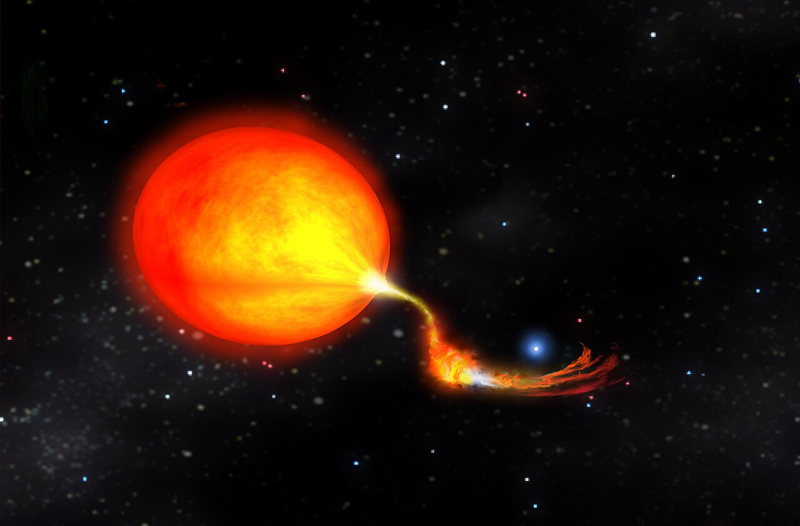
A neutron star about 12,000 light years away completes 597 revolutions on its axis every second, and the reason anyone noticed is that the star it orbits is being eaten. The object, PSR J2053+6905, is a redback: a millisecond pulsar in a close binary with a companion that the pulsar’s particle wind strips of its outer layers and heats to a glow. Anna Karpova of the Ioffe Institute in St Petersburg and James Taylor of West Virginia University report the detection in a paper posted to arXiv on 5 November, with observations gathered between October 2025 and January 2026 (the preprint). At 1.68 milliseconds, the spin period makes it the third fastest redback on record and the tenth fastest pulsar of any kind in the Australia Telescope National Facility catalogue.

The speed is a fossil. A neutron star does not get to spin that fast on its own. It has to be dragged up to those rates by dragging gas off a companion, and the same process leaves the star heavier than a typical neutron star and the companion lighter than it started. Both halves of that history show up here. The pulsar is a recycled millisecond object, and the companion has been reduced to about 0.3 solar masses, roughly half what a zero-age main sequence star of its radius would have carried. There are only about 90 confirmed redbacks and black widows in the Galactic field and roughly three dozen more candidates, so each new member is a data point in a small sample, and this one comes with a mass that tightens the constraints on the equation of state of ultradense matter. A neutron star of 2.12 solar masses, as the modelling here suggests, sits near the upper limit of what matter can support against its own gravity without collapsing into a black hole, and every good mass measurement narrows the menu of allowed physics for the cores of collapsed stars.

The route to this object ran through gamma rays long before it reached a radio dish. Fermi mapped 4FGL J2054.2+6904 as an unassociated gamma-ray source, and Kerby and colleagues proposed in 2021 that it might be a pulsar, since a Swift counterpart nearby looked variable. Three years of archival optical data, plus fresh Swift and eROSITA X-ray observations, led Karpova and her collaborators to call it a plausible redback. Zwicky Transient Facility light curves folded on an orbital period of roughly 7.5 hours showed a single peak rather than two, which is what irradiation looks like when one hemisphere of the companion does all the facing, and the X-ray spectrum was hard, with a photon index near 1. What nobody had was the radio pulse itself. Without it the object stayed a candidate, and candidates are common; confirmed spiders are not.

Searching for it took the kind of patience the Green Bank Telescope makes possible. Its L-band receiver pointed at the Gaia coordinates of the optical counterpart for a total of 7.5 hours, split across four sessions between 29 October 2025 and 9 January 2026. A pulsar in a binary does not hold a steady frequency, because the orbit keeps speeding the spin up and slowing it down, so the team ran a jerk search that tracks how quickly that drift changes, testing eight harmonics with thirty-minute segments to keep the drift within each segment small. The first candidate pulled out of the data was the right one.

Turning that detection into a mass took three instruments and a stubborn bit of bookkeeping. Radio timing gave an orbital period of 7.46657907 hours, a projected semi-major axis, and a mass function for the pair. Optical spectroscopy with the 10.4-metre Gran Telescopio Canarias on La Palma then measured the companion’s radial velocity from the magnesium triplet near 5170 angstroms, returning a velocity amplitude of 337 km per second and a systemic velocity of minus 191 km per second. A brighter star in the same field turned out to drift by about 30 km per second over the course of the run, which is instrumental rather than orbital, so that drift was measured with the same technique and subtracted before the fit. Combining the radio and optical mass functions fixes the ratio of pulsar to companion at 7.05. Folding the optical light curves and fitting a model in which the pulsar heats one face of the companion returns a pulsar mass of 2.12 solar masses, a companion of 0.30, a distance of 3.6 kiloparsecs and an inclination near 66 degrees. The companion comes out at about 5550 kelvin on its dayside and 4960 on the nightside, a 600 kelvin swing that sits in the range typical for this class of binary.

The hardest number to explain is not the mass but the shape of the light curve. Folded on the orbital period, the companion does not rise and fall the way a tidally distorted star should. Instead it is lopsided, and the lopsidedness grew. The section of the curve between orbital phases 0.25 and 0.75 held steady across three observing campaigns in September 2023, June 2024 and August 2025, while the rest of the orbit brightened steadily across the same three years. Straight irradiation and ellipsoidal distortion cannot produce a shape like that, and neither can the shock that forms where the pulsar wind hits the companion. The authors favour a picture in which the companion, locked to a 7.5-hour orbit and therefore spinning fast itself, drives a magnetic dynamo vigorous enough to hold large surface spots for years, and a cold spot slowly dissipated or drifted during the run. Similar long-lived spots have been invoked to explain the light curves of other pulsar binaries, and if the spot does fade, the clean full-orbit light curves would tighten the geometry and confirm the heavy pulsar mass.

Several things are still open. The radio timing could not be phase connected, because the algorithm that links separate sessions found hundreds of equally good solutions for how many rotations the star made between them, so the fit carries free phase jumps and the timing parameters remain loosely constrained. New observations with the CHIME6 telescope are planned to fix that, together with a fuller treatment of the gamma-ray data. The mass of 2.12 solar masses rests on a light curve model with a reduced chi-squared of 469 over 149 degrees of freedom, which the authors themselves read as evidence that the model is missing something, most likely the spot itself. And the distance from the timing dispersion measure of 44.13 parsecs per cubic centimetre comes out between 2.3 and 3.0 kiloparsecs depending on which model of the intervening electron column is used, a little closer than the 3.6 the light curve fit prefers. The companion’s spectrum also shifts between K and G spectral types with orbital phase, which is itself odd and worth watching.

What is not in doubt is the pulsar. A 1.68 millisecond spin, a confirmed redback classification, a companion being cooked by its own companion’s wind, and a neutron star heavy enough to make the equation of state uncomfortable. The team behind it is candid that the system is more complicated than the simple models they tried, and the next round of photometry and timing will be the test of whether their explanation for the growing light curve asymmetry holds up.