


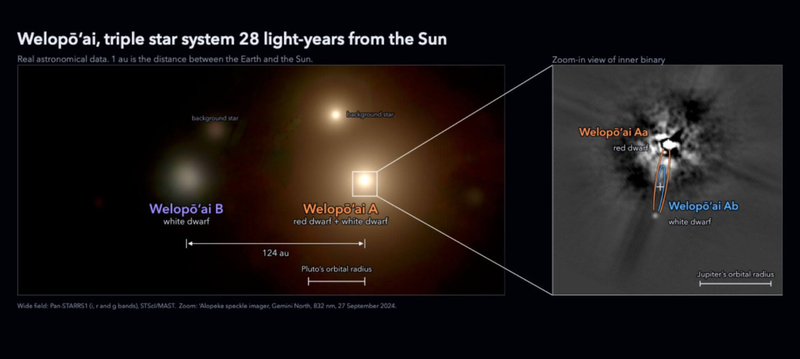
Wide field: Pan-STARRS1 (r, i and g bands), STScI/MAST. Zoom: ʻAlopeke speckle imager, Gemini North, 832 nm, 27 September 2024.
Somewhere about 28 light-years from here, a small red dwarf star is orbited by a dead one. The dead one is a white dwarf: a burnt-out stellar core, about the size of Earth, that is what a Sun-like star leaves behind once it has used up its fuel and puffed off its outer layers. That alone would be unremarkable. What makes the arrangement odd is the company it keeps: the pair travels with a second white dwarf far out in the background. The configuration appears to have assembled itself in a way its authors cannot explain. “The system should not exist,” says Patrick Dufour, a white dwarf specialist at the Université de Montréal and a co-author, as Nature World News reported.
The finding was not the goal of the survey that produced it. Étienne Artigau and 20 colleagues were hunting for planets around the red dwarf, an M4 V star catalogued as TYC 3980-1081-1 and IRAS 21500+5903, using SPIRou, the near-infrared spectrograph on the Canada-France-Hawaii Telescope on Maunakea. The team collected 411 validated integrations across 103 epochs spanning 4.8 years, measuring how the star’s spectral lines shifted. The per-spectrum uncertainty was 3.0 metres per second, and the signal they found was four orders of magnitude larger than that noise floor, with the wrong shape entirely for a planet.
The data showed a near-constant acceleration of about 5 metres per second per day, some 1800 metres per second per year, with no sign of the periodic wobble a planet imposes on its star. A Jupiter-mass planet on a multi-year orbit around a 0.42 solar mass star can produce at most 40 to 130 metres per second per year of this effect. The red dwarf was moving 45 times faster than that ceiling allows, and the peak-to-peak swing in its velocity reached about 16 kilometres per second. By mid-2023 the curve had begun to bend, and the only consistent reading was a decade-long period with a companion mass well above the substellar range.
The paper in Astronomy and Astrophysics, volume 715, page A321, follows the detection with a hunt for the culprit. Speckle imaging with ʻAlopeke at the 8.1 metre Gemini North telescope reaches the diffraction limit and separates close companions that ordinary imaging cannot. It found what the radial velocities could not: a white dwarf 6.7 to 7.0 magnitudes fainter than the red dwarf, 0.6 arcsecond away. Near-infrared imaging with GNIRS on the same telescope confirmed it in the J, H and Ks bands. The full text is on arXiv under a CC BY 4.0 licence.
Once the companion was in hand, the team could do the thing white dwarf work depends on most: weigh it. Brightness and colour give a temperature and a radius with uncomfortable slack, so the group folded the speckle astrometry and the radial velocities into one Keplerian fit and let the orbit do the arithmetic. The result is a dynamical mass of 0.6180 solar masses with an uncertainty of 0.7 percent. Only a handful of white dwarfs within 20 parsecs have a dynamical mass at all, and this is the most precise of them. The benchmarks usually quoted carry errors of 1 to 14 percent. The red dwarf’s own mass came out at 0.4189 solar masses with 1.7 percent precision, among the best determined for any field M dwarf.
The inner pair circles with a semi-major axis of 4.644 astronomical units and a period of about 9.83 years, with an eccentricity of 0.1898 pinned down to better than one percent and an inclination of 81.2 degrees. The outer white dwarf, a known magnetic hydrogen-atmosphere star the pair was already catalogued with, sits 123.9 astronomical units away in projection on an orbit longer than a thousand years. At 8.46 parsecs, this is the nearest known hierarchical triple containing two white dwarfs, with no analogue within 30 parsecs.
Two things about the system do not sit comfortably together, and the authors are candid that neither has a clean resolution. The first is the age. The red dwarf spins once every 46.84 days, and applied to the rotation-age relation for mid-type M dwarfs that implies an age of 3.6 plus or minus 1.0 billion years. The white dwarfs tell a different story. The inner one radiates at about 5210 kelvin, which on standard cooling tracks gives it 5.3 to 5.5 billion years of cooling. Adding the main-sequence lifetime of the roughly 1.4 solar mass star that became it puts the total age of the system at 9 to 11 billion years. Rotation is a poor age proxy for mid-M dwarfs and the tension should not be over-read, but the two clocks disagree threefold.
The second is metals. The red dwarf is unusually enriched for its presumed age, at a metallicity of plus 0.17 plus or minus 0.12 dex measured from the SPIRou spectra, a figure that independent photometric and optical spectroscopic measurements broadly agree with. To explain that in a 10-billion-year-old star, the red dwarf would have needed to capture roughly 69 percent of all the metals ever expelled by the white dwarf’s progenitor. It would have taken none of the hydrogen and helium that made up more than 98 percent of that envelope. Even granting a more massive progenitor, the required capture fraction stays above 40 percent. The paper names and dismisses Bondi-Hoyle wind accretion, Roche-lobe overflow and dust-gas segregation: none of them delivers a large fraction of a giant’s metal budget while excluding its gas. Simulations of the solar neighbourhood find that 5 percent of stars that old carry supersolar metallicity, so the red dwarf sits in a sparse corner of the age-metallicity diagram rather than an empty one.
The dynamics have their own puzzles. The outer companion’s projected misalignment from the inner orbit’s line of nodes is 81.5 degrees on the sky, consistent with a large mutual inclination between the two orbits. The Kozai-Lidov timescale the authors estimate for that configuration is only 0.05 to 0.07 million years, five orders of magnitude shorter than the cooling ages of the white dwarfs. The system is nonetheless stable: direct integrations over 10 million years hold together across a broad range of outer-orbit parameters. The puzzle is how the inner binary avoided a common-envelope inspiral, and what stopped the white dwarf progenitor’s tides from dragging the red dwarf inward when the giant expanded. Working backwards through the mass loss, the two were probably separated by only about 2.6 astronomical units before the progenitor shed roughly 0.8 solar masses. A 1.5 solar mass star at the tip of the asymptotic giant branch reaches a radius of about 1.2 astronomical units, so the red dwarf should have been engulfed, and it was not.
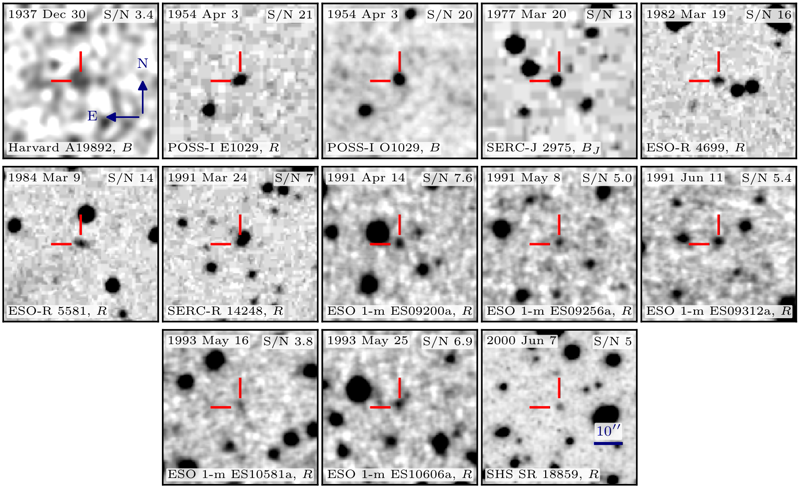
The name the team chose captures something of the mood. Welopōʻai was proposed through the A Hua He Inoa programme at the ʻImiloa Astronomy Center with the Canada-France-Hawaii Telescope. It joins two Hawaiian roots, welo for an inherited or family trait and pōʻai for an orbit or encircling path, and was suggested as a way of tracing lineage through motion. The Crossref record lists all 21 authors, and Sci.News has Artigau’s own account of the moment the radial velocity curve stopped looking like a planet. What the next observations settle is straightforward enough to name. Gaia’s fourth data release should yield a non-single-star astrometric solution to confirm the distance. Continued astrometry and archival plates would pin the wide orbit, and JWST imaging of the inner white dwarf would test the tentative infrared excess, which might be dust from a circumstellar disc.
The authors are careful to call that excess tentative, at 3 sigma in the Ks band and 1.5 sigma in H. They also note that a 12 micron point from the IRAS archive appears to be a faulty or variable measurement rather than evidence of anything. The red dwarf and its two white dwarf companions sit 28 light-years away in an arrangement that Patrick Dufour, one of the co-authors, says should not exist.



 Subscribe to blog posts using RSS