


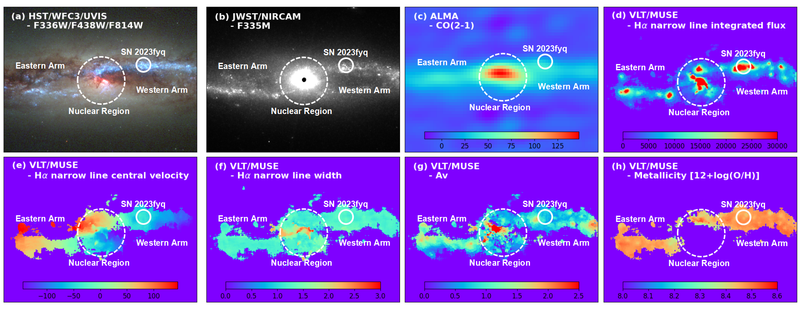
Image source: Hong et al. 2026, A&A 715, A161, Figure 1 (CC BY 4.0).
In 2011 the Hubble Space Telescope photographed NGC 4388, a spiral galaxy about 18 megaparsecs away in Virgo, tilted close to edge-on at 79 degrees. The Wide Field Camera 3 recorded it from the ultraviolet to the near-infrared, and on one of its spiral arms, some 10 arcseconds from the nucleus, the frames show a modest point of light hemmed in by bright blue neighbours. Twelve years later the Zwicky Transient Factory found a supernova at those coordinates. SN 2023fyq erupted on 17 April 2023 and was filed first as a peculiar Type Ib, before its spectrum revealed the narrow helium lines of a Type Ibn event (Dong et al. 2024, ApJ 977, 254). A team led by Xinyi Hong at the National Astronomical Observatories of China went back to the Hubble frames, and their result, published as A161 in the November 2026 issue of Astronomy & Astrophysics, is the first direct detection of a Type Ibn progenitor in pre-explosion images.
Type Ibn supernovae are named for their narrow helium lines, a feature Pastorello and collaborators proposed in 2007 for the class built around SN 1999cp. The narrowness is diagnostic: the ejecta are still crashing into material the progenitor shed, so the radiating shock stays thin and the helium lines stay narrow and blueshifted. Because so much kinetic energy is turned into radiation at the contact front, these explosions outshine ordinary stripped-envelope supernovae, with absolute peaks of roughly -17 to -20 magnitudes (Karamehmetoglu et al. 2017; Wang et al. 2024). They rise in about ten days and fade steadily near 0.1 magnitudes a day (Farias et al. 2026; Cai et al. 2026).
The progenitor has been argued over since the class was named, with the textbook picture a stripped Wolf-Rayet star of more than 25 solar masses. But Wolf-Rayet stars in our own galaxy have never been seen to erupt, and the two-year-long outburst that announced SN 2006jc looked like a companion star rather than the star itself (Pastorello et al. 2007; Foley et al. 2007). Archival searches agree: the progenitor of SN 2015G was absent from pre-explosion frames, which excluded a single massive Wolf-Rayet star (Shivvers et al. 2017), and a companion was later identified for SN 2006jc (Maund & Ramirez-Ruiz 2016; Sun et al. 2020).
Catching a progenitor is hard: the star is faint, sits in a crowded field, and any light that outlives it has to be separated from whatever else shares that line of sight. Most of the Wide Field Camera 3 imaging dates from 2011, roughly 4,450 days before the explosion, and spans F336W to F160W; a later ultraviolet frame came 588 days after maximum light, on 7 March 2025. Webb added mid-infrared frames in June 2023 and 2024. At the supernova position sat a point source, detected in every pre-explosion filter, which the authors label Source A.
The proof that Source A was the star sits in the ultraviolet. In F336W the pre-explosion magnitude was 21.126 and the late-time magnitude 22.051, a fade of 0.925 magnitudes. By 588 days the supernova itself should have vanished on its radioactive tail, so the light that disappeared was the star’s and what survived belongs to something else. They split the spectral energy distribution accordingly: a blackbody for the progenitor, a BPASS synthetic cluster for the remainder. Observations forced that split: the narrowband F665N flux sat well above the continuum, and since the progenitor is hydrogen-poor the H-alpha line must come from ionized cluster gas, while the infrared points lay above the Rayleigh-Jeans tail, as red supergiants in a cluster would.
The environment had to be measured too. The Multi Unit Spectroscopic Explorer on the Very Large Telescope surveyed the galaxy in March 2022, and the team subtracted a modelled stellar continuum to isolate the gas. ALMA mapped carbon monoxide (2-1) emission with its 7-metre array. The optical image makes the eastern arm look patchy and the western arm continuous, while Webb’s near-infrared image shows both arms bright and balanced: dust lies in front of the eastern arm’s stars and behind the western arm’s.
The tightest constraint came from the stars. A catalogue of 135 sources inside 100 parsecs was fitted with PARSEC isochrones through hierarchical Bayesian modelling (Maund & Ramirez-Ruiz 2016). Two ages emerged, log(t/yr) = 6.69 and log(t/yr) = 7.22, and the cluster age from the energy distribution, log(t/yr) = 7.1 plus or minus 0.1, lands on the older one. The progenitor therefore shares the age of the cluster, 13 to 16 million years, which as a single star implies an initial mass of 13.7 to 16.2 solar masses. As physics it is a contradiction: a star that heavy should have left far more than the 0.54 solar masses of ejecta the supernova produced (Dong et al. 2024), and anything above 100 solar masses would have died long before 13 million years.
What remains is a binary: one star already a helium star, the other a compact object, with the helium coming from the interaction rather than the star’s own wind. Dong and colleagues modelled a 2.5 to 3 solar mass helium star whose envelope was stripped by Roche-lobe overflow onto the companion, leaving an equatorial disk of about 0.6 solar masses and an extended envelope of about 0.3. Tsuna and colleagues built a merger scenario with a helium star and a neutron star on a 100-day orbit. The radio data point the same way. Baer-Way and colleagues reported the first radio view of a Type Ibn, in SN 2023fyq, and fitted circumstellar gas of about 10^-18 grams per cubic centimetre at a radius of 10^16 centimetres, a mass-loss rate near 4 x 10^-3 solar masses a year before the explosion. Their non-detections in radio and X-rays 525 days on point to a dense shell a few times 10^15 to 2 x 10^16 centimetres thick, not the smooth steady wind a single star would leave.
One number deserves attention. In the 2011 frames the progenitor’s luminosity was already above 10^39 ergs per second with a radius above 100 solar radii; by the last ground-based precursor detections the radius had ballooned past 400 solar radii and the temperature dropped below 12,500 kelvin. The quiet brightness of Source A is therefore an upper limit on the star’s quiescent luminosity, because it was not sitting still. The same logic runs the other way: if interaction still powers the supernova at 588 days, the cluster has been overestimated, which makes the progenitor brighter and the cluster older.
This turns progenitor hunting from anecdote into method. The same archive logic can be run on every stripped-envelope supernova with pre-explosion coverage, and the pieces are becoming routine: infrared detectors deep enough to separate a hot star from cluster light, honest error bars on crowded-field photometry, and gas maps that sort out extinction. The class also looks less uniform than the label suggests: SN 2006jc announced itself with a giant eruption two years before it exploded and its companion is a supergiant, while SN 2023fyq announced itself with steady, long-lived binary interaction and a companion likely to be a neutron star or black hole. Same narrow helium lines, different engines.
 Subscribe to our RSS feed







There are no comments.
Add A Comment