


Image source: Fratian et al., Nature Materials (2026), author preprint arXiv:2601.09970.
A bit in a modern memory chip sits in a patch of oxide a couple of nanometres thick, and everything that makes the cell work has to survive there. Multiferroics have been the materials people point at for a cell that breaks the rule: their electric polarization flips under a small voltage, and because polarization is tied to magnetic order, a bit written electrically can be read out magnetically, with no current through the element. Squeeze a multiferroic down to chip dimensions and it goes inert. The trade calls the wreck the dead layer.
On 28 October 2026, Geo Fratian and 34 colleagues at Brown University and other institutions reported in Nature Materials that the dead layer is a boundary condition rather than a law of nature (Fratian et al., Nature Materials, October 2026; arXiv:2601.09970). They grew films of bismuth ferrite, BiFeO3, four unit cells thick, and the film is still ferroelectric, still magnetic, and something new besides: an altermagnet.
The reason to care now is arithmetic about electricity. Data centres drew roughly 415 terawatt-hours in 2024 and the International Energy Agency expects around 945 terawatt-hours by 2030 (IEA, Energy and AI, 2025). Much of that goes to accelerators and their cooling, but the storage and interconnect around them burn energy per bit, and that is where a magnetic memory trick could pay.
Multiferroics have been on the table since the early 2000s because coupling does work for you: a voltage that flips polarization also flips the magnetic state, so the write is electrostatic and cheap while the read is magnetic and non-volatile. The trouble is that both orderings are fragile in a thin film, and two failures arrive together. The polarization puts bound charge on the film surfaces, and that charge builds a depolarizing field that fights the polarization. Meanwhile the crystal chemistry decays: off-stoichiometry creeps in, the spin-orbit anisotropy pinning the spins weakens, and charge transfer at the interface blunts the magnetic moments. Ferroelectricity in perovskite films was known to die below a critical thickness of about six unit cells (Junquera and Ghosez, Nature, 2003).
The fix was mechanical before it was chemical. The team deposited bismuth ferrite on dysprosium scandate, a rare-earth oxide with a slightly narrower lattice than bismuth ferrite’s, so the film inherited a compressive epitaxial strain. Strain matters because the polarization is not a property of the bismuth atom alone: it comes from bismuth cations sitting off-centre inside corner-sharing oxygen octahedra, a distortion locked to the way those octahedra tilt. Clamp the lattice and that network survives at a few unit cells.
The second ingredient was an electrode: 20 nanometres of strontium ruthenate, a conducting perovskite. The full stack, BiFeO3 on SrRuO3 on DyScO3, matters as much as the strain does. For a uniformly polarized slab the naive estimate of the depolarizing field is E_dep = -P / (ε0 * εr), and a metal electrode cuts that roughly in half, leaving P / (ε0 * (εr + 1)), because free carriers from the metal cancel the bound charge at the interface (Junquera and Ghosez, Nature, 2003). That shorting switches off the field that would otherwise flatten the polarization. The authors call it a short-circuit electrostatic boundary condition (Fratian et al., Nature Materials, October 2026). “We’ve established that we can get rid of the dead layer,” said Lucas Caretta, an assistant professor of engineering at Brown (Brown University, October 2026).
Verification took most of the paper, and it is why the result holds up. The films were checked with atom-resolved high-angle annular dark-field scanning transmission electron microscopy and multislice electron ptychography, which maps the polarization vector cell by cell; with interferometric piezoelectric force microscopy, which asks whether polarization can still be switched; with x-ray diffraction, which measures strain and phase; with nitrogen-vacancy magnetometry, which reads the magnetic order locally; and with dichroism photoemission electron microscopy at the iron L edge, which maps the domain structure. First-principles calculations supplied the symmetry analysis and the bands.
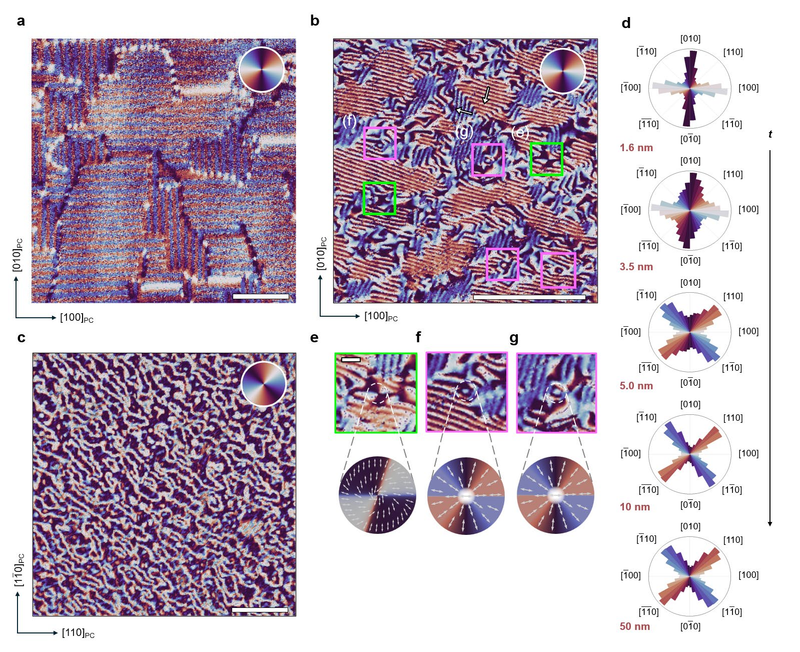
At four unit cells, calculations and images converge on a state the literature did not have: a collinear monoclinic phase with a mirror plane M_b and the Néel vector lying in the film plane. The spins stop waving. In bulk bismuth ferrite the magnetic order is a cycloid, a spiral with a wavelength of tens of nanometres; clamped hard, a film squeezes that spiral out and the spins line up along one axis. Collinear antiferromagnets are fast and leak almost no stray field, but their signal is hard to detect. The thicker samples hold a second surprise: between 3.5 and 10 nanometres the texture fills with vortices and swirl-like topological defects, with the defect density highest in the 3.5 nm film and lower in the 5 nm and 10 nm films (Fratian et al., Nature Materials, October 2026, Extended Data).
Here is the physics behind the new label. In an ordinary collinear antiferromagnet the two sublattices are related by a symmetry that also flips spin, so the spin-resolved bands come out doubly degenerate: an up state at momentum k has a down partner at the same k, and the splitting vanishes. An altermagnet changes the relation, tying the sublattices together with a rotation of the crystal rather than a translation or a mirror, and the nonrelativistic splitting takes the form Δ(k) ∝ σ · k, where σ is the Pauli vector and k the momentum (Šmejkal et al., Science Advances, 2020). Here the pattern is the d-wave case, the splitting tracking momentum along the polar axis and vanishing in the plane. That gives a magnetic signal that changes sign with momentum in a material with no net magnetization, the property altermagnetism was named for and imaged in manganese telluride (Amin et al., Nature, 2024).
The dichroism separates that phase from a canted antiferromagnet. Where a collinear antiferromagnet carries a small canted moment, x-ray magnetic circular dichroism comes from that moment and keeps one sign. In an altermagnet the nonrelativistic contribution flips sign as symmetry-related sublattices are exchanged, so the contrast reverses at particular photon energies while the canted-moment contribution stays put. The group saw it: dichroism images of the four-unit-cell film show domains whose contrast reverses between two photon energies and vanishes at a third, in the geometry symmetry allows and not the one it forbids. Spin-resolved photoemission found the same signature in momentum space, the in-plane spin polarization changing sign near kx = -0.15 inverse angstroms (Fratian et al., Nature Materials, October 2026, Extended Data).
Two obstacles stand between this and a memory chip. The demonstration is a film on a substrate, not a device with a transistor underneath and a read path; nothing here shows a bit written and read repeatedly, and endurance is the metric that kills most proposed memories. Altermagnetism is also more a diagnostic than a working mechanism so far: the electrical responses that would let it be read out directly, the anomalous Hall and Nernst signals, are small and usually measured cold.
What the work settles is that the dead layer was an artifact of the film’s boundaries, and that one conductive layer plus a strain engineer’s choice of substrate is enough to call it back. The direction it opens is a memory cell written with a voltage and read without a current, in a material whose readout comes from a symmetry rather than from a magnetisation that leaks into its neighbours. That is a long way from a part number, but it is the first material thin enough to make the idea worth building.
 Subscribe to our RSS feed









There are no comments.
Add A Comment