


A planet-sized X-ray spectrometer finally opens its eyes
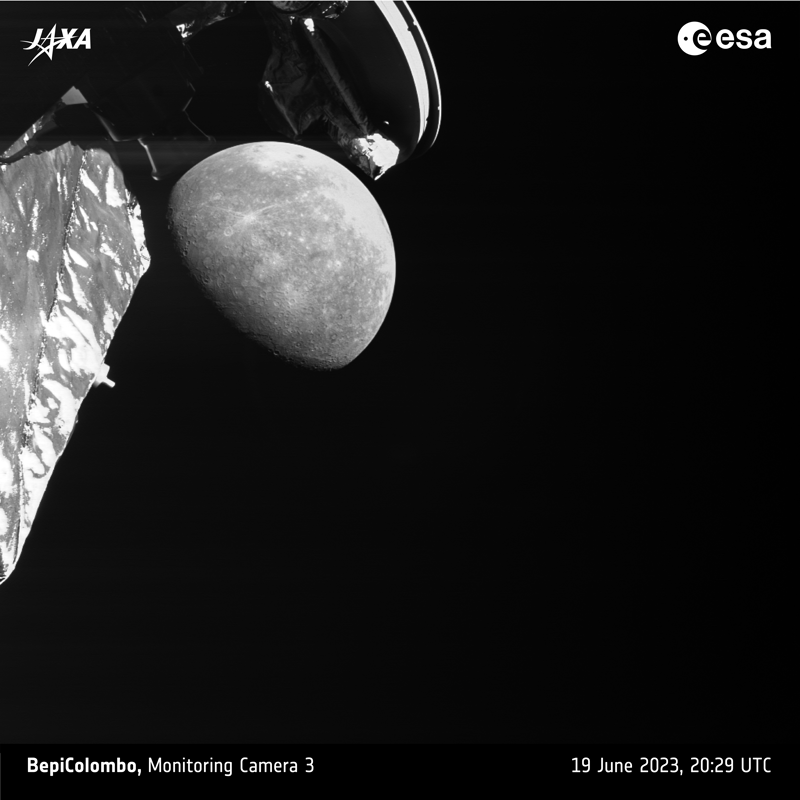
The Crab Nebula sits 6,500 light-years away in Taurus, the wreck of a star that exploded in the year 1054 and left behind a rapidly spinning neutron star, as the Chandra photo album records. It is also, as of September, the first astronomical object the Mercury Imaging X-ray Spectrometer has ever seen. For most instruments that would be a modest milestone. MIXS is an X-ray telescope, the first of its kind ever flown on a planetary science mission, and it spent the last eight years folded under a spacecraft, pointing it in every direction except the sky. The team at the University of Leicester got its calibration target, compared the result against what the same hardware produced in a laboratory in 2015, and the instrument came back slightly sharper than it had left. On 21 November 2026, the spacecraft carrying it is captured into polar orbit around Mercury.
Checking a telescope against a supernova remnant before pointing it at the planet it was built for sounds backwards. X-ray astronomy has a calibration problem with no clean solution, and the workaround is to fly a known source. Before MIXS can say anything quantitative about the surface of Mercury, someone has to establish that the detector still resolves what it is supposed to resolve after a rocket launch and eight years in space. The Crab is the obvious choice, since its X-ray output is strong and steady, and it is among the most studied objects in the sky.
What MIXS does is chemistry at a distance, and the method only works because Mercury is nearly airless. On a body without atmosphere, solar X-rays and charged particles strike the ground directly and excite atoms in the regolith. Those atoms re-emit at their own characteristic energies, as K and L shell fluorescence lines spanning 0.5 to 7.5 keV. Line energies are fixed by atomic structure, so the spectrum of a patch of ground is a chemical fingerprint. The instrument measures that spectrum and inverts it into abundance maps for magnesium, aluminium, silicon, sulfur, calcium, titanium and iron, according to the Max Planck summary of the science goals, sampling the top 10 to 20 micrometres of the surface according to the instrument paper. It is a laboratory technique turned inside out, with the Sun as the excitation source.
The observing sequence was unglamorous by design. On 11 and 12 September 2026, after the Mercury Transfer Module separated from the joined spacecraft on 3 September and steering passed to the planetary orbiter’s own thrusters, MIXS spent 39 hours of exposure broken into 55 separate slews. The slews were not for variety: half-hour pointings at different offsets to the Crab were interrupted so that the spacecraft’s reaction wheels could be off-loaded, as the movie caption explains. Integrating the whole campaign produces one image of the Crab spread across the detector, and the width of that spread is the angular resolution, which determines how sharply MIXS will separate features on Mercury’s surface. The team measured it and found it slightly better than the laboratory value from 2015, which the Leicester release reports as the instrument operating better in flight than it did on the bench. That September window was the first chance to look: the release notes that MIXS could not see into space until the transfer module had separated, and ESA’s arrival log records that, on 15 September, the planetary orbiter’s instruments were powered on together for the first time since that separation.
Adrian Martindale, the instrument scientist who has worked on MIXS since he was an undergraduate in 2003, put it bluntly. The last time anyone looked through this telescope, he said, was in a Leicester basement before launch. Eight years and 10 billion kilometres later, it looks just the same.
The instrument has a lineage reaching back further than the mission. Professor George Fraser was the original principal investigator and the architect of the novel optic design; he died in March 2014. Emma Bunce, now the principal investigator and director of the Institute for Space, said the team is thinking of him as they work the instrument for the first time in flight, and that he would be proud of the first light observations. MIXS is the only UK-led science instrument on the mission, supported by the UK Space Agency alongside STFC, ESA and the University of Leicester. A consortium spanning the UK, Finland, France, Germany and Spain built it. Its instrument data sheet lists a mass of 10.8 kilograms, a power draw of 24 watts and 20 gigabytes of storage.
Two optical channels sit behind the method. ESA’s instrument page describes MIXS-T as a true imaging telescope with a narrow field of view of about one degree, built for high-resolution mapping, and MIXS-C as a collimator with a wide field of roughly ten degrees that collects flux efficiently for the planetary survey. Both channels read out onto a cooled, radiation-hardened silicon detector array about twenty millimetres square, held at minus 45 degrees Celsius. The collimator uses microchannel plate optics whose channel geometry resembles a lobster-eye telescope, except that the channel lengths favour the energy-independent component of the transmitted flux rather than focusing low energies.
The Sun is a variable illumination source, and that is the hard part of turning fluorescence into chemistry. Its X-ray output swings by orders of magnitude on timescales from seconds to years, driven by flares and coronal activity, and it does not vary in a way anyone can model from the ground. Absolute abundances cannot be extracted from a fluorescence spectrum without knowing the exact incident solar flux at the moment of measurement. That is what the Solar Intensity X-ray and particle Spectrometer, SIXS, provides. It rides on the same spacecraft as MIXS, so the two instruments view the Sun and the planet from one platform at the same time, and it measures the solar X-ray, proton and electron environment over a field of view of at least 180 degrees, as ESA’s SIXS page describes. Its data is not optional; every valid fluorescence analysis requires it.
The two spacecraft then take very different orbits. Mio settles into an elliptical polar orbit of about 590 by 11,640 kilometres, completing one revolution in 9.3 hours, while the planetary orbiter descends to 480 by 1,500 kilometres and circles in 2.3 hours, as ESA’s spacecraft overview sets out. On the night side, where the Sun does not illuminate the ground, MIXS will still have work to do: energetic particles striking Mercury’s auroral zone are expected to generate continuum and line X-rays of their own.
What happens next is a sequence of separations rather than a single dramatic moment. The two orbiters are still stacked together when they are captured into polar orbit on 21 November. They separate on 9 or 10 December, the magnetospheric orbiter’s sunshield comes off on 16 December, the planetary orbiter reaches its final orbit on 10 March 2027, and the science phase begins on 6 April 2027, according to ESA’s arrival timeline.
The capture itself is gentler than the phrase orbit insertion suggests. Rather than a single braking burn, the approach uses weak stability boundary capture, in which the stack drifts into Mercury’s gravitational sphere of influence and needs only a small manoeuvre at closest approach to become bound. Ed Belbruno introduced the technique in 1987, and Japan’s Hiten mission used it for a lunar transfer in 1991. The capture sequence unfolds across some sixteen manoeuvres over six months.
The reason to care is what a chemical map of Mercury would settle. The planet formed closer to the Sun than any other, in a region of the protoplanetary disk where it should have been stripped of volatile material, and it sits in a solar wind that has been scouring its surface since the planet formed. If MIXS finds a broadly differentiated surface, with a crust of one composition over a core of another, that constrains how quickly the planet separated. If it finds the same rock types scattered across the surface, that points to a violent origin and a history of redistribution. The abundances it returns, accurate to between 5 and 50 percent depending on how concentrated the element is, as ESA’s instrument page puts it, turn geology into chemistry and chemistry into formation history. No imaging X-ray telescope has ever been flown to a planet before, and this one has proved it can see.
 Subscribe to our RSS feed







There are no comments.
Add A Comment