


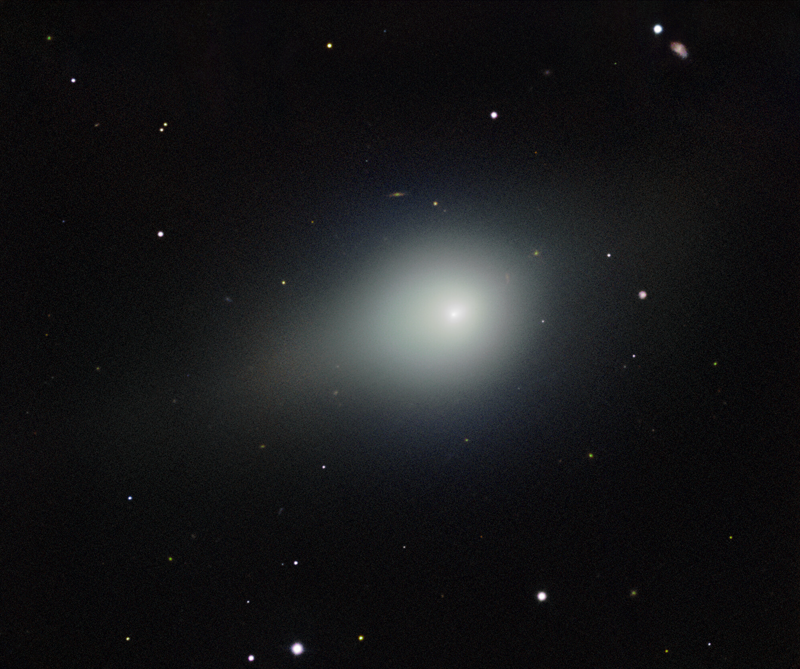
A heavy-water signature in the third interstellar visitor on record is rewriting what astronomers thought they knew about how comets form in other planetary systems. The comet 3I/ATLAS, which swept past the Sun in late 2025 on an unbound hyperbolic trajectory, carries roughly one deuterium atom for every hundred hydrogen atoms in its water ice. That is several times the ratio measured in any comet born in our own solar system, and it sits in territory that astronomers have struggled to explain with models tuned to the chemistry of nearby star-forming regions. A new analysis by a team led by Kenji Furuya of the RIKEN Pioneering Research Institute shows that the heavy-water fingerprint fits a comet that condensed out of a metal-poor molecular cloud, one older and more pristine than the cloud that gave the Sun its comets.
Why this matters goes beyond a single visitor’s biography. Interstellar objects are the only samples of other planetary systems that pass through the inner solar system on timescales short enough to study in detail. ʻOumuamua, discovered in 2017, was too faint and too dry to give up much of its chemistry. Borisov, the second confirmed visitor in 2019, was active enough to reveal carbon-based molecules but stayed below the brightness threshold for the most demanding isotopic work. 3I/ATLAS, the third confirmed interstellar object, found by the ATLAS survey on 1 July 2025, was bright enough to feed both the Very Large Telescope’s UVES spectrograph on Cerro Paranal and the James Webb Space Telescope, producing the first carbon, nitrogen, and water isotopic ratios measured in an interstellar comet. Those three numbers together, especially in a comet that has now left the inner solar system, are the closest astronomers will get to handling material from a protoplanetary disk around another star.
The story behind the heavy-water result runs back through several papers and one stubborn measurement. Earlier in 2026, Opitom and colleagues used UVES between 6 and 26 December 2025 to measure a carbon-12 to carbon-13 ratio of about 151 and a nitrogen-14 to nitrogen-15 ratio near 363 in the comet’s cyanogen (CN) gas, both well above the values typical of solar system comets. The carbon-12 to carbon-13 ratio sits closer to what models predict for the outskirts of an old, metal-poor protoplanetary disk. The JWST measurements that followed returned the heavy-water ratio itself, about 1% deuterium to hydrogen, which is roughly 50 times the ratio measured in a typical solar system comet and significantly higher than the values seen in nearby low-mass star-forming regions. The result was the third isotopic anomaly the comet had handed astronomers, after the carbon and nitrogen measurements, and it tied together two otherwise unrelated puzzles in a single chemical fingerprint. Furuya’s team, reporting in The Astrophysical Journal Letters, asked a deceptively simple question: can a low-metallicity origin explain both the carbon and the water isotopic signatures simultaneously? The same Opitom result was also reported by Sci.News the day the Nature Astronomy paper appeared.
The answer, from a grid of gas-ice astrochemical models spanning the cloud-to-core stages of star formation, is yes. The models vary four parameters: gas density, the strength of the interstellar ultraviolet radiation field, the cosmic-ray ionization rate, and the cloud’s metallicity (the abundance of elements heavier than helium, which astronomers treat as a proxy for how enriched the gas is by earlier generations of stars). The team tracked the chemistry of water and deuterated isotopologues from the diffuse cloud phase through the dense prestellar core, solving for the gas temperature at every step. The water D/H ratio observed in 3I/ATLAS is most readily reproduced at sub-solar metallicities, roughly half the Sun’s complement of heavy elements or less, and at relatively high cloud densities near 10,000 particles per cubic centimeter. Two of the four input parameters matter less: the ultraviolet field strength and the cosmic-ray ionization rate, provided the latter stays below about 10^-15 per second.
The deep dive into why metal-poor conditions pump up deuterium centers on a piece of interstellar chemistry that only happens in the cold. In molecular clouds at around 10 Kelvin, cosmic rays ionize molecular hydrogen and produce triatomic hydrogen ions (H3+). These ions can swap a proton for a deuteron when they collide with the common deuterated hydrogen molecule HD, producing H2D+ and ordinary H2. At cold temperatures the reverse reaction does not have enough energy to proceed, so deuterium becomes trapped in H2D+ until an electron recombines with it and frees a deuterium atom. That deuterium atom can then bond with oxygen to form HDO, heavy water, and from there normal water ice that inherits an unusually high D/H ratio. Three properties of a metal-poor environment amplify the effect. Less carbon monoxide means less H2D+ destruction, since CO readily reacts with it. Less water photodissociation by ultraviolet photons means a smaller flood of atomic hydrogen that would dilute the ratio. A modest cosmic-ray ionization rate keeps the reverse reaction from putting deuterium back into the more stable HD form. With all three effects turned on, the models produce D/H ratios near the 1% observed in 3I/ATLAS without invoking any exotic new physics. The same chemistry explains a related puzzle: the carbon-12 to carbon-13 ratio, which JWST measured earlier in 3I/ATLAS at somewhere between 123 and 191 depending on which carbon-bearing molecule was observed, is also a natural product of a metal-poor cloud. Galactic chemical evolution predicts that older stars, which formed before many supernovae had enriched the interstellar medium, should leave behind a higher ratio of carbon-12 to carbon-13 in their protoplanetary disks, simply because the heavy isotopes that would normally reset the balance had not yet been produced in large quantities.
The team’s robustness check is just as telling. They compared the D/H ratio of methane to that of water in 3I/ATLAS and in solar system comet 67P/Churyumov-Gerasimenko. The absolute deuteration of methane in 3I/ATLAS is around 3%, an order of magnitude above the 0.2% in 67P, but the ratio of methane deuteration to water deuteration stays close between the two comets. The chemistry that controls relative fractionation between water and methane is insensitive to the metallicity of the parent cloud, even when the absolute fractionation is not. That convergence is a quiet vote of confidence in the low-metallicity story.
The takeaway is specific and it sets up the next observation rather than closing the field. The carbon, nitrogen, and water isotopic ratios in 3I/ATLAS together describe a comet that condensed around a star several billion years older than the Sun, in a region of its disk where heavy elements were scarce and water ice picked up an outsized share of deuterium before the disk even began to form planets. The comet is now too faint and too distant for any current facility to repeat these measurements at higher signal-to-noise, and 3I/ATLAS’s perihelion passage on 29 October 2025 is now nearly a year in the past. The next interstellar visitor will eventually arrive, but until then, 3I/ATLAS remains the only sample astronomers have from a metal-poor protoplanetary disk, and the heavy-water ratio is the clearest handle on what that disk looked like.
 Subscribe to our RSS feed









There are no comments.
Add A Comment