


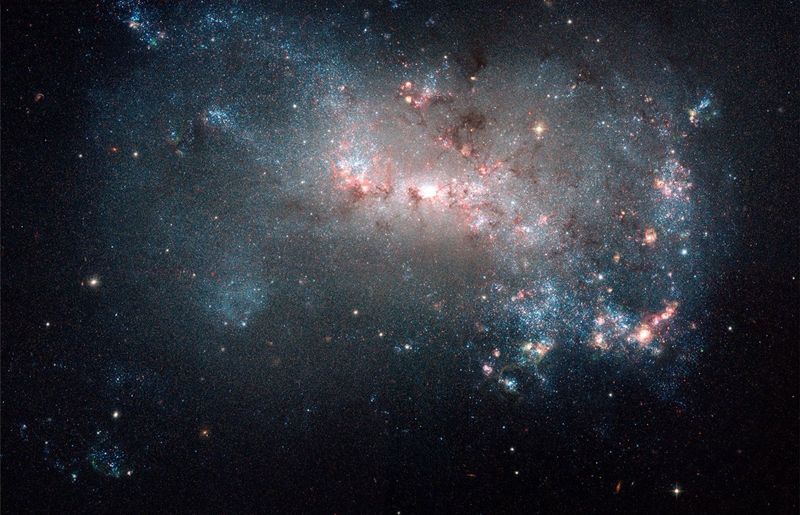
NGC 4449, one of the 37 dwarf galaxies in the GLOW sample. Credit: NASA, ESA, Hubble Heritage and Hubble Collaboration, Alessandra Aloisi (STScI, ESA), via NASA.
A galaxy’s oxygen budget can be computed before anyone looks through a telescope. Stars make oxygen in their cores, so the quantity a galaxy ought to contain follows from how much stellar mass it has ever formed. Set that expectation against the gas, dust and starlight instruments actually turn up, and the accounts rarely balance. For Milky Way-like galaxies the shortfall is smaller, some of the missing material sitting in the halo of gas around the disk. For the smallest galaxies in the neighbourhood the figures have never come close. A survey of 37 dwarf galaxies within roughly 19.5 million light years of Earth now puts a number on the gap, and it is a large one: on average these systems keep only about a ninth of the oxygen their stars produced.
Oxygen is the standard stand-in for the whole family of heavy elements. It is abundant and comparatively straightforward to detect, and its production is well understood, so a measured abundance reads as a census of everything stars have forged. The choice of dwarf galaxies matters more than the choice of tracer. These systems occupy the mass range in which feedback from massive stars and supernovae shapes how a galaxy grows. They are also the ones thought to have done much of the reionization of the early universe, and there are enough of them that their outflows could seed the intergalactic medium with metals. A study from 2014, as the NASA release recounts, had already found that Milky Way-like star-forming galaxies shed much of their oxygen, some of it detectable in the diffuse haloes around their disks. The new work extends that accounting to low-mass galaxies across a wide range of environments, and finds retention fractions much smaller than the simulations predicted.
The project is called GLOW, for Galaxies Losing Oxygen via Winds, funded by NASA and the National Science Foundation. Kristen Wingfield McQuinn leads it. She is also mission head of the science operations centre for NASA’s Nancy Grace Roman Space Telescope, based at the Telescope Science Institute in Baltimore, and an associate professor at Rutgers. Grace Telford of the University of Utah is co-investigator, and she set out the puzzle plainly in a NASA release: the oxygen had to have been inside these galaxies at some point, so the only way it can be absent now is if it was pushed out, which takes energy from massive stars and supernovae.
The measurement is bookkeeping across several archives. Hubble’s optical images resolve individual stars in these galaxies, which is what makes the sample possible. Fitting the colour-magnitude diagrams against stellar evolution models then yields each galaxy’s history of star formation and how its metallicity has climbed over time. From that the team estimates the total stellar mass ever formed, corrects for the share returned to the interstellar medium by winds and supernovae, and multiplies by a yield of newly synthesized oxygen per solar mass of gas turned into stars, 0.010 at low metallicity. Alongside that they add up the oxygen actually present: in the gas, from the Very Large Array and the Australian Telescope Compact Array; in the stars and stellar remnants, from the resolved populations Hubble photographed; and in the dust, while the stellar masses behind the calculation come from the retired Spitzer Space Telescope. The sample is restricted to systems within about 6 megaparsecs, close enough for the telescope to pick out individual stars, and to a stellar mass range of roughly 3 million to 3 billion Suns, where simulations expect the largest fraction of the oxygen to be blown out. The resulting census found retention running from 4 to 25 percent, mean near 11 percent, with most of the oxygen that survives sitting in the gas, ahead of the stars and the dust. NGC 4449, an irregular galaxy in the sample, retained about 17 percent, with 8.9 percent in its gas, 6.0 percent in its stars and 1.8 percent in dust.
The gap comes down to three possible explanations. The first is the circumgalactic medium, the diffuse halo of gas outside the disk. Surveys using the Cosmic Origins Spectrograph to hunt for highly ionized oxygen in absorption against background quasars find only 1 to 7 percent of the oxygen these galaxies made in their hot haloes, and correcting for cooler gas phases pushes the halo budget to perhaps 5 to 35 percent. Even the generous end of that range leaves most of the oxygen unaccounted for. The second possibility is that the models are wrong, and this is where the result gets uncomfortable: three separate cosmological simulations, all reproducing the observed mass-metallicity relation for these galaxies, predict that the dwarfs keep considerably more of their metals than the observations show. The third is that the models get the mass-metallicity relation right but the physics of the winds wrong.
That is the option the team argues for. They fitted a simple regulator model of galaxy evolution, tuning the wind’s mass-loading factor, how enriched the expelled material is, and how much gas flows back onto a galaxy from the intergalactic medium. The best fit, to the data and to the stellar mass-halo mass relation seen in Milky Way satellites, gives a wind mass-loading factor that scales with stellar mass as a power of minus 0.45. The expelled material carries twice the metallicity of the gas it left, and accretion onto these low-mass systems runs 40 percent below the universal baryon fraction. The full paper sets out the uncertainties: the halo measurements that constrain where the oxygen went carry large corrections for ionisation state and for how much of the halo is filled with gas.
The result settles one thing: the models used for these systems have been too generous. Every simulation checked reproduces the mass-metallicity relation and still overpredicts retention, which puts the error in the feedback, not the mass-metallicity relation. Whether most of the missing oxygen has reached the intergalactic medium is still open, since the halo measurements carry large uncertainties, but the balance of the evidence points to a good deal of it having left the gravitational reach of these galaxies altogether. A contemporary summary put the headline plainly: gas-rich dwarfs hold about a tenth of the oxygen their stars have made.
The next steps are already funded. McQuinn has an approved programme to use the Roman Space Telescope to find fainter and smaller systems across a wide swath of sky, and Hubble and the James Webb Space Telescope would then be pointed at their stars to reconstruct how they formed. Telford is going the other way, using Hubble to zoom in on the massive stars that produce the oxygen and blow it out, to work out how those stars differ in small galaxies. The question the paper leaves open is quantitative and testable: how much of the oxygen a dwarf galaxy makes ends up in the halo, and how much is gone for good.
 Subscribe to our RSS feed









There are no comments.
Add A Comment