


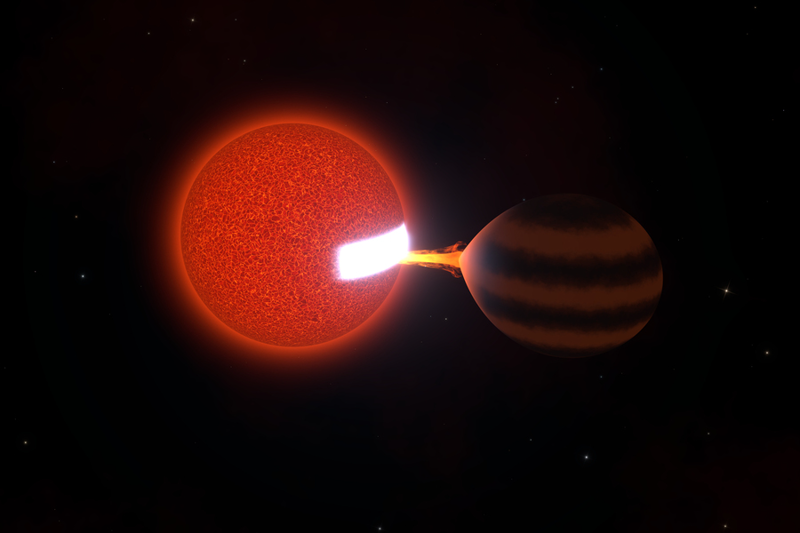
Roughly 300 light-years from Earth, in a part of the Milky Way that no catalogue has bothered to name, two objects circle each other every 86 minutes and 39 seconds. One is a small star, a red dwarf about 85 times the mass of Jupiter. The other is a brown dwarf about 25 times Jupiter’s mass, an object too heavy to be a planet yet too light to fuse hydrogen the way stars do. They orbit so close together that the entire configuration would fit inside the diameter of the Sun. And the smaller one has been quietly leaking material onto the larger one, at a rate slow enough that the larger object will be feeding on its neighbour for billions of years. The system, named ZTF J0440+2325, is described in a paper appearing today in Nature Astronomy by Aaron Householder, Kevin Burdge, and collaborators at MIT and partner institutions, and reported in a parallel MIT News feature by Jennifer Chu. It is the first confirmed case of stable, long-lived mass transfer from a substellar object onto a main-sequence star, and it pulls a tidy assumption about what happens to planets and brown dwarfs that end up too close to a star.
The tidy assumption is the swallow-engulfment model. When a planet, a brown dwarf, or any other substellar object drifts close enough to its host star, the standard picture is that the host tidally strips or disrupts it on a short timescale. The engulfed material gets swallowed and incorporated into the star, the companion disappears, and the binary turns into a single object with a slightly higher mass. This is the fate that astronomers have routinely inferred from observations of close white-dwarf and neutron-star binaries, and it is the fate that theory predicts for the Earth when the Sun leaves the main sequence in five billion years and expands into a red giant. The brown dwarf in ZTF J0440+2325 was supposed to be on the same conveyor belt, dragged inward by tidal friction and consumed on a timescale of thousands to millions of years. Instead, it is doing something much slower and stranger. It is leaking material onto its companion at a rate of about one hundred-thousandth of an Earth mass per year, a number the team works out in the Nature Astronomy paper using the photometric wobble of the binary and the assumption that the donor is overflowing its Roche lobe along the L1 Lagrange point. That is about 40 million dump trucks of material per year by the team’s own analogy, a quantity that sounds large but is a tiny fraction of the brown dwarf itself. The star will not run out of food before the Galaxy ages out from under it.
What the team saw first was the triangular waveform. The Zwicky Transient Facility, a wide-field optical time-domain survey that uses a camera on the 48-inch Samuel Oschin Telescope at Palomar Observatory in California, had been picking up a strange light curve from a star in Taurus for several years. Supernova light curves are bell-shaped: gradual rise, peak, gradual fade. Buried in the ZTF archive was a signal that did not look like a bell at all. It looked like a triangle, repeating on a period of about 87 minutes, with no counterpart at other wavelengths and no obvious explanation. Burdge, an assistant professor of physics at MIT who had been searching the ZTF data for periodic variables, noticed it during a search for a different kind of system. He originally suspected a “black widow binary,” the colloquial name for a millisecond pulsar that is slowly eroding a low-mass stellar companion with its particle wind and radiation. In a black widow, the optical light curve wobbles because the companion is being whipped around the much heavier neutron star, and the orbit usually shows a clean Doppler signature of that motion. The ZTF light curve did not wobble in the same way, which is what tipped the team off that the two objects were not a David-and-Goliath pair but a more balanced system in which neither dominates. Householder, a graduate student in MIT’s Department of Earth, Atmospheric and Planetary Sciences, reanalysed the ZTF photometry and combined it with follow-up time-series spectroscopy. The wobble was small, the spectrum showed hydrogen and helium emission lines characteristic of an M dwarf, and the orbital fit locked the masses at roughly 85 and 25 Jupiter masses. The orbit fit inside the Sun.
The simulation work clinched the picture. Once the team had a mass, a radius, and an orbital geometry, the next question was whether the brown dwarf was overflowing its Roche lobe, the teardrop-shaped region of space around a body in a binary inside which material is bound to that body. If the brown dwarf were inside its Roche lobe, no mass transfer would be possible; the two objects would simply orbit forever without exchanging material. If the brown dwarf were overfilling the lobe, material would spill through the L1 point and rain down on the companion’s surface. The team ran a set of smoothed-particle hydrodynamics simulations with the measured masses, the measured orbital separation, and a brown-dwarf radius tuned to match the photometric brightness. The simulated test particles do not orbit the brown dwarf indefinitely; they stream across the L1 point and pummel the surface of the red dwarf at high speed. The team describes the geometry as more like an asteroid hitting the Moon than the usual accretion disk around a black hole or a neutron star, where material spirals inward through a flattened disk before settling onto the central object. In ZTF J0440+2325, the brown dwarf is too small for its own gravity to capture the inflowing material into a disk, so the stream lands directly on the surface and heats a roughly circular hot spot at the impact point. That hot spot is what produces the triangular waveform. As the brown dwarf orbits, the hot spot rotates in and out of view, and the system brightens when the hot spot faces Earth and dims when it faces away. The peak of the triangle is the moment of direct face-on view, when the impact fireball is brightest.
The mass-transfer rate is low enough that the system is genuinely stable on astrophysical timescales. Most binary mass transfer is unstable on some level: the donor shrinks as it loses mass, the orbit responds by widening or shrinking in ways that either accelerate or choke off the transfer, and the system either spirals toward a common-envelope merger or settles onto a longer-period detached configuration. What the simulations show for ZTF J0440+2325 is the rarer case in which the mass-loss timescale of the brown dwarf and the angular-momentum loss timescale of the orbit are tuned just right that the rate stays roughly constant for hundreds of thousands of years and may hold for the entire remaining lifetime of the brown dwarf, on the order of billions of years. The brown dwarf, as a substellar object, cannot fuse hydrogen and so does not have a main-sequence lifetime in the usual stellar sense, but it has a thermal-cooling timescale, and the team argues that the binary will outlive that timescale many times over. The brown dwarf will not be eaten quickly. It will be eaten slowly, continuously, and quietly, and the Galaxy will be a different place by the time the meal is finished.
What the team plans to look for next is more of the same. The triangle-shaped light curve is a distinctive signature, and the ZTF archive contains years of survey photometry that have not been systematically searched for it. The paper names a second candidate, ZTF J1444+4820, with an even shorter 67-minute period and a similar wobble signature. If that system confirms, the slow-eating configuration stops being a one-off and becomes a routine endpoint of binary evolution when the masses and separation land in roughly the right place. The triangular waveform, the small wobble, and the absence of a Doppler signature that would betray a heavy compact object are the three ingredients of the search. The same configuration, in principle, applies to small stars and giant planets, and the team plans to look for those as well. The conventional picture of close planetary companions has to share the page with a quieter alternative: a slow, steady meal that outlasts planets.
 Subscribe to our RSS feed









There are no comments.
Add A Comment