


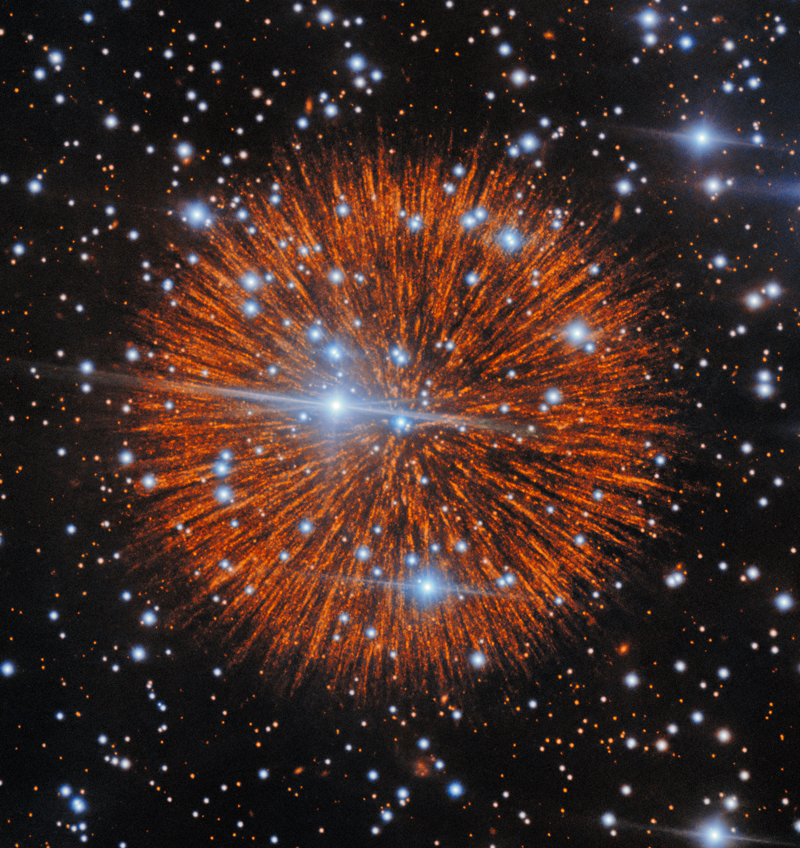
In the constellation Cassiopeia there is a small, oddly symmetrical puff of gas that, on the best nights, looks like a firework frozen at the instant it bursts. Astronomers call it Pa 30, and it is the leading candidate for the remains of a supernova that flared over China, Japan, and the medieval Middle East in the summer of 1181. New narrowband imaging from the Gemini North telescope on Maunakea, published on 6 October 2026 in The Astrophysical Journal, shows that Pa 30’s famous radial filaments are not smooth streamers at all. They are chains of small, evenly spaced knots of gas, lined up like beads on a string along every spoke of the nebula, and the new observations resolve about ten times more of them than any previous study had seen (Cunningham et al. 2026 ApJ; NOIRLab press release). That changes what astronomers thought they were looking at, and it gives the field a way to measure how the ejecta of an 850-year-old failed thermonuclear supernova actually broke up as it ran outward.
Pa 30 was nothing more than an entry in a star catalogue until 2013, when an American amateur astronomer named Dana Patchick, sorting through Wide-field Infrared Survey Explorer data for a citizen-science hunt for planetary nebulae, picked out a previously unrecognized infrared source he labelled “Pa 30” (Sci.News). Follow-up imaging on the 2.1-metre telescope at Kitt Peak and then the 2.4-metre Hiltner telescope revealed a faint nebula threaded by remarkably straight radial filaments, almost perfectly circular in outline, with a hot blue star at the centre (Cunningham et al. 2026 arXiv:2610.06424). The reason that matters is that a normal Type Ia supernova is the catastrophic disruption of a white dwarf that has been pushed over the Chandrasekhar mass limit by accretion from a companion. The white dwarf is destroyed completely; no central star survives; the expanding debris forms a roughly spherical shell with no heartbeat. Pa 30 has a star at its centre that is still very much alive and very hot. Spectra put its surface temperature at roughly 200,000 kelvin and its stellar wind at about 16,000 kilometres per second (Cunningham et al. 2026 ApJ). That is the calling card of the much rarer Type Iax class, a family of faint thermonuclear explosions in which the white dwarf survives the blast, sometimes barely. Only a handful of Type Iax events have been catalogued, and Pa 30 is the only confirmed one whose remnant we can resolve in detail.
The 1181 identification is what turns Pa 30 from a curiosity into a calibration point. Eight separate texts record that a “guest star” appeared in Cassiopeia between 4 and 6 August 1181 and remained visible to the naked eye for 185 days. For decades the historical remnant was confused with the radio pulsar wind nebula 3C 58, but 3C 58 turned out to be too old to match. In 2021, Andreas Ritter and a team at Queen’s University Belfast identified Pa 30, with its associated central star (which they dubbed Parker’s Star after the Hong Kong astronomer Quentin Parker), as the much more plausible remnant of the 1181 event (Sci.News). The geometry fit: an age of roughly 850 years, a position consistent with the historical records, and an ejecta velocity near 1,000 kilometres per second. The 2026 Gemini North campaign, led by Tim Cunningham, then at the Center for Astrophysics at Harvard and Smithsonian and now at the University of Warwick, with Ilaria Caiazzo at the Institute of Science and Technology Austria, John Raymond, and Scott Kenyon, set out to see what was hidden in the filaments at the highest resolution available from the ground. They used the Gemini Multi-Object Spectrograph (GMOS) in narrowband filters tuned to the [S II] and [O III] emission lines of low-ionization gas, and took very long exposures to pull faint substructure out of the background. Each radial spoke resolved into a string of small bright knots separated by fainter gaps, marching outward from near the central object, and the [O III] imaging produced the first confirmation that the diffuse oxygen emission in the nebula is co-spatial with the sulphur filaments rather than being a separate, smoother component (Cunningham et al. 2026 ApJ).
The other headline from the same campaign is a quiet one: the centre of the nebula sits almost exactly where the central star sits. Surviving supernova remnants are expected to recoil, and models of double-white-dwarf mergers predict a kick of anywhere from a few to several hundred kilometres per second for whatever survives the blast. Cunningham and colleagues used their imaging to pin the geometric centre of Pa 30 with a Monte Carlo Markov chain and compared it to the position of the central star, concluding that any transverse kick must be under about 100 kilometres per second at the 3-sigma level (Cunningham et al. 2026 arXiv:2610.06424). That is unusually small for a merger survivor. It tightens the constraint on how energetic and asymmetric the explosion could have been, and it adds another piece of evidence that the 1181 event really was a Type Iax: a comparatively gentle thermonuclear runaway in which much of the white dwarf’s mass was ejected but a substantial core remained intact, sitting nearly where it began. What the knots themselves are made of is the open question the new data sets up. If the filaments were once smooth, their beaded structure implies either that the ejecta itself was clumpy on small scales when it was launched, or that the interstellar or circumstellar material the ejecta ran into was inhomogeneous enough to break the flow up into discrete radiative-cooling zones. The characteristic spacing Cunningham’s team measures, around 10^16 centimetres per knot, is roughly the size scale that Rayleigh-Taylor fingers in supernova remnants are expected to produce, and strings of similar knot cascades can be seen in the core-collapse remnant Cassiopeia A, although without Pa 30’s strict radial geometry (Cunningham et al. 2026 ApJ).
Follow-up is already in the queue. STScI program 18082, accepted in June 2026, will pair the Gemini narrowband imaging with a 16-orbit Hubble WFC3 campaign in [S II] to map Pa 30’s filaments across their full length, and JWST program 9111, in parallel, is using MIRI’s integral-field unit to obtain mid-infrared spectra of six bright filaments to measure their dust content and cooling balance. The combination should let the team tie the optical knots to specific ejecta species (oxygen, neon, sulphur) and to the dust that survived the explosion, and to test whether the beading is consistent with a clumpy progenitor or a clumpy medium. There is also a separate, very recent coda to the Pa 30 story: a separate team announced in early October 2026 that the central star, IRAS 00500+6713, has a measurable green tint in its visible-light spectrum, the first white dwarf to show one, painting it with the same mechanism that gives oxygen-rich Wolf-Rayet stars their colour (NASA APOD 2026 October 7). The 1181 supernova is the only historical Milky Way Type Ia-class event whose remnant we can resolve and the only Type Iax remnant at all, and with knots now measurable one by one, a quiet central star that did not fly away, and a Hubble and JWST follow-up in flight, it is the closest thing the field has to a benchmark for what a failed-but-not-quite thermonuclear supernova looks like 850 years after it happened.
 Subscribe to our RSS feed









There are no comments.
Add A Comment