


Tianwen-2’s first look at Kamoʻoalewa, and why its lunar origin is wobbling
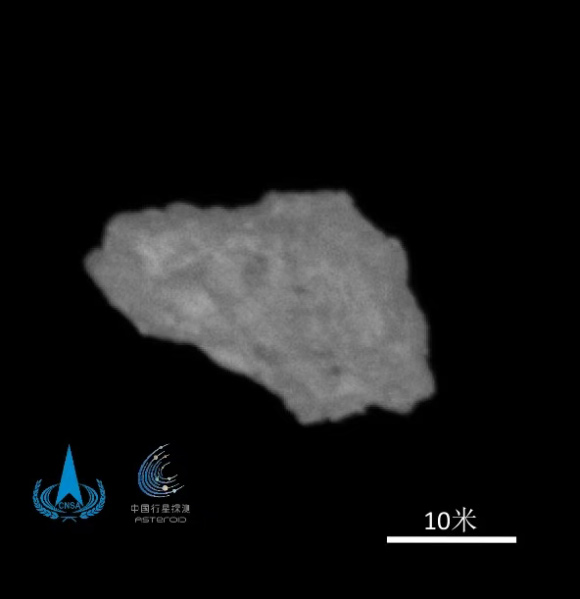
A small, elongated rock against a black sky, with a 10-metre scale bar tucked into the lower-right corner. That is the entire first portrait of asteroid 469219 Kamoʻoalewa, returned on 2 July 2026 by China’s Tianwen-2 probe from a distance of about 20 kilometres. The picture is rough, but it is enough. Kamoʻoalewa is roughly the size of a small office building, and until now the only data astronomers had on its surface came from telescopes on the ground and from a few passes of the James Webb Space Telescope. Now a spacecraft is sitting in front of it, and the first thing that picture reveals is that the rock looks nothing like the Moon, which is what a five-year-old theory said it should look like (SpaceNews, Sci.News).
Kamoʻoalewa is one of seven known quasi-satellites of Earth, meaning its orbit around the Sun closely tracks ours even though it is not gravitationally bound to the planet. From our moving viewpoint it appears to loop around the Earth like a slow second moon, but the similarity is an illusion of perspective (Wikipedia). For most of the past decade the working hypothesis has been that Kamoʻoalewa is a chunk of the Moon’s far side, blasted into space by an impact and later nudged into an Earth-like orbit. The red colour of its reflectance spectrum, measured from telescopes in 2021, looked more like heavily weathered lunar silicates than like any common type of near-Earth asteroid (Space Daily).
That hypothesis is now under coordinated pressure from three independent lines of work: a population model published in Astronomy & Astrophysics, a reanalysis of the spectrum in Nature Communications, and the new JWST observations led by Benjamin Sharkey at the University of Arizona. Tianwen-2’s image does not settle the question, but it shows that the spacecraft can find, track and image a target only tens of metres across, which is the prerequisite for the sample return that will settle it. The mission is China’s first attempt at an asteroid sample return, and the spacecraft is built to bring roughly 100 grams of material home in late November 2027 (Sci.News, SpaceNews).
Tianwen-2 launched from the Xichang Satellite Launch Center on 29 May 2025, riding a Long March 3B/G2 rocket. CNSA disclosed little about the cruise until the spacecraft was already at its target. Independent tracking by AMSAT-DL in Europe picked up the probe’s signal as it approached the asteroid and showed a series of engine burns (SpaceNews). On 6 June 2026 the spacecraft first detected Kamoʻoalewa. The next day it executed a capture manoeuvre at 30,000 km to match the asteroid’s orbital plane. By 19 June it had closed to 2,000 km. On 2 July it settled into a 20 km station-keeping point and took the picture (Sci.News, SpaceNews).
CNSA announced the arrival on 6 July 2026. The agency’s statement stressed that the optical navigation data reduced uncertainty in the asteroid’s predicted position from hundreds of kilometres, based on ground observations alone, down to the kilometre scale. The 20 km point is the start of close-proximity science operations, including global mapping and selection of the sampling site. Departure from Kamoʻoalewa is planned for April 2027, with the reentry capsule delivering samples in late November 2027 (SpaceNews).
Kamoʻoalewa was discovered on 27 April 2016 by the Panoramic Survey Telescope and Rapid Response System, Pan-STARRS, at Haleakala Observatory in Hawai’i. Its name is a Hawaiian phrase that translates roughly to “oscillating celestial fragment” (Sci.News, Wikipedia). Ground-based estimates put its diameter between 40 and 100 metres. The Tianwen-2 image, with its 10-metre scale bar, suggests a diameter of just over 20 metres. That matches the JWST-based estimate from Sharkey’s team, published as a preprint in late June 2026, which puts the mean diameter at 18 plus or minus 2 metres and the rotation period at about 27.9 minutes (SpaceNews, arXiv:2606.24017).
Granvik, an astronomer at the University of Helsinki and Luleå University of Technology, told SpaceNews that the first image “basically confirms” the high geometric albedo implied by Sharkey’s JWST work, and that this reflectivity is not compatible with the low-to-moderate albedo of lunar material. “So it seems that Kamoʻoalewa is of asteroidal origin,” Granvik said (SpaceNews).
The lunar-fragment hypothesis was a coherent story built from two indirect clues, not from direct evidence. The 2021 spectroscopic study led by Benjamin Sharkey found that Kamoʻoalewa’s reflectance was unusually red and resembled heavily weathered lunar silicates more than common near-Earth asteroid types. A 2024 Nature Astronomy paper led by Yifei Jiao then proposed a specific source: the 22-kilometre-wide Giordano Bruno crater on the lunar far side, whose estimated age and impact physics could produce fragments of the right size and send some into co-orbital space (Space Daily).
Three recent studies each chip away at that picture. The first is a population model by Marco Fenucci and colleagues in Astronomy & Astrophysics. The team modelled both ordinary near-Earth asteroids delivered from the main belt and fragments produced by the Giordano Bruno impact. Their estimate produced 1.23 plus or minus 0.13 Kamoʻoalewa-like objects from the main-belt population, compared with 0.042 from Giordano Bruno ejecta. That is more than an order of magnitude in favour of a main-belt origin, although the calculation is a population argument, not a parent-body match (Space Daily).
The second is a May 2026 Nature Communications paper led by Pengfei Zhang. The team reanalysed the absorption feature and found it consistent with LL chondrites, the stony meteorites associated with asteroids like Itokawa. In laboratory tests, highly space-weathered LL-chondrite powder reproduced Kamoʻoalewa’s reflectance spectrum even though solid pieces did not. They proposed an origin in the Flora asteroid family, followed by extensive weathering of fine surface material (Space Daily).
The third is Sharkey’s new JWST observations, taken in February 2026 and supported by Large Binocular Telescope measurements in April. The infrared spectrum is much less red than the 2021 ground-based result. The authors say the colours resemble several silicate asteroid classes, including S, V, or E-types, more than weathered lunar material. The albedo and absorption features may fit an oldhamite-bearing, enstatite-rich composition. The preprint’s best-fit geometric albedo is 0.59, with model fits as low as 0.36 still working, which is far too bright to match lunar highland or mare material (arXiv:2606.24017, TechTimes).
None of these three studies identify the same asteroid analogue. What they share is that none of them require Kamoʻoalewa to be lunar rock. Tianwen-2 will be the tiebreaker. Its 11 science payloads include cameras, laser ranging, spectrometers, sounding radar and particle analyzers, plus the DIANA dust analyzer contributed by Italy (SpaceNews). For sampling, the spacecraft carries three redundant techniques: hovering, touch-and-go, and anchoring plus attachment, with the last dependent on whether the surface can support it. The anchoring approach is unusual; it would require the spacecraft to grip a body that is only tens of metres across. After the sample heads home, the main spacecraft is to continue onward to the active main-belt comet 311P/PANSTARRS, where it would carry out the first close investigation of an active main-belt object (SpaceNews).
The first Tianwen-2 picture of Kamoʻoalewa establishes that the spacecraft has reached its target and can resolve an object barely wider than a tennis court at 20 km. It does not yet say where the asteroid came from. Between now and the late-2027 sample return, the most consequential measurements will be multispectral imaging at lower altitudes and the choice of sampling site. Laboratory work on the returned grains can compare mineralogy, elemental ratios and isotopes with Apollo and Luna samples on one side and with LL chondrites on the other. A lunar match would have to overturn the new statistical and spectral arguments against it. A chondritic match would mean an ordinary asteroid had acquired a lunar disguise through long space weathering, which would be its own kind of finding (Space Daily).
The next milestone in the timeline is the move from 20 km station-keeping into closer mapping. The first attempt at sample collection is expected in 2027. Granvik’s reading of the new albedo, Fenucci’s population model, Zhang’s LL-chondrite fit and Sharkey’s JWST spectrum together point the same direction, but they do not yet reach the Moon. That is what the sample return is for.
 Subscribe to our RSS feed









There are no comments.
Add A Comment