


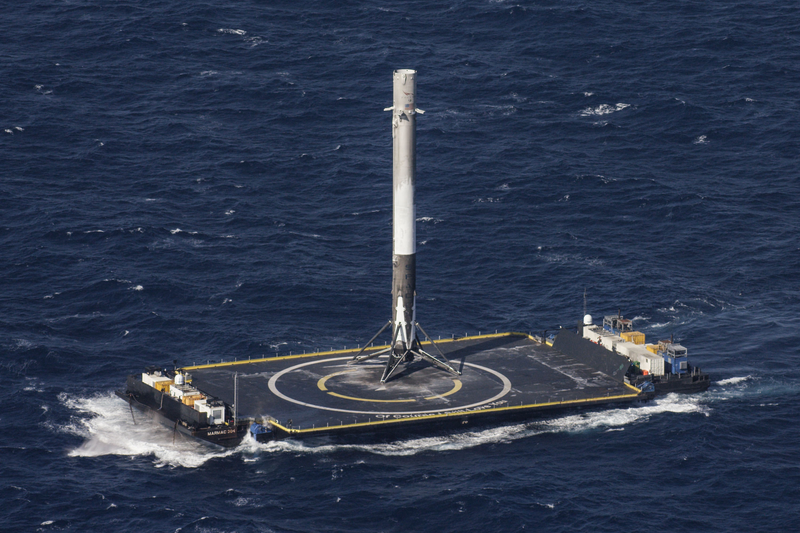
On 22 August 2026 at 07:25 UTC, a Falcon 9 climbed off Space Launch Complex 4E at Vandenberg carrying 29 Starlink satellites. By the time the second-stage Merlin 1D Vacuum cut off over the south Pacific, the autonomous spaceport drone ship Of Course I Still Love You had caught a Block 5 booster on its ninth flight and pushed the vessel’s successful landing tally to 220 out of 228 attempts (Wikipedia, ASDS landings history, accessed 22 August 2026). The numbers look routine because they are routine. That is the point.
Reusable orbital rockets stopped being an experiment years ago and quietly became a load-bearing column of the global launch industry. The most-flown Falcon 9 first stage, B1067, has now flown 36 missions and is certified to keep going to 40 (Wikipedia, List of Falcon 9 first-stage boosters, accessed August 22 2026). A drone ship named for a science-fiction vessel is on track to record its 230th catch sometime this autumn. The launch industry has changed more in this decade than in the previous five, and the change looks, from one Starlink mission to the next, almost boring.
Cost per kilogram to low Earth orbit is the cleanest single number in the launch industry, and it has collapsed. The Space Shuttle ran near $54,500 per kilogram on the OIG baseline in 2012 dollars (NASA OIG IG-12-002, 2012). Falcon 9’s standard price sits near $67 million for an expended mission of about 22.8 tonnes to LEO — roughly $2,900 per kilogram on the list (SpaceX, Falcon User’s Guide, April 2020; Wikipedia, Falcon 9 Block 5). On a reused mission the airframe cost amortizes across the flight count, and the marginal kilogram price drops further.
The mechanism is not a bigger rocket. It is reuse of the most expensive stage. Industry analyses put the manufacturing cost of a Falcon 9 first stage at roughly 60 percent of the rocket’s total price (Wikipedia, List of Falcon 9 first-stage boosters, citing Everyday Astronaut estimates). Propellant for one Falcon 9 launch is under one percent of the vehicle price on SpaceX’s own figures. When the first stage can be reused, the marginal cost of another flight is dominated by propellant, inspection, and a small amount of refurbishment.
The Tsiolkovsky equation, Δv = v_e × ln(m_0 / m_f), describes how much velocity change a stage can deliver, where v_e is the exhaust effective velocity, m_0 the initial mass, and m_f the burnout mass. The economic equivalent, what rocket accountants sometimes call reuse leverage, looks like cost_per_flight ≈ fixed_cost / flights + marginal. Improvements in the denominator compound quietly.
The recoverable first stage began as a SpaceX research project funded out of company revenue after 2011 (Wikipedia, SpaceX reusable launch system development program). Early Falcon 9 flights tried to land on parachutes; the stages disintegrated on re-entry. The first successful propulsive landing came on Falcon 9 Flight 20 in December 2015, when a Full Thrust first stage set down on Landing Zone 1 at Cape Canaveral. Eighteen weeks later, on 8 April 2016, the same autonomous drone ship Of Course I Still Love You that would later log 220 catches recorded its first stage, the CRS-8 booster. By March 2017 SpaceX had reflown a landed first stage; by October 2017 the cadence was settling in.
Block 5, the current variant, debuted in May 2018 aboard Bangabandhu-1, and from the start it was engineered for at least 10 flights without major refurbishment. The certification staircase since then has been a study in disciplined risk: 10 flights in 2021 (B1051), 15 flights by 2023, then 20, and now 40 per booster. Each step followed a deep-dive inspection of a representative stage — B1058 and B1060 for the 20-flight certification — before SpaceX approved the next tier. B1067, which first flew in 2021, hit 36 flights in 2025 and is now the operational record holder.
Of the 694 Falcon family launches logged by 22 August 2026, 626 were Block 5 missions; 625 succeeded (Wikipedia, Falcon 9 Block 5). There has been one in-flight failure since the 2015 CRS-7 mishap — the Starlink Group 9‑3 second-stage anomaly — for a family success rate of 99.57 percent. Booster recovery is now standard, except when milestones roll over. On 22 August OCISLY hit landing 228, success 220. Just Read the Instructions, used briefly for Cape launches, logged 157. A Shortfall of Gravitas, the Atlantic drone ship, hit 166. The math: 650 successful Falcon 9 first-stage landings, 13 nominal failures, in 663 attempts.
Block 5 is not Block 4 with longer life. It is a structural rewrite aimed at thermal survival and rapid turnaround, and three components did most of the work.
First, the base heat shield at the bottom of the interstage was thickened and mounted on a stronger structure so a returning stage can absorb repeated supersonic heating without cracks propagating into the propellant tanks. Skin temperature during a boost-back re-entry peaks at roughly 1,500 K for a few tens of seconds; the aluminum-lithium alloy tanks survive only a finite number of these cycles, which is why certification life is a count, not a calendar span.
Second, the four hypersonic grid fins at the top of the stage were changed from aluminum to titanium alloy (Ti-6Al-4V) so they no longer deform visibly after each flight and can be reused without machining or replacement.
Third, the four landing legs switched from a deployable hydraulic mechanism with many moving parts to a carbon-fiber composite assembly that folds flush against the stage, removing the pins and seals that had been a top refurbishment item.
The Merlin 1D engine at the heart of the stage had to learn ten flights without major service at the same time. It runs on the gas-generator cycle with a pintle injector — the same architecture as the Apollo Lunar Module descent engine — and feeds from a single-shaft dual-impeller turbopump originally designed by Barber-Nichols. Sea-level thrust is rated at 845 kN, dry mass 470 kg, thrust-to-weight ratio near 184, and chamber pressure about 9.7 MPa. Specific impulse runs around 282 seconds at sea level and 311 seconds in vacuum per the published Falcon User’s Guide (SpaceX, April 2020). Those are modest numbers next to staged-combustion or ion engines, but they are the right trade for a reusable booster that has to be inspected, refurbished, and reflown in weeks.
Re-entry burn and landing burn use three-engine and single-engine restarts, so the Merlin 1D has to reignite in vacuum after separation and then reignite again on the way down. Cold-gas nitrogen thrusters handle fine attitude control between burns, which is what allows a Block 5 to land on a 91-by-52-meter drone ship sitting in swell at the edge of the open Pacific.
Reuse has eaten the launch industry in a way the engineers of the 1970s would have recognized but probably could not have predicted. Within SpaceX, the next step is full reusability with Starship, where the second stage also returns — a much harder problem because orbital velocity is near 8 km/s, more than four times the ~1.7 km/s a returning first stage survives. Outside SpaceX, the cadence pressure is starting to bend competitors: Blue Origin’s New Glenn has demonstrated its first-stage landing; Rocket Lab plans to recover Neutron’s booster; Stoke Space is targeting full reuse of a small launcher; China’s LandSpace has caught fairings and is testing full booster recovery. Reusability is no longer a fringe technology. It is the floor now. B1067 will eventually retire, and SpaceX will already be counting the flights of its replacement.
 Subscribe to our RSS feed









There are no comments.
Add A Comment