


A rose-colored stone the size of a dinner roll was picked up in the Sahara desert in 2022 and then sat in a collection drawer for four years. It took until this autumn for anyone to work out what it actually was, and even then the answer unsettled the planetary science community. Researchers at the University of New Mexico had tagged the rock as Martian from its oxygen isotope ratios, and to them it looked like an ordinary member of the shergottite family, the group that accounts for most of the meteorites we have from the Red Planet. Yang Liu, a researcher at NASA’s Jet Propulsion Laboratory, almost turned the job down. Unfamiliar textures and odd minerals were enough to make her look twice, and what she found were zircon crystals, the mineral geologists use to put a precise age on a rock. The dating came back at more than 4.1 billion years. The meteorite, named Teghaza 001 after the salt flat in Mali where it turned up, turned out to belong to a group of three: the most ancient Martian meteorites ever recovered on Earth. The NASA account of the work appeared at the end of October, alongside a paper in the journal Science (Liu et al. 2026).
The reason this rock matters is a mismatch that planetary scientists have been stuck on for decades. The surface of Mars is dominated by terrain that is more than three billion years old, yet the meteorites we have collected from Mars are mostly much younger than that. The three main families of Martian meteorite, shergottites, nakhlites and chassignites, all formed 2.4 billion years ago or later. That leaves a gap: we have been sampling a planet whose ancient crust we cannot reach, using rocks that tell us about a comparatively recent chapter of its history. Only two specimens have ever turned up that are genuinely ancient. One, ALH84001, is made almost entirely of a single mineral and has yielded conflicting age readings for decades. The other is a jumble, Northwest Africa 7034, better known as Black Beauty, whose fragments include material older than 4.3 billion years but which mixes together many distinct rock types. Teghaza 001 is different in kind. It is a single coherent igneous rock, coarse-grained and rich in plagioclase, and its composition, mineralogy and texture all point to something no other sample has shown: a piece of Martian crust that formed from a mantle source with essentially primordial composition, then soaked in water.
Getting there took a change of heart. Liu had been handed the meteorite because the New Mexico group had already confirmed its Martian origin and assumed it was a routine shergottite. She took a look anyway. The textures did not match anything in her experience, and the mineral suite was strange, and buried inside was a set of zircon grains. Those zircons gave the team a uranium-lead age of roughly 4.11 billion years, which is the headline number. The second author, Lee Saper, who did the work as a postdoctoral scholar at JPL and is now at NASA Ames, put it more plainly than the age did: in the team’s view this is the first piece of Martian crust from a region of Mars for which no sample has ever been obtained. Carl Agee, who directs the Institute of Meteoritics at the University of New Mexico and co-authored the companion study, was more impressed still. A reviewer of the Science paper, Liu has said, called the rock a Rosetta Stone for Mars, and Agee pointed out that Black Beauty contains a few pieces of that age but is a conglomeration of many rock types, whereas Teghaza 001 is one unadulterated kind of rock. Sci.News reported both reactions, and Scientific American ran with the Rosetta Stone framing.
The dating itself was the hard part, and the method matters more than it might appear. Most age determinations dissolve a sample entirely and analyze the bulk. That works fine on an ordinary rock. It does not work on something rarer than anything the team had handled before, and it destroys what is left. So Francois Tissot at Caltech, whose group pioneered the in-situ alternative, used rubidium and strontium instead, working on a piece no larger than a fingernail and analyzing single mineral grains on its surface. Because the method leaves the sample largely intact, the meteorite stays available for later work. Tissot’s rubidium-strontium result came in near 4.24 billion years, less precise than the zircon number but consistent with it. The two dates bracket something slightly more interesting than a crystallization event. Either one may mark the moment hot, mineral-rich water moved through the rock shortly after it cooled, rather than the instant it solidified, which would explain why the oxygen isotopes are heavier than those of other Martian meteorites. Those heavy isotopes come from fluids enriched in oxygen-18, either circulating through the crust or interacting directly with the magma. A companion paper in Science Advances pushed the water story further by measuring the hydrogen and deuterium locked inside igneous calcium phosphates. The magmatic water in the rock looks ordinary for Mars, but a deuterium-rich component had been mixed into it, carried in by magmas that passed through crust which had already been altered by water. That sets a floor under the deuterium-to-hydrogen ratio of the Martian hydrosphere 4.1 billion years ago at roughly twice the value in Earth’s seawater, which fits models in which Mars lost hydrogen to space quickly.
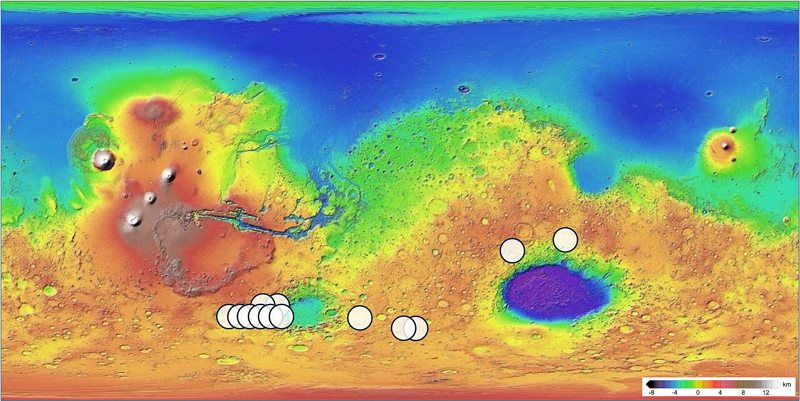
Closing the loop took orbit. Comparing the rock’s chemistry against spacecraft measurements, the team narrowed the origin down to thirteen candidate sites, and the map NASA’s Jet Propulsion Laboratory published with the work shows where they sit. Nearly all of them fall in the southern highlands, the heavily cratered terrain in the planet’s southern half, and two lie just northwest of the enormous Hellas impact basin, whose dark blue floor in the elevation rendering marks it as one of the lowest places on Mars. The candidates cannot be narrowed further than that. A meteorite ejected by an impact carries no record of the direction it came from, and the southern highlands are among the most heavily resurfaced terrains in the solar system, so the specific outcrop is likely long gone. What the map does establish is that the rock came from a part of the ancient crust, most likely the highlands, that has never been sampled and that orbital instruments had already shown to be chemically distinctive.
What happens next is mostly a matter of other teams getting hold of the science. The two papers published this year, one in June and one at the end of October, are a starting point rather than a summary, and the authors make no pretence that the story is closed. The meteorite is eight fragments weighing 798.5 grams in total, with the largest about 442 grams and roughly ten centimetres across, and it has already yielded two independent ages, a water story, and a set of candidate launch sites. There is a reasonable chance that no second rock like it turns up soon, which is what makes the reviewer’s comparison do real work: one fragment, carried off Mars by an impact nobody witnessed and landing in the Sahara decades later, is giving scientists their first physical evidence about the crust of a planet at an epoch they could previously only model.
 Subscribe to blog posts using RSS








