


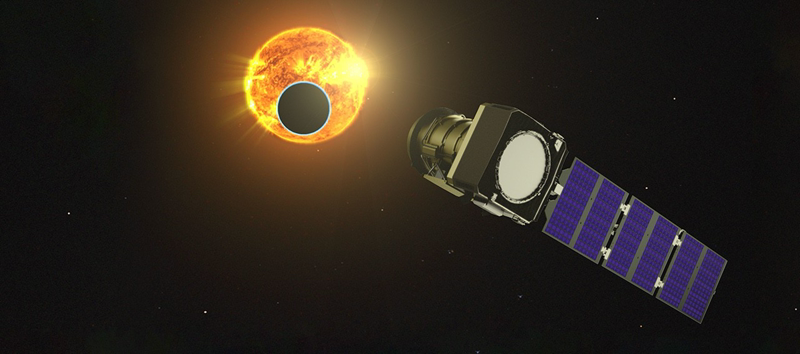
A NASA SmallSat called Pandora finished its commissioning campaign in mid-August and started routine science observations this week, becoming the first spacecraft ever launched under NASA’s Astrophysics Pioneers program to begin returning data. The mission’s job is unglamorous and foundational: stare at known transiting exoplanets for 24 hours at a time, in visible and near-infrared light together, and work out how much of the signal that astronomers have been calling “the planet’s atmosphere” is actually the star’s surface talking back. Over its year-long primary mission, Pandora will repeat that pattern at least 10 times each on at least 20 different worlds (NASA Science, Aug 25, 2026).
Pandora is not a flagship-class observatory. It is a 45-centimeter telescope in a small-satellite bus, launched on January 11, 2026, with a cost cap closer to a university instrument than to a NASA great observatory. The trade is that the mission gives up raw sensitivity and trades it for time: it can spend full days on a single target, something James Webb Space Telescope, Hubble, or any of the other big telescopes simply cannot afford to do, because their schedules are filled with hundreds of competing requests (NASA Science mission page).
Transit spectroscopy is the dominant way the field measures exoplanet atmospheres today. When a planet crosses in front of its star, a thin sliver of starlight passes through the planet’s atmosphere on its way to Earth, and the wavelength-by-wavelength absorption of that light is supposed to encode the composition of the atmosphere. Water, methane, carbon dioxide, hazes and clouds all leave fingerprints at characteristic wavelengths, and a community of thousands of papers since 2002 has built up an enormous catalog of “detected” molecules on this premise.
The premise has a quiet problem. Stars are not uniform disks. Their surfaces host hotter, brighter patches called faculae and cooler, darker patches analogous to sunspots, and those patches grow, shrink, and rotate across the star’s face on timescales of hours to weeks. When the planet transits, the starlight that grazes the planet’s atmosphere is the light coming from the exact patch of the star covered by the planet at that moment. If that patch happens to be a facula, the recorded spectrum is biased bright; if it is a starspot, the spectrum is biased dark. Both biases can mimic or erase molecular features that the atmosphere alone would have produced.
This contamination problem has been written about for years, most concretely in a 2018 paper by Benjamin Rackham (then at Harvard, now at MIT) and Daniel Apai, which showed that starspot and facula crossings could fake the entire water feature in an Earth-sized planet’s transit spectrum, with the implication that several claimed habitable-zone water detections needed re-evaluation (NASA Science, Aug 25, 2026). Rackham is now on the Pandora team. The mission is, in a real sense, a purpose-built response to the contamination question his paper raised. That response has implications for how the next decade of Webb and Ariel spectra should be interpreted.
Pandora is the first mission under NASA’s Astrophysics Pioneers program, a line that NASA created in 2020 to fund astrophysics SmallSats at roughly $20 million each, with a higher-than-usual tolerance for risk. Pioneers missions are meant to answer focused scientific questions with focused instruments, on short timelines and modest budgets, and to give early-career principal investigators a path to flying a mission. Pandora was selected in the inaugural 2021 call (NASA Science mission page).
The principal investigator is Elisa Quintana at NASA’s Goddard Space Flight Center, with project management and engineering at Lawrence Livermore National Laboratory. The telescope itself was a joint development between Livermore and Corning Incorporated: an all-aluminum 18-inch (45 cm) primary, chosen for its thermal stability over a long stare. The detectors are the heart of the instrument, and the near-infrared one is a Teledyne HxRG part originally built and qualified as a flight spare for the James Webb Space Telescope (NASA Science, Aug 25, 2026). The bus was built by Blue Canyon Technologies, which also handled spacecraft assembly, integration, and environmental testing, and which provides ongoing mission operations support. The University of Arizona leads mission operations, and NASA’s Ames Research Center performs the data processing.
Pandora launched on January 11, 2026, into low Earth orbit. The commissioning campaign that followed took roughly seven months, longer than the four-to-six months NASA’s SmallSat missions often need, mostly because of the precision pointing required to hold the telescope on a star and not drift during a 24-hour exposure. By mid-August, deputy project manager Jordan Karburn of Lawrence Livermore was ready to call it: the spacecraft is healthy and all the instruments are performing as well as the team had hoped. Routine science observations began on August 25, 2026 (NASA Science, Aug 25, 2026).
The instrument’s central trick is the simultaneous visible and near-infrared stare. When Pandora points at a star that is hosting a transit, both detectors record photons at the same time. The visible detector measures the brightness of the star across the stellar surface, including the changing pattern of spots and faculae as the star rotates. The near-infrared detector measures the transit spectrum itself, where the planet’s atmospheric absorption lives.
To turn those two measurements into a contamination-free planet spectrum, the team uses the pattern of brightening and dimming in the visible band to model what the star was doing during the transit in the infrared. They subtract the inferred stellar component from the observed infrared spectrum, leaving the planet’s absorption as the residual. That is the same general technique the field has applied to individual Hubble and Spitzer observations, but applied across a whole program at a depth and time coverage those missions could never match.
The visible detector alone does not give you a clean stellar surface map, because the planet is also blocking part of the star during the transit. Pandora solves that by spending 24 hours on each target, with the transit landing somewhere inside that window. The 20 hours outside the transit capture the stellar rotation signature cleanly, and the 4-hour transit window captures the planet’s absorption while the stellar pattern is still being monitored in the visible.
The 20-target, 10-observation, 24-hour-stare program is calibrated against a smaller list of well-characterized exoplanet host stars that other observatories have already studied in detail. The plan is that Pandora will first nail down the stellar contamination correction on those targets, where independent Webb and Hubble spectra exist for cross-checking, and then apply the validated correction to more challenging targets further out.
The Pandora team’s claim, made by project scientist Knicole Colón at NASA Goddard, is that combining Pandora’s many-hour stares with shorter Webb snapshots will give the community the first set of planet spectra that are demonstrably free of the starspot/facula confusion that has plagued the field. That is a specific, testable claim, and the year-long primary mission is sized to deliver it (NASA Science, Aug 25, 2026).
Pandora is a quiet mission by NASA’s standards, and that is the point. The Astrophysics Pioneers line was created to fund focused science that flagship missions cannot deliver, on the argument that some questions need dozens of hours per target rather than a single snapshot. Pandora’s question is the one that underlies every transit-spectroscopy result published since 2002: how much of what we attribute to a planet’s atmosphere is actually the star’s surface?
The mission is now collecting data. The first peer-reviewed results are likely to land in late 2027 or early 2028, when the team has had time to reduce the first 12 to 18 months of stares and compare them against the existing Webb and Hubble baseline. If the contamination correction works as advertised on the well-characterized stars first, the team will extend the technique to the more interesting targets, including small cool stars whose habitable zones fall in the Sweet Spot for atmospheric characterization.
The broader programmatic test is whether Pioneers as a line can deliver the science per dollar that the 2020 decadal review committee hoped for. Pandora is the first example the field will judge.
 Subscribe to our RSS feed









There are no comments.
Add A Comment