


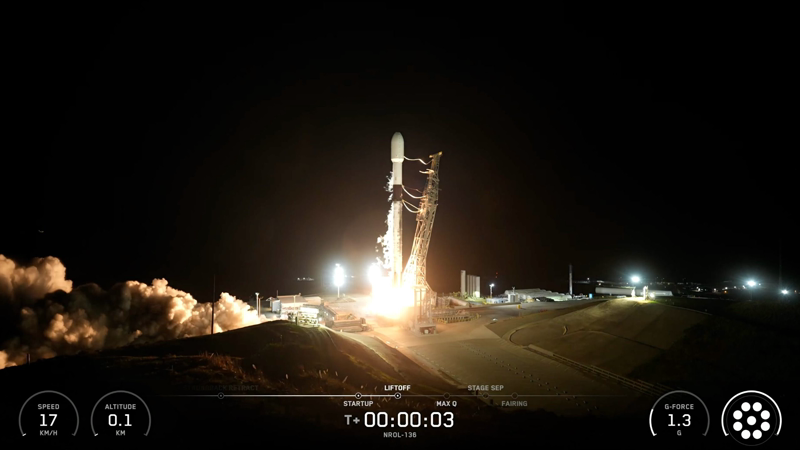
One pad in Santa Barbara County fired 64 Falcon 9s in 2025, and on the night of 20 November 2026 it did something it had never managed before: turn around in a day and a half. Two rockets left Space Launch Complex 4E at Vandenberg Space Force Base 32 hours and 3 minutes apart. The first was USSF-317, a classified Space Force mission. The second was NROL-136, a classified launch for the National Reconnaissance Office. Neither payload was described in public. According to SpaceX, the gap between them was both a company record and a world record for a launch-to-launch turn on a single pad.
The interval measures pad throughput rather than rocket speed, a distinction that is worth keeping straight. A vehicle that leaves the ground at 4:23 in the morning is largely a solved problem by the time it clears max Q. What decides how many missions fit into a year is how long the concrete, the ground systems and the range need to be made ready for the next one. Over 2025, SLC-4E flew 64 Falcon 9s, an average of one every 5.7 days, and the base launched 66 rockets in all, as TechTimes reports. A 32-hour turn is roughly four times faster than that average, and it was set on a night when both flights served the same customer. The margin was not marginal. Two records fell that morning: the previous turnaround at SLC-4E, set in June at 55 hours, 48 minutes and 21 seconds, and SpaceX’s record for any pad, the 45 hours between two back-to-back Starlink flights from Cape Canaveral in January. Spaceflight Now’s live coverage has both, and Next Spaceflight’s launch notes put the improvements at about 23 and 13 hours. The demand behind all of it is government constellation work, and both flights were part of it. NROL-136 was the fifteenth launch of the proliferated architecture the NRO began deploying in May 2024, satellites developed with SpaceX and Northrop Grumman and built to give the agency more frequent coverage of more places, as Space.com reports. It was the fourth of those launches in 2026 and the NRO’s sixth mission of the year overall, the one before it in October having flown on a Falcon Heavy, according to TechTimes. The emblem spells out the strategy in two words, Strength in Numbers, according to the NRO’s mission page. USSF-317, two days earlier, was the other kind of constellation job: after the flight the Space Force confirmed the payload belonged to the Space Data Network Backbone, a government-owned data transport system, and the Air Force said the development and launch of the Space Data Network Backbone was accelerating, with three successful launches in two weeks, according to Spaceflight Now’s live coverage. The regulatory groundwork had been laid too: in October 2025 the Department of the Air Force approved a rise in Falcon launches at SLC-4 and SLC-6 from 50 a year to 100, and the FAA issued its record of decision on that environmental review the same month, as the agency’s Falcon program page records.
The two flights were 32 hours apart and flew on two different Falcon 9 first stages. USSF-317 lifted off at 8:20 in the evening Pacific time on Friday, and its first stage came down on the droneship Of Course I Still Love You in the Pacific, per the mission page, on the eleventh flight of that booster, designated B1100. It was the 121st Falcon 9 of 2026, as Space.com records, and the stage touched down 8 minutes and 21 seconds after liftoff. NROL-136 followed at 4:23 the next morning, flying the booster B1097 on its 14th flight, and that booster came back to land on shore at Landing Zone 4 inside the base fenceline rather than on a ship, setting down 7 minutes and 37 seconds after liftoff. SpaceX’s vice president of launch, Kiko Dontchev, wrote that the new interval broke the company’s previous record of 45 hours from Pad 40 in Florida, and named the next target: a 24-hour turn. Next Spaceflight’s mission page puts NROL-136 at the 705th Falcon 9 flight and the 739th SpaceX launch, and notes that B1097 was coming back 66 days after its previous flight, on the company’s 697th recovery attempt.
The interval had little to do with Vandenberg learning to launch faster. Almost none of the 32 hours was spent with a rocket on the pad. Both mission pages carry the same countdown, and it puts the launch director’s clearance for propellant loading at 38 minutes before liftoff, with first stage RP-1 and liquid oxygen beginning at 35 minutes, second stage oxygen at 16 minutes and engine chill at 7 minutes. The vehicle is rolled from the integration hangar on a transporter-erector and brought to flight readiness somewhere other than the pad, which is the logic behind the ship-and-shoot approach the Falcon vehicle guide describes, as TechTimes explains. Nearly all of the elapsed time went elsewhere: to a booster being recovered and inspected, a payload being processed, and a range being re-cleared for a different trajectory and a different customer. The concrete itself is older than the company using it. SLC-4E was once called PALC2-4, and the NRO’s site history records Atlas and Titan rockets flying from it between 1963 and 2005.
The other half of the cycle is where the boosters end up, and that is where the two flights differ. USSF-317’s stage went to sea, where a droneship’s fastest turnaround on record is about five days. NROL-136’s stage came back to land at LZ-4, a pad SpaceX took over in 2015 and converted into a landing zone, first used for a booster recovery during the SAOCOM 1A mission in October 2018, as the base’s own release on that first attempt records. Launch and landing now share one stretch of coast, and the FAA still describes booster landings there under the old name. Of the 64 Falcon 9s that launched from SLC-4E during 2025, 56 first stages came down on ships and 8 returned to LZ-4, according to the Space Force’s annual monitoring report for the base, which NOAA Fisheries links as the second-year monitoring report.
The manifest shows what a faster pad cycle buys. SpaceX’s launch manifest lists USSF-266 from SLC-4E on 24 November and USSF-380 from the same pad on 28 November, so in the nine days from 20 to 28 November the pad flies four times, against an average of one every 5.7 days last year. The floor is set by something else. A 24-hour turn would mean the same pad flying twice inside a single day and night, and it would run into the constraint that no amount of pad work removes: a fleet of boosters that has to come back from the Pacific on a ship. The limit on how fast the national security space program can be supplied is no longer how quickly a Falcon can be built.
 Subscribe to our RSS feed









There are no comments.
Add A Comment