


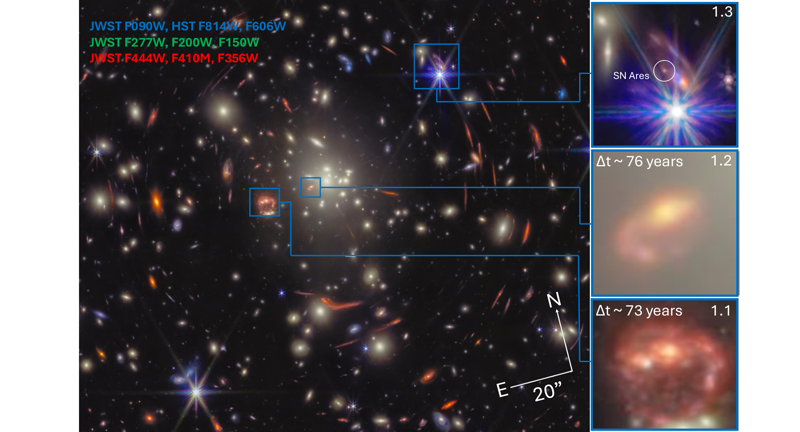
Figure 1 of the paper on arXiv, the cluster field and the three images of the host galaxy, under CC BY 4.0.
The faint smudge that turned up in a James Webb image of a galaxy cluster in August 2025 is only the first of three copies of the same event, and the other two are due to arrive in roughly seventy years. Astronomers have since measured its spectrum, worked out what kind of star died, and built three independent models of the cluster’s gravity that agree on when the next two images will show up. The prediction gives a floor rather than a date. Even the earliest model puts the second arrival at about seventy years out, which would make it the longest delay ever forecast for a lensed supernova. The number matters because it is a measurement of the universe’s expansion rate waiting to happen, if anyone is still around with a telescope big enough to catch it.
The mechanism is ordinary gravitational lensing, and a cluster beats a single galaxy on scale. A massive foreground cluster bends light from anything behind it so that several distorted, magnified images of the same source appear on the sky, each travelling a different route through the cluster’s field. The routes differ in length, so the images do not arrive together. The gap between arrival times, the time delay, depends on how the mass sits in the lens and on the geometry of the path. Since that same geometry sets the distance to the source, a well-measured delay measures distance, and distance pins down the expansion rate. The tension between expansion rates from the early universe and from nearby standard candles has stayed unresolved for years, and a delay measured to a fraction of a percent would be a clean, independent way in. Supernovae suit this better than quasars because a supernova has a predictable light curve with a sharp radioactive peak, making the moment of explosion easy to date. The VENUS team’s release from January frames the appeal plainly, with Seiji Fujimoto noting that strong lensing turns galaxy clusters into what he calls nature’s most powerful telescopes.
The discovery came out of VENUS, a JWST treasury programme imaging sixty rich galaxy clusters in deep exposures. The strategy is plain: point the most powerful telescope ever built at the busiest regions of the sky and let magnification do the rest. On 23 August 2025 the Near Infrared Camera imaged the field of the cluster MACS J0308.9+2645 in ten filters. Comparing those frames against template images taken before the explosion, the pipeline flagged a new point of light inside a large, actively star-forming galaxy behind a bright foreground star. That host appears three times in the field, the signature of a multiply imaged source. Difference imaging did the rest, and the preprint reports that Webb’s resolution keeps the foreground star’s glare from swamping the transient.
A month later the team received Director’s Discretionary Time, and on 23 September 2025 the Near Infrared Spectrograph took a spectrum through a single slit, 4012 seconds of exposure in prism mode. Redshift came out at 1.276, measured from the host galaxy’s own emission lines rather than from the supernova, and the light that produced it left the universe when it was about 4.9 billion years old, less than half its present age. The spectrum covers the rest-frame optical through the near infrared, and it shows helium clearly at 5876, 7065 and 10830 angstrom, alongside hydrogen alpha and Paschen beta. Helium together with hydrogen is the signature of a Type IIb: a massive star that shed nearly all its hydrogen envelope but kept a shell of it that burns and glows, with the helium underneath exposed. It is the highest-redshift supernova of that class ever classified from a spectrum.
The classification lets the team compare the observed brightness against the light curves of known Type IIb events and ask how long ago the star actually died. Fitting three local analogues, SN 1993J, SN 2011dh and SN 2011fu, and a population template built from the whole class, all land on a spectrum taken about a month after the light curve peaked, the population fit giving 34 days plus or minus 10. SN 1993J is the closest match, though Ares still differs, showing stronger hydrogen emission and a weaker calcium triplet, which the authors read as differences in envelope structure and mass. Correcting for the magnification of about five and a half, the inferred peak absolute magnitude comes out between minus 17.1 and minus 17.9, right inside the distribution of nearby Type IIb events rather than at its bright end. The star itself was unremarkable, and the cluster’s magnification is what made it detectable at all.
The hard part is the clock: getting the delay right means modelling the cluster’s mass distribution well enough to say which light path takes longer, and the team built three models with three different software packages, each fitted to dozens of multiply imaged background galaxies. The first, made with Lenstool, puts the magnification of the discovered image at 5.6 and predicts the second arrival in 70 years and the third in 73. The second, made with glafic, says 72 years and 77. The third, a parametric model built with AstroLensPy from JWST data, says 76.4 and 79.1. All three put the image already observed first, which the authors note follows from the geometry rather than from any particular model. The spread between the models is wider than the formal error bars on any one of them, so the delay is at least about seventy years rather than exactly seventy, with the best current expectation somewhere in the seventies. A change of three kilometres per second per megaparsec in the assumed expansion rate shifts the delays by roughly five years, so the cosmology used to calculate the delay is itself part of the error budget.
The number cannot yet be checked by anyone outside the collaboration, because the methods behind the three lens models are unpublished, and the authors expect it to move. Webb is scheduled to take multi-object spectroscopy of the cluster field in early 2027, supplying redshift measurements for more multiply imaged background sources and tightening the models. Catching the return needs a telescope nobody has built: the paper notes that even the Habitable Worlds Observatory, the next flagship concept, might need servicing in orbit to last long enough, and Phys.org’s write-up quotes the team calling this the most precise single-step measurement of cosmology currently on offer. For scale, the previous record belongs to SN Requiem, whose fourth image was forecast for 2037, about two decades after the first. Four lensed supernovae have already produced expansion-rate measurements, and they scatter from 65 to 76 kilometres per second per megaparsec, wide enough to straddle the current disagreement.
What the wait buys is time to study the physics. Fewer than ten strongly lensed supernovae have had their spectra taken at all, and Type IIb events are rare locally, around seven percent of Type II events, so a supernova this distant and this well characterised is worth having on its own. All three of the local analogues that fit Ares best are known to have binary progenitors, which leads the authors to suspect a multiple-star origin here too, though hydrogen from the host galaxy sits over the line that would measure the envelope mass. The companion supernova found by the same survey in another cluster, SN Athena, is due back in one or two years, and its reappearance will be the rehearsal: a shorter baseline and a chance to test the modelling before anyone commits seventy years of telescope time to the long one.
This post covers two supernovae in two clusters, and a number that will not be settled for a lifetime. The prediction is provisional, and better lens models will revise it. But the event itself is already unusual in a way unrelated to cosmology: a stripped-envelope star at redshift 1.276, caught by accident in a difference image, classified from its own spectrum, inside a host the universe has already handed us three times. The rest of it is patience.
 Subscribe to our RSS feed







There are no comments.
Add A Comment