


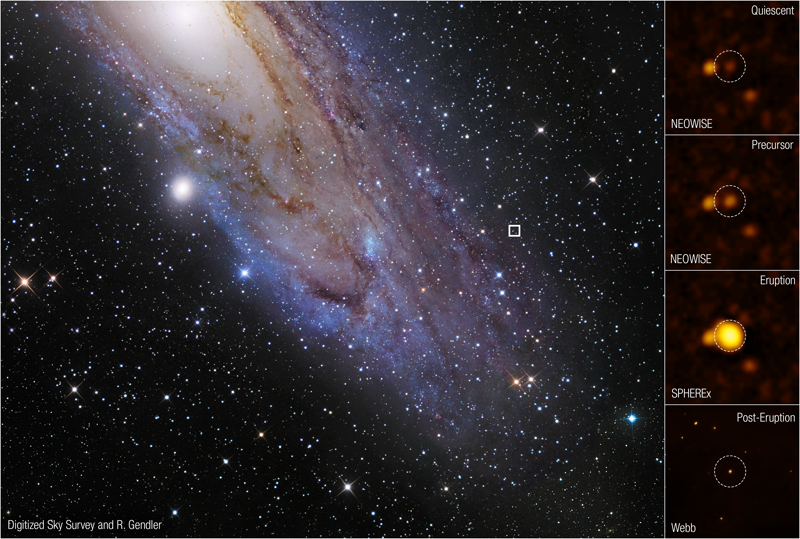
The same four phases of AT 2025abao as the telescopes saw them: NEOWISE in the quiet phase and again in the precursor phase, SPHEREx during the eruption, and Webb after the merger, over a Digitized Sky Survey view of Andromeda. Credit: NASA, ESA, CSA and STScI, with images by Viraj Karambelkar and Kishalay De of Columbia, processing by Alyssa Pagan at STScI, on a background by Robert Gendler. NASA asset page.
Somewhere about 2.5 million light-years from here, a star slightly less massive than the Sun spent seven years spiralling into a bloated supergiant and then became part of it. Astronomers watched the whole thing happen, which is unusual for anything involving stars. The system carries the catalogue name AT 2025abao. The team that studies it calls it Bao, and the two stars inside it Big Bao and Little Bao. What settled the case was the James Webb Space Telescope, which pointed at the target on 24 December 2025, 47 days after the eruption had already peaked, and spent three hours of Director’s Discretionary Time measuring the dust around it.
Spending three hours of the most expensive telescope in operation on a star merger in a neighbouring galaxy takes some explaining. It comes down to what common envelope evolution decides. When a small star orbits inside the outer layers of a large one, it drags gas along with it and bleeds orbital energy into friction. How much of that energy goes into unbinding the envelope, rather than merely heating it, decides the pair’s fate: either the two survive as a tight binary, or they spiral all the way in and merge. That efficiency is usually written as a single Greek letter, alpha, and until now it has been a number you feed into simulations and then argue about. Alpha matters because common envelope is the gate that every compact binary passes through on its way to becoming a neutron star pair, a black hole, a millisecond pulsar or a gravitational wave source.
Bao’s story starts in the infrared. In February 2023 the retired NEOWISE survey flagged an unusual variable star in M31, and cross-referencing other archives showed the object had sat at a steady luminosity from 1989 until it began to brighten in 2018. A September 2024 image from WINTER, the Wide-field Infrared Transient Explorer, showed it not only brightening but throwing off dust. The team’s earlier paper, published online on 28 October 2025 and titled as a possible onset of common envelope evolution in an asymptotic giant branch star, laid out the slow build-up of the same object under its WINTER survey designation WNTR23bzdiq. That build-up came in stages: a rise of 0.5 magnitudes in the optical from 2018 to 2021, a one-magnitude optical outburst lasting about a thousand days through 2021 and 2023, another one-magnitude brightening in 2024, and a steady one-magnitude climb in the mid-infrared across a decade of NEOWISE data. Archived optical observations from 2003 to 2015 showed nothing more than erratic wobbles below 0.3 magnitudes. Before any of it happened, the star looked like a cool, early-AGB object with an effective temperature near 3,500 K and a luminosity of roughly 1.6 times 10 to the 4 solar luminosities, consistent with a star of 7 plus or minus 2 solar masses. The paper compared the object to the giant star merger OGLE-2002-BLG-360 and flagged the timescales as the mismatch.
The event picked up speed in the second half of 2025. In July 2025 SPHEREx, on a routine survey, caught Bao fading quickly in visible light while rising in the infrared. On 17 October 2025 the Zwicky Transient Facility saw the eruption outright, watching the stars rapidly brighten and heat up. The Himalayan Chandra Telescope in India took visible-light spectra later that month, Swift delivered fast-turn ultraviolet data in November, and Gemini North on Mauna Kea watched in visible light from November through the following February. The brightness plateaued across November and December and then faded slowly back toward where it had started.
Webb’s mid-infrared view on 24 December was the piece that closed it. The data traced dust that the primary had been shedding over centuries, including the two months since the merger, and when the team matched that dust to the output of their updated simulations of the system, the model that fit was the one in which the two stars had actually merged. NASA’s release calls it the first time telescope data have been used to measure common envelope efficiency directly, and the timing of the follow-up was itself a record: 47 days after the peak of an eruption, the earliest catch yet of an event of this kind. Stellar mergers are famously hard to catch, and Viraj Karambelkar, the first author at Columbia University, said as much when he spoke to Phys.org: the team noticed something unusual in 2023, kept watching, and then in 2025 it erupted.
The picture the team put together is an extreme one. Before the eruption, Big Bao was around seven times the mass of the Sun, 350 times its radius and 18,000 times its luminosity, which is how it could drown a 0.7 solar mass companion without either star being torn apart. Little Bao was slightly less massive than the Sun, slightly smaller in radius and fainter. The friction during the inspiral was doing something specific: the drag was turning orbital energy into heat that radiated away rather than storing up in the gas, a phase that the Nature paper calls radiatively efficient and one that matches what models of convective transport in common envelopes predict. When the two finally met, the fall of a 0.7 solar mass star into the core of the giant powered the ejection of the outer tenth of the envelope at speeds about ten times the primary’s escape speed. That speed is the figure that matters, because comparing the energy that went into unbinding the envelope against the energy that went into overcoming the drag is exactly how you measure alpha. The team’s constraint puts it between 0.01 and 0.4. That is a wide range, and it is the first one anchored to an observed event rather than to a simulation.
Several things stay open. The mass of the merged star is not settled, since only future observations will show how its heft settles after the collision. The paper occupies pages 628 to 633 of Nature 659, and a good deal of the modelling rests on a single system that astronomers happened to be watching, which is a sample size of one in the strictest sense. The team itself is careful about the claim: one of the first direct observations of the energy that orbital friction dumps into a common envelope is not the same thing as a complete census of common envelope outcomes, and the efficiency range is a bound rather than a measurement of a single value. The author list runs to 45 names, a fair measure of how many instruments and archives had to line up for this to work.
What the case changes is the method. For most of the subject’s history, common envelope events have been reconstructed from the wreckage. You find a tight neutron star binary or a black hole with a suspiciously light companion and infer backwards what must have happened to their progenitor. Bao is the other way round. The team watched the slow brightening, caught the eruption, watched the aftermath and modelled the whole arc, so the constraint on alpha comes from the physics of an event rather than from a fossil. NASA is about to make this kind of event common rather than lucky. The Roman Space Telescope’s Galactic Bulge Time-Domain Survey is set to flood the discovery space with transients, and Karambelkar expects “a large influx of similar discoveries just ahead”. One event does not settle alpha, but it does make the next test possible.
 Subscribe to our RSS feed






There are no comments.
Add A Comment