


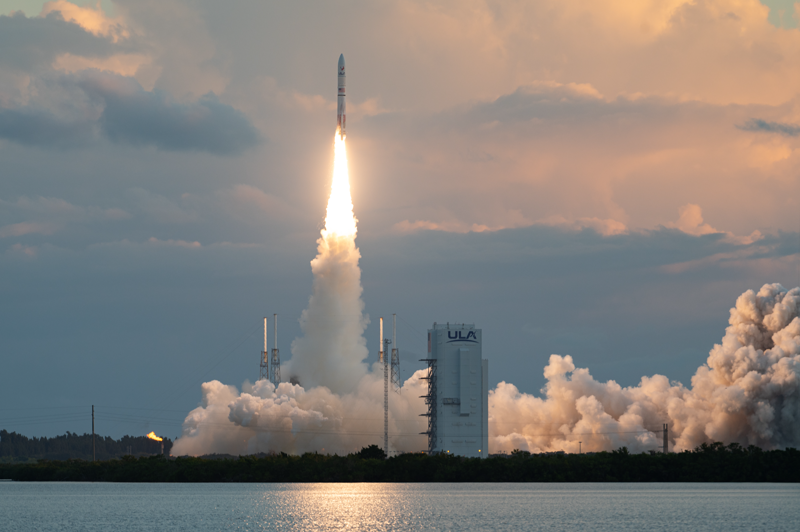
The Vulcan on its second certification flight, the flight that introduced the booster nozzle problem ULA spent nine months fixing.
The rocket looked right. That was the problem. On Sunday afternoon, at 12:40 p.m. Eastern time, a 214-foot Vulcan Centaur climbed away from Space Launch Complex 41 at Cape Canaveral on a north-easterly heading, throwing 3.8 million pounds of thrust and a column of orange flame over the treeline. Nothing about the first two minutes of the climb looked wrong. The six solid strap-on boosters from Northrop Grumman did their job, burning out and falling away about a minute and forty seconds after liftoff, and the two methane-burning BE-4 engines from Blue Origin kept pushing the core stage up through the thickening air. Then the flight telemetry began showing the hydrogen-fuelled Centaur upper stage correcting its attitude in ways nobody had planned. Ten minutes into the ascent, United Launch Alliance confirmed that the vehicle had suffered an anomaly and had failed to deliver its payload to orbit. The forty Amazon Leo satellites it carried went with it.
Sunday was not an easy day to get to the pad. A Friday attempt was scrubbed after a fault at a gaseous nitrogen plant knocked out a service used by several launch providers. Saturday slipped on network problems between the rocket and ground systems, and on Sunday morning controllers put the countdown on hold at twenty seconds to resolve an unexplained fault with the vehicle itself. ULA re-targeted the end of the launch window, fixed the problem and flew at the last minute. Nothing in the countdown pointed at what would happen next, and nobody yet knows whether the fault that stopped the countdown had any connection to the one that stopped the rocket. The failure was not really about the vehicle’s headline problem, and that is what makes it awkward for the company trying to prove it can compete with SpaceX. Vulcan had flown four times before Sunday and reached orbit every time. Two of those flights, the second in October 2024 and the fourth in February, ended with one of the solid boosters’ nozzles burning through and dropping away roughly thirty seconds after liftoff. Space.com described it as a problem serious enough for the U.S. Space Force to pause national security launches on the vehicle until ULA addressed it. ULA spent the following months chasing what chief executive Mark Peller called three credible causes for the nozzle damage, all of which he said had been mitigated through design and process changes. On Sunday the boosters behaved themselves. The failure came further up the stack, during the Centaur’s planned burn of twelve minutes and fifteen seconds. Wikipedia’s flight record for the vehicle now notes that the upper stage malfunctioned and the payload never reached orbit. The Centaur has been flying since the 1960s. Something about how it was being flown on Sunday broke it.
That matters more than one lost launch normally would. Sunday was not a routine mission. It was Leo Vulcan 1, the first time Amazon had put its constellation on ULA’s rocket, and it came at a moment when the other launchers on Amazon’s manifest were in no better shape. Amazon’s own mission tracker lays out the order and the vehicles: forty satellites on a Vulcan VC6L from Cape Canaveral on Sunday, thirty-six on an Ariane 6 from Kourou no earlier than 23 November, and twenty-nine more on an Atlas V in July, the last Amazon cargo flight that rocket will carry before its remaining vehicles are reserved for Starliner. The company has bought 38 Vulcan flights, 24 on New Glenn, 24 on Ariane 6 and 13 on Falcon 9 to build a constellation the FCC licensed at 3,236 satellites, and Amazon Leo has nearly 400 satellites in orbit after fourteen missions of a planned hundred or more. Forty of them were supposed to reach the same place on Sunday.
The New Glenn slot is the sharpest problem. Blue Origin’s rocket has flown three times, most recently in April 2026, and that last flight ended with an upper stage malfunction that left AST SpaceMobile’s BlueBird 7 in a lower-than-planned orbit, according to the vehicle’s flight record. Before that came a static fire test on 28 May, which tore a vehicle apart on the pad at Launch Complex 36 and wrecked the site, an explosion described at the time as one of the largest ever to happen on a launchpad. Blue Origin’s chief executive Dave Limp traced the cause to the main oxygen valve on one of the seven BE-4 first-stage engines. When he announced the finding he said hardware recovered from the pad had confirmed it. On 5 November he said the return to flight would slip to January 2027. The engines powering Sunday’s Vulcan were the same BE-4s, which makes the failure a curious one. ULA’s first stage flew on engines whose manufacturer had just lost a whole rocket to a valve defect, though Blue Origin had retrofitted a fix onto the engines installed for this mission, and ULA said the first stage ran long compared with the pre-launch timeline.
Amazon’s statement, released the same afternoon, was careful. There is risk with any launch, it said, and that is especially true for inaugural missions like LV-01. It added that ULA had been a trusted partner, and that Amazon believed the company would learn from the mission and deliver on its long-term plans for Vulcan. With 38 Vulcan flights still to fill, Amazon has every reason to mean it. But the arithmetic has tightened. ULA now faces a potentially significant grounding while engineers review telemetry, and with the New Glenn pad also out of action and the Atlas V’s remaining flights reserved for Starliner, the Ariane 6 is now the only vehicle on Amazon’s near-term manifest with a full slate of flights behind it. SpacePolicyOnline’s weekly summary called it the first total failure for ULA in the company’s history. The FCC had already waived the deadline for Amazon to reach half its constellation by July 2026, and it is now demoting the spectral priority of satellites launched after that milestone deadline unless the company speeds up.
What comes next is an investigation into a failure that happened in a sixty-year-old upper stage on a rocket that had spent nine months being patched up for an entirely different problem. ULA said it would work with Amazon and others to find the cause, determine corrective action and return to flight as quickly as possible, and that customers would have visibility into the process. NASA Administrator Jared Isaacman wrote that the agency was available to assist, adding that “Artemis, Moon Base, and the nation need ULA.” The Vulcan has flown five times now. Four of those ended with satellites in the right orbit. The fifth ended with forty of them on the way down and a customer with a hole in its deployment schedule where a constellation meant to compete with Starlink is supposed to be filling up.
 Subscribe to our RSS feed









There are no comments.
Add A Comment