


ESCAPADE fires engines at Earth to slingshot toward Mars
The visualization models how the magnetotail shifts over eight hours, with the cyan traces showing where the spacecraft were headed that March.
Two spacecraft the size of a refrigerator are about to do something no Mars-bound spacecraft has done before: fire their engines while diving past Earth, using the planet’s gravity at the same moment, to sling themselves toward the Red Planet. The first of the pair, named Blue, will make its closest approach to Earth and light its engine at around 5 a.m. EST on Saturday, November 7. Its twin, Gold, does the same thing two days later, around 6 a.m. EST on Monday, November 9, with each burn lasting roughly nine minutes. NASA’s announcement of the maneuver calls it a trans-Mars injection burn, and no Mars-bound spacecraft has ever executed a powered Earth flyby, or Oberth maneuver, before it.
The trick exists because of a calendar. Earth and Mars reach a favourable alignment for a fuel-efficient transfer only every 26 months, and for most of the history of Mars exploration that spacing has decided when missions could launch. ESCAPADE, a NASA and University of California, Berkeley mission in the agency’s small and cheap SIMPLEx programme, refused to wait. Its two spacecraft launched on November 13, 2025, when the two planets sat on opposite sides of the Sun and a direct transfer was expensive or impossible. Instead the pair curved out to the Earth-Sun L2 point, about a million miles away, and looped there in what NASA describes as a kidney-bean-shaped orbit for nearly a year, studying space weather while they waited for the planets to come round. When the geometry finally lined up, the spacecraft fell back toward Earth and met it at exactly the right moment. The route saves propellant. In the long run it may save whole missions from having to schedule themselves around a planetary clock.
There is a reason to burn at the closest point rather than earlier or later, and it comes down to arithmetic rather than bravado. Kinetic energy scales with the square of velocity, so a spacecraft moving twice as fast has four times the energy to give away. A burn applied at the bottom of a gravity well, where the vehicle is moving fastest, does far more work for the same propellant than the identical burn applied higher up where the speed is lower. The Oberth effect is named after Hermann Oberth, an Austro-Hungarian-born German physicist who described it in 1927, and it explains why the useful place to burn is the point of closest approach: the engine has the least time to act but the most energy to convert. ESCAPADE gets both effects at once. Earth’s gravity bends the trajectory toward Mars while the engine, firing at maximum speed, gets more out of every kilogram of propellant it spends.
Getting there took some doing. ESCAPADE began as a cheap ride-along on the Psyche asteroid mission, and the spacecraft were built on the Rocket Lab Explorer bus with a launch date set by somebody else’s manifest. When Psyche moved to a different rocket, ESCAPADE needed a launcher of its own, and the spacecraft grew from an original 90 kg design to about 200 kg dry mass each, with a launch weight of 535 kg per spacecraft. Blue Origin’s New Glenn won the launch contract in February 2023 for roughly $20 million, and the first attempt was scrubbed on November 9, 2025 because of cumulonimbus clouds in the launch area. A second attempt on November 12 was called off because of a solar storm. Launch finally happened at 3:55 p.m. EST on November 13, with the booster returning to its landing site.
On the science side, the pair carries a magnetometer, an electrostatic analyzer and a Langmuir probe for measuring plasma density and electron energy, plus a dual-wavelength camera that takes visible and infrared pictures of Mars at the same time. The instruments were built by teams at Berkeley, Embry-Riddle and Northern Arizona University, and the camera’s wide field is meant to catch Mars in a single frame from far enough out to watch the polar caps change with the seasons and to image the planet’s aurora. Both spacecraft are designed to fly as a pair, holding a separation of zero to 30 minutes along the same path so that scientists can tell whether a magnetic signal changed because the instrument moved or because the environment did. After the cruise they will reach Mars in September 2027, split into orbits with apoapsis values of 7,000 and 10,000 kilometres, and become the first multi-spacecraft mission to fly in formation around another planet.
The year at L2 produced work of its own. The spacecraft passed through a distant part of Earth’s magnetotail, the region stretched away from the planet by the solar wind, and no spacecraft had explored that part of the tail directly before. NASA says the instruments recorded activity and structure there that the team has not yet published, which amounts to a rehearsal for the plasma environment the pair will face around Mars.
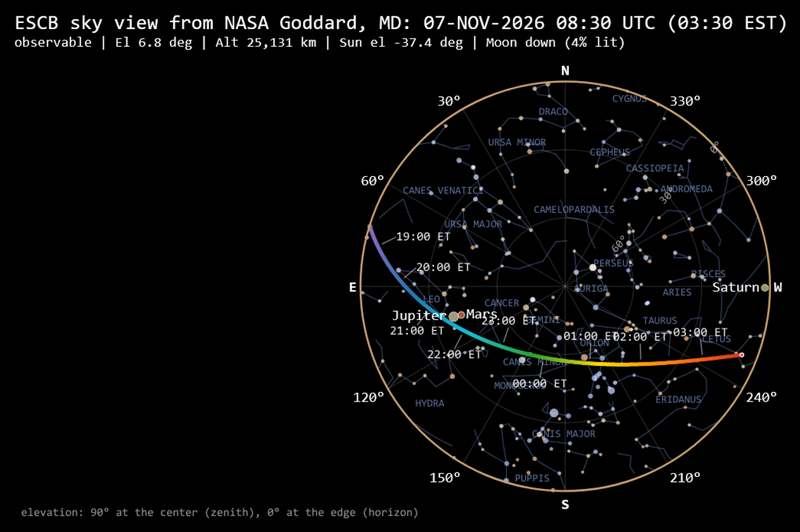
The flybys are also visible from the ground, if faintly. NASA says some observers may be able to pick the spacecraft out as dim points against the stars with a telescope. The best viewing is from the western United States, between midnight and 1 a.m. Pacific time on November 7 and between 1 and 2 a.m. on November 9, before each craft drops below the horizon to make its burn. The burns themselves happen over southern Australia at around 8:51 p.m. and 9:51 p.m. local time, and should be watchable with a telescope from there. NASA has published all-sky charts for several cities and points to the Jet Propulsion Laboratory’s Horizons system for coordinates.
What happens in the days after each burn will settle how much of this works. Within a few days the mission team will know how accurately the spacecraft are pointed, and a series of trajectory correction manoeuvres through the summer will trim the path to line up with Mars. The payoff arrives in September 2027, when the pair starts measuring how the solar wind strips gas off the Martian atmosphere, a question NASA’s MAVEN mission has been working on for more than a decade. The schedule is what changes. If a Mars mission can park at L2, sit out a bad alignment and leave on a powered flyby, then the 26-month cycle stops being a law of nature and becomes a budget question. The Planetary Society notes that SIMPLEx missions receive less than $80 million, against $583 million for MAVEN through its primary mission, and the whole ESCAPADE programme cost about $75 million including the launch. The failure mode is just as plain: if an engine does not light on the day, the next good window is two years away.
 Subscribe to our RSS feed









There are no comments.
Add A Comment