


Artemis I’s Lithium Fluoride Crystals Finally Read Lunar Radiation
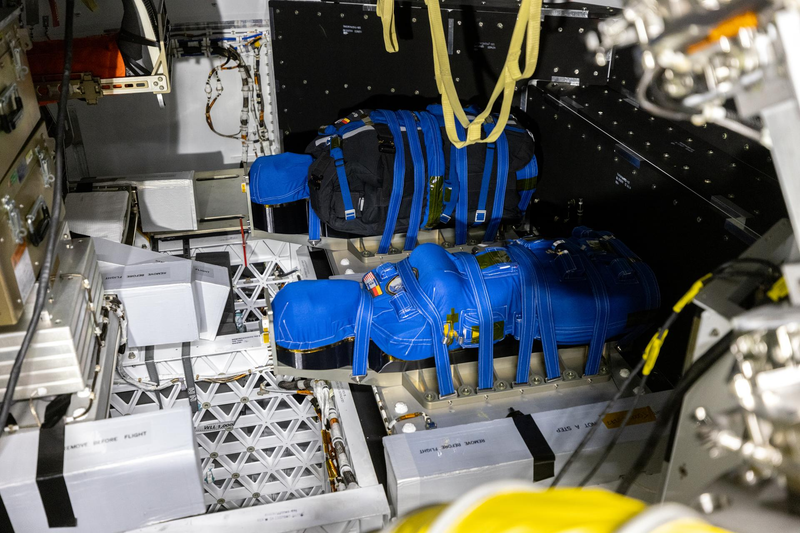
Two mannequin torsos were strapped into the passenger seats of an Orion spacecraft at Kennedy Space Center in Florida in August 2022, and for 25 days they flew out past the Moon and back. They had no skin, no blood and no nerves. What they carried was the densest survey ever flown of what ionizing radiation does to a human body outside low Earth orbit: thousands of detectors buried in slices of tissue-equivalent material built to mimic bone, organ and skin, plus more than ten thousand small crystals logging every particle that passed through them (IFJ PAN, October 2026). The flight ended in December 2022; the readout is still running. A paper in Radiation Measurements published this past September put the smallest of those crystals, chips of lithium fluoride a few millimetres across, to work on a question that sounds simple and is not: how much radiation does a person actually absorb near the Moon, compared with a person working a few hundred kilometres up over the equator? The Moon is the worse place, and by a smaller margin than intuition insists.
Three particle populations decide what a crew receives. Galactic cosmic rays are the steady background, mostly protons with a thin tail of heavy nuclei at energies past 10^20 eV. Solar energetic particles arrive in bursts after a flare, mostly protons in the tens of megahelectronvolt range. The Van Allen belts hold geomagnetically trapped protons that dominate the radiation budget in low Earth orbit, then vanish as soon as a spacecraft climbs out of them. The three behave very differently against shielding. A few centimetres of water knocks down most of a solar energetic particle and does nothing useful against a galactic cosmic ray, which carries enough energy to cross metres of metal, plastic and water while showering secondary particles.
The useful question is not how much radiation exists but how much a body in a specific place collects. Inside the space station, the earlier Matroshka experiment found the dose piled into shallow tissue near the surface, where low-energy trapped protons dumped their energy early (IFJ PAN, 2026). NASA caps an astronaut’s career effective dose from spaceflight at 600 mSv and selects crews so their lifetime risk of radiation-induced death stays low (NASA-STD-3001, Volume 1). Every millisievert on that ledger is an engineering problem paid for in kilograms.
Artemis I was the first chance to measure any of it with a body in the room. Orion launched on 16 November 2022, flew past the Moon on 21 November at 130 kilometres and again on 5 December at 128 kilometres, and splashed down off San Diego on 11 December (Nature, December 2024). The Matroshka AstroRad Radiation Experiment, led by the German Aerospace Center with NASA and the Israel Space Agency, carried two headless female phantoms built from 38 slices of tissue-equivalent material. Helga flew bare, Zohar wore a prototype vest called AstroRad, and both torsos held more than 12,000 detectors between them (ESA, August 2026).
The first results, published in Nature in 2024, showed how much the spacecraft shapes the environment: dose rates inside Orion varied by a factor of four between the most and least shielded positions, and rotating the capsule during the inner-belt pass halved the dose rate as the thick axis swung into the proton plane (Nature, December 2024). Total absorbed dose across the mission reached 13.47 mGy at the least shielded location, and the two belt crossings still contributed up to 23 percent of that. No solar particle event occurred during the flight, and the only other change was the Moon itself, whose bulk blocked about a third of the cosmic ray flux during the close passes.
Two papers this year fill in the rest. A Science Advances study in August modelled the August 1972 solar storm, which fell between the Apollo 16 and Apollo 17 missions, and found the AstroRad vest could cut effective dose by 58.2 percent, worth up to 193 days of deep space exposure (ESA, 2026). Then in September, Pawel Bilski and colleagues at the Institute of Nuclear Physics of the Polish Academy of Sciences reported the first quantitative use of fluorescent lithium fluoride track detectors from the lunar flyby (Bilski et al., 2026). The crystals are millimetre-scale chips grown by the Czochralski method, pulled slowly from a melt of purified lithium fluoride. Ionizing radiation leaves defects in the lattice that act as color centers, and under blue light those centers re-emit red fluorescence. Under a microscope, a heavy particle appears as a scratch in the crystal marking where energy was deposited.
Reading the pictures was easy. Extracting numbers was not, because cosmic rays arrive from every direction, so tracks wander out of the focal plane and blur into a background glow the camera collects with the sharp segment. Highly ionizing particles cut continuous lines, weakly ionizing ones leave dotted chains, and both change the fluorescence intensity that carries the ionization density. After corrections to subtract that background, the lithium fluoride results land within 15 percent of conventional etched track detectors across the overlapping energy range, and they pick up tracks below those detectors’ threshold (Bilski et al., 2026). The Krakow group also supplied nearly 600 thermoluminescent detectors, chips that store absorbed energy in the lattice and release it as light when heated.
The result underneath the instrument work is the headline: the dose inside the phantoms near the Moon came out essentially uniform, where the station data had been lumpy (Bilski et al., 2026). Trapped protons in low Earth orbit stop at different depths in a body, so they pile dose into the outer tissue. Galactic cosmic rays carry enough energy to cross a whole torso and deposit only a fraction of it along the way, so their dose spreads out almost evenly. The Van Allen contribution disappears near the Moon and the galactic contribution replacing it is larger, so the total goes up; the two effects partly cancel, and the margin is not the jump the geometry of the belts suggests. Dose equivalent still has to be computed with radiation weighting factors, H = sum_R w_R D_T,R, where protons count as one and alpha particles and heavy nuclei count as twenty, because heavy nuclei deliver a disproportionate share of biological damage per unit of absorbed dose (NASA-STD-3001, Volume 1). By that measure a crew on a lunar mission would spend a small fraction of a career’s allowance.
What the uniform dose map changes is design. If the dose is flat, shielding the skin buys little and every kilogram has to go somewhere with real mass: a storm shelter, a water-walled bunk or a berm of regolith on the surface. If the dose is lumpy, as it is in low Earth orbit, the same shelter can be tens of centimetres of structure parked behind the seats. The Moon is also a useful if temporary shield for the rest of the sky: during the Artemis I flybys it cut the cosmic ray dose by about a third simply by being in the way, one more argument for keeping habitats and crewed vehicles apart.
None of this replaces a crewed measurement. Artemis II carried four astronauts around the Moon in April 2026, the first people to leave low Earth orbit since Apollo 17 (NASA), and the missions behind it will wear the dosimeters these crystals have just calibrated. The value of the two papers this year is that they turn a vague dread into a number with an uncertainty attached, the only form in which radiation risk can be engineered against.
 Subscribe to our RSS feed









There are no comments.
Add A Comment