


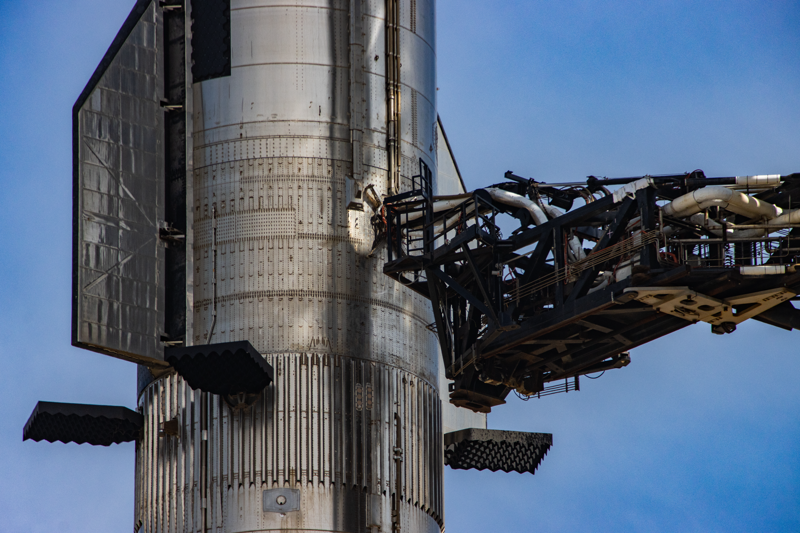
The quick disconnect arm is the fitting that practice refuelings are rehearsed with, the same class of hardware a fleet of V4 tankers would need on orbit.
Late on Friday night, Elon Musk posted a single sentence about the next version of Starship on X, and it was about how tempting it would be to fit a 500-ton-thrust Raptor 4 into the booster’s outer ring, replacing the Raptor 3 that sits there now. It came with no schedule and no commitment. Underneath that musing sits Starship’s next major upgrade. V4 is the version due to fly in 2027, and it is the version the Artemis IV architecture rests on, whether or not anyone at the agency has put it in those words.
The arithmetic behind that is not complicated. A crewed lunar landing needs a depot in low Earth orbit, and one recent model of that fill puts it at roughly 1,200 tonnes of propellant. Tankers have to supply it. At the 100 tonnes per tanker used in that model, that takes about twelve flights. Musk has been saying that six to eight will do, and the reason his number is smaller is that he is counting on a different rocket. Divide the same 1,200 tonnes by the 200 tonnes that a V4 tanker is projected to carry and you land on six, which is close to the figure he has been using. The lower manifest rests on a fleet of V4 ships and V4 boosters flying V4 Raptors, plus close to zero boiloff while the depot sits in orbit for weeks. NASA’s own safety advisory panel is working from 22 flights instead. That count is built on the capabilities of the rocket that exists today and on thin data about how fast cryogenic methane and oxygen leak away from an unshielded tank in sunlight. An analysis of the boiloff problem puts both numbers side by side. Both are in circulation, and the gap between them comes down to which of the two versions of Starship you are counting on.
Getting to V4 means getting through V3, which is where the programme stands. Flight 14 on September 28 was the first Starship to reach orbit, and it deployed 26 Starlink V3 satellites on the way up. It did not finish as planned. An early engine shutdown, which Musk attributed to a fault in the engines’ flight software, forced an early return, and both stages ended up in the ocean rather than on the tower. Flight 15, the next attempt, is the one the reuse case depends on, and SpaceX is targeting Friday November 13. Kiko Dontchev, the company’s vice president of launch, gave that date at the UP.Summit. That made it the first target to come straight from a SpaceX executive rather than from air traffic planning slides. The mission plan is a dual catch. The Super Heavy booster returns to the launch tower, as it has done three times already, and then the Ship comes home from orbital velocity and gets caught by the same arms, which has never been attempted. Booster 22 fired all 33 of its Raptors for a full-duration static fire on October 25. Ship 42 followed with a single-engine burn on October 26 and a 60-second firing of all six engines on October 27. The hardware is ready. The Federal Aviation Administration has not yet published a Flight 15 licence, and Gwynne Shotwell has said she expects it to cover a return to the launch site and tower catches for both stages. Teslarati has the details.
The vehicle on that pad is a V3, and the changes SpaceX described for V3 show how the company works from one version to the next. Propulsion was reworked around Raptor 3, a higher-flowing engine that now sits on both stages. The Ship carries new docking adapters, which are the fittings a future propellant transfer needs. The booster’s fuel transfer tube, the large metallic structure that runs cryogenic methane and liquid oxygen down to the engines, was redesigned. Super Heavy picked up an integrated hot stage, more vent area, and three grid fins in place of four, each half again as large and strong enough for lifting and catching the vehicle. V4 continues that logic rather than replacing it. Wikipedia’s Starship entry now lists Block 4 at an estimated 142 metres, or 466 feet, against 124.4 metres for Block 3, with payload to low Earth orbit of an estimated 200 tonnes against 100. Thirty-nine Raptors fly today, 33 on the booster and six on the Ship; V4 stretches the Ship and takes the count to 42, and is expected to debut in 2027.
The engine is where the performance comes from, and the Raptor line has bought thrust without buying mass at every step. Raptor 1 delivered 185 metric tons of thrust on an engine weighing about 2,080 kilograms. Raptor 2 raised that to 230 tons while cutting the mass to roughly 1,630 kilograms. Raptor 3 is flight-rated at 250 tons at sea level and 275 tons in vacuum, with the engine mass down to 1,525 kilograms and a stated target of 280 tons. The thrust-to-weight ratio of the family has climbed from 88.9 to 141.1 to 163.9. In late October Musk said Raptor 4 should reach 300 tons at sea level at roughly the mass of Raptor 3. Thirty-three engines at that rating would amount to about 9,900 tons of liftoff thrust, close to three times what the Saturn V produced from its five F-1 engines. Wikipedia tracks the engine’s history and Teslarati covers the Raptor 4 target. Sea-level thrust is the number that matters. The stack is heaviest and still deep in the gravity well at the moment it leaves the pad, where every extra second of climbing spends propellant against gravity rather than against orbit. The booster’s engine count is fixed by its 9-metre diameter and by how densely the engines pack around it, so thrust per engine is the cheapest way to raise liftoff performance without redesigning the booster. That is the logic behind the outer ring in Musk’s post. Whether a 500-ton engine ever reaches the pad is a separate question from the direction of travel.
What to watch is dated and physical. The first tells are the licence that authorises Flight 15 on November 13 and whether the Ship comes home from orbit and gets caught by the tower. The deeper tell is whether SpaceX can hold the Raptor 4 promise of 300 tons at Raptor 3’s mass, since every tanker flight saved in the Artemis manifest is paid for by engine performance. If the 500-ton outer-ring engine stays a musing, the six-flight manifest stays a target rather than a plan, and V4 still arrives as a 142-metre stack with 42 Raptors and roughly twice the payload of the vehicle flying today. The Flight 15 licence is still unpublished, and no Starship upper stage has ever been caught.
 Subscribe to our RSS feed









There are no comments.
Add A Comment