


Voyager 1 reaches one light-day from Earth on November 18
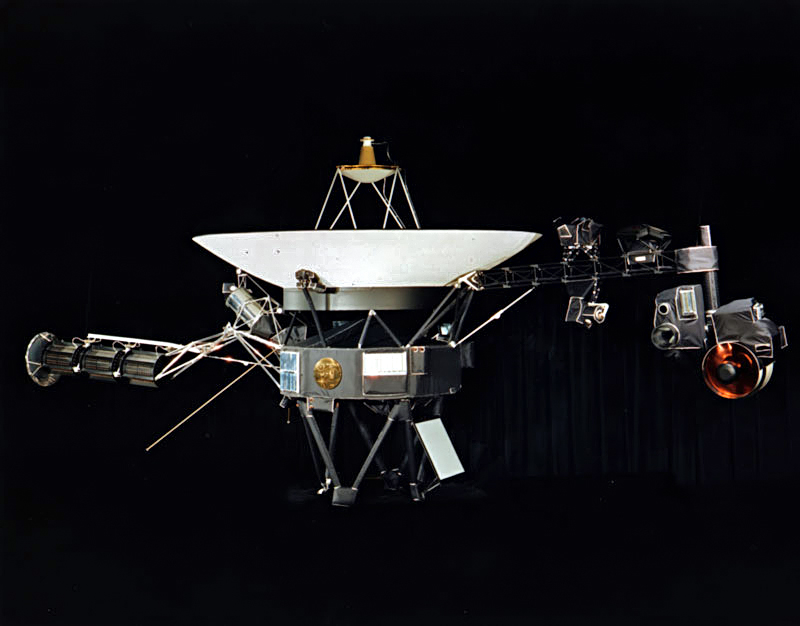
On 18 November 2026, at 2:16 in the morning Pacific time, Voyager 1 will cross a line in space that no human-made object has ever reached. The probe will be 16.094 billion miles (25.902 billion kilometers) from Earth, which is the distance light covers in a single day. Getting there took 49 years, two months and 11 days of flight for a probe that has cruised at nearly 38,000 mph (61,000 kph) since leaving Cape Canaveral on a Titan-Centaur rocket in September 1977. Nothing on board will react to it: no instrument fires, and the space on either side of the marker looks the same. The significance is arithmetic. After nearly half a century of flying away, the distance to home is large enough that a radio exchange takes a full day each way.
That is a strange condition for a machine to be in. Light travels about 186,000 miles every second, so once the marker is passed it crosses the gap between Earth and Voyager 1 in exactly 24 hours. A command sent then would take a day to arrive, and the reply another day to come home. Suzanne Dodd, the Voyager project manager at NASA’s Jet Propulsion Laboratory, put it plainly: you send your message and then “you go home and you wait two days” before an answer arrives. Two days is not much for a person waiting on a colleague. It is a long time for a spacecraft with a power supply running down and a radio that has to keep its dish on target.
The light-day is a useful unit for a reason that has nothing to do with poetry. Nothing outruns light, so it is the one ruler that never stretches as you take it to larger distances. The same logic that lets astronomers quote the Sun as 8 light-minutes away and Andromeda at about 2.5 million light-years also puts the Moon at 1.3 light-seconds from here. Neptune sits about four light-hours and 10 light-minutes off, and Voyager 2 needed 12 years to get there. The nearest star, Proxima Centauri, is 4.24 light-years away. Voyager 1’s new marker falls between those scales, and the number makes the solar system look small: a neighborhood whose nearest house is a four-and-a-quarter-year walk away.
The spacecraft that reached that marker was never meant to get there. It was built for a five-year job involving flybys of Jupiter and Saturn, and nobody involved had any idea how far it would eventually go. Voyager 1 launched on 5 September 1977 with ten science instruments and weighing 1,592 pounds (721.9 kg). Its power came from three radioisotope thermoelectric generators, which turned the heat of decaying plutonium into about 158 watts each at launch. It took the faster of the two routes, past the asteroid belt ahead of its twin, and overtook Voyager 2 on 15 December 1977. The alignment of the four outer planets that made the mission possible occurs only about every 175 years, and the two Voyagers together cost about $865 million including their nuclear batteries.
What it found along the way is a long list. At Jupiter it found a thin ring and two new moons, Thebe and Metis. At Saturn it added five moons and a new ring called the G-ring. Another discovery came out of an image nobody was looking for, taken for navigation rather than science: four days after the Jupiter encounter, project astronomer Linda Morabito processed a picture of Io and noticed something protruding from the limb of the moon. It was a volcanic plume, the first sign of active volcanism seen beyond Earth, and it changed what people expected from a world that had seemed dead. Later, the spacecraft turned its cameras back toward the planets for a family portrait taken from 40 AU, and the small pale speck of Earth in one of those frames became the Pale Blue Dot, a phrase that Voyager science team member Carl Sagan made famous.
In December 2004 Voyager 1 crossed the termination shock, where the solar wind still dominates, and in August 2012 it became the first spacecraft to pass the heliopause into interstellar space. By then it was still working, and it is now one of only two objects ever to have operated outside the heliosphere. The probe has been sending back data from a region no other human-made object has ever occupied, doing it with a shrinking tool kit.
The instruments have been switched off in a planned order for years, one at a time, as the plutonium decays. Of the ten instrument sets the spacecraft carried, seven have been shut down. The cosmic ray telescope stopped on 25 February 2025, and the Low-energy Charged Particles experiment, which had run almost without interruption since launch and measured the density structure of the space beyond our heliosphere, was switched off on 17 April 2026. What remains on Voyager 1 are the magnetometer and the plasma wave instrument. Voyager 2, which flew the longer path to Uranus and Neptune and has stayed closer to Earth as a result, still runs three.
In September 2026 the team pulled off a maneuver they call the Big Bang. Engineers switched off three powered devices on Voyager 1 in one step and swapped in three lower-power alternatives. All six exist to keep the spacecraft warm enough to operate in the cold. The swap had to happen all at once, because the heat the old units put out only balances if all three change together. Without it, the mission would have had to shut off another instrument as early as summer 2027. The same swap, run on Voyager 2 a few weeks earlier, gave the twin’s three instruments more time too.
The thin margin showed in October. On 18 and 19 October, NASA’s Deep Space Network could not detect Voyager 1’s signal during two scheduled communications attempts 24 hours apart, and the probe reappeared on the 20th. Engineers have so far traced the loss to a group of thrusters going offline with the backups switching on automatically, a protective response built into the spacecraft that puts it into a safe state when something looks wrong. Nothing on board was permanently broken, and the team has kept talking to the spacecraft since. But a half-century-old probe deciding on its own to go quiet for two days, then coming back, is what happens when the margins are this thin.
Science, meanwhile, has not stopped. A paper by Jeewoo Park of NASA’s Goddard Space Flight Center and colleagues, published this year in The Astrophysical Journal, reports what Voyager 1’s magnetometer has seen since a pressure front in 2020 pushed the surrounding magnetic field up. The strength of that field has stayed elevated instead of settling back down, holding between 0.45 and 0.53 nanotesla, while the field’s orientation has kept rotating toward the nominal Parker spiral, the pattern the Sun’s own rotation would produce. Intermittent, spiky behavior has generally been easing off, though it flared up again in 2023 and 2024 before settling. The authors’ conclusion is careful but pointed: after all these years the spacecraft has not yet reached a pristine interstellar medium free of the Sun’s influence, so the boundary where the solar system ends looks less like an edge than a transition.
The milestone on 18 November is mostly bookkeeping rather than a change in the sky. It marks the point at which the distance to the nearest star takes more than a single day’s worth of light to cross. Voyager 2 will get its own light-day in November 2035. Both probes keep climbing away from the Sun on the power their plutonium still gives them, carrying a gold-plated copper record with greetings in 55 languages, whale song and ninety minutes of music toward a star more than 17 light-years off, AC +79 3888 (Gliese 445), which Voyager 1 should pass within about 1.7 light-years of in some 40,000 years. Nobody will be around to watch that happen, and the disk will still be there, waiting for whoever does arrive.
 Subscribe to our RSS feed









There are no comments.
Add A Comment