


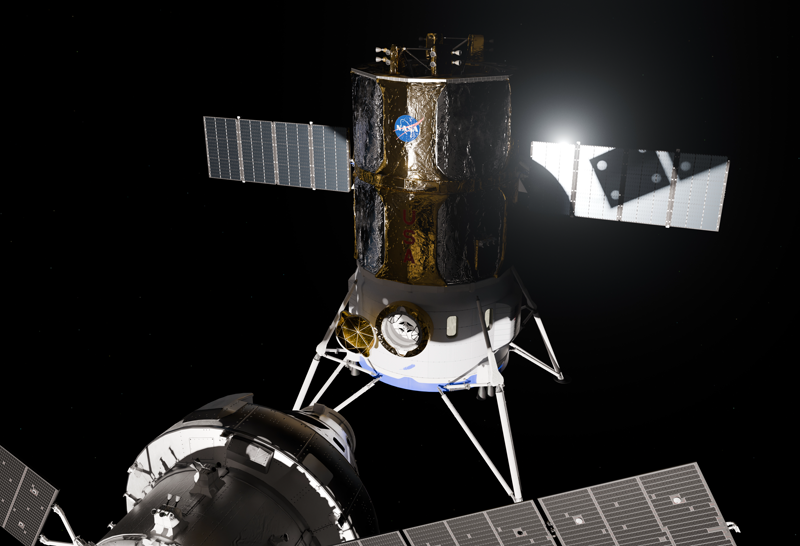
NASA’s Artemis III does not land anyone on the Moon. It flies to low Earth orbit, carries no lander that touches a surface, and is built around a docking test between two commercial spacecraft and a NASA capsule. Two engineers who work on NASA’s Human Landing System program explained what the test involves on the most recent episode of the Johnson Space Center’s Houston We Have a Podcast.
The guests are Kent Criswell, lead systems engineer for HLS at Blue Origin, and Reid Ruggles, lead systems engineer for HLS at SpaceX. They describe a mission built around a problem that looks easy on paper. Docking in low Earth orbit is solved, has been since Gemini and perfected by the Shuttle and the ISS. What has never been attempted is doing it with hardware that two different companies built separately, on a schedule that depends on a third rocket landing on time.
NASA’s own program page lays out the sequence step by step, and NASA’s Artemis III mission page repeats it in detail. Artemis III is a 14-day flight sending Randy Bresnik, Frank Rubio, Andre Douglas, and ESA astronaut Luca Parmitano up on SLS from Kennedy, with the crew launching only after a Blue Origin lander test article is already in orbit and has passed its checkout. That article goes into a circular orbit roughly 273 miles above the surface and can loiter there for up to 30 days, which is the schedule cushion the rest of the sequence depends on. Starship flies later, since it has a much shorter on-orbit lifetime, and settles into a lower orbit at 206 nautical miles chosen for its communications coverage. Orion itself flies a circular orbit throughout, and all three vehicles have more launch opportunities available than a lunar trip would allow, which is what makes the tight sequence workable.
Each lander gets different hardware and a different set of test objectives. The Blue Moon article carries the real crew cabin, the environmental control and life support system, and enough avionics and flight software that NASA’s page describes it as an early look at how a commercial lander behaves as an integrated vehicle in space. Up to two crew members in orange survival suits open the hatch and go inside to assess the cabin environment and the controls firsthand, spending roughly two days aboard. An instrumented spacesuit mass simulator stands in for a person and reports on conditions inside the cabin in real time, the same trick the agency used with the suited Moonikin on Artemis I. SpaceX’s version is thinner, and the details are harder to come by. The Starship Version 3 article flies without a crew cabin and nobody goes inside it, and the demonstration runs up to two hours. For that leg, what matters is where the docking hardware sits and who flies the stack. Orion connects to Blue Moon along the side of the vehicle, next to the crew cabin, and Orion’s software controls the joined stack once the two are mated. Later, Orion aligns nose to nose with the Starship article, and the SpaceX test article takes over control of the stack. The mission covers two docking geometries, and two different companies hold the controls.
Ruggles describes what low Earth orbit does to Orion that deep space does not. In orbit, a spacecraft moving from full sun into Earth’s shadow can swing from hundreds of degrees Fahrenheit to something near freezing inside forty-five minutes, and metal in a docking mechanism expands and contracts with that cycle, changing the hardware that has to mate. Orion’s thermal control system was built for deep space, and low Earth orbit is not that. Light bouncing off Earth is a steady heat input that a lunar polar orbit does not deliver in the same way, since the Moon’s surface is far less reflective. Getting Orion into the shadow of a lander also breaks the tail-to-sun attitude that keeps the capsule thermally stable, a constraint that did not exist in the mission designs the capsule was originally drawn for.
There is also an optical problem. Ruggles notes that Orion has to acquire its target visually, and that the target’s surface finish changes how it looks. Bare stainless steel reflects differently from a vehicle painted in AZ-93 white, the standard space paint used across the industry, and the acquisition software has to cope with both. He also raises the case of Orion’s own thrusters firing close to a station-keeping lander, a plume impingement problem that cannot be replicated on the ground, because ground tests do not run one spacecraft’s thrusters against another parked vehicle.
The rehearsal stops short of the landing. Both engineers are clear that the real risk sits in the landing itself, where the exhaust plume interacts with the regolith and the vehicle has to find a safe spot among craters, hills, and boulders tens of feet tall. Ruggles calls the uncrewed demonstration mission the linchpin, because it is the first time either company will show that its lander can reach the Moon, land, stay, and lift off again. Criswell, describing Blue Origin’s Mark 1 robotic south pole landing, notes that the uncrewed demonstration comes after Artemis III and that Blue Origin chose to exceed the contract by flying the uncrewed mission for the same duration as the crewed one and ascending back off the surface. NASA built the HLS contracts in the order that worked for the ISS, where an uncrewed demonstration comes before the crewed one, and both companies say they have already qualified their docking hardware on the ground, with SpaceX doing so in 2023 and Blue Origin running pressurized docking tests earlier this year. What remains untested in Earth orbit is the thermal environment a real lunar descent brings, where the sun angle is low, the surface is cold and dark, and the landing plume has to be contained by an engine that has not yet flown.
Both engineers make the same point. Ruggles argues that Apollo succeeded because the program climbed from Mercury to Gemini to Apollo, letting hardware and crews build up in steps, and notes that the agency has not attempted deep space missions in a long time. Criswell puts it more bluntly, pointing out that one company doing something does not mean everyone can. NASA supports the providers with collaboration work worth roughly 80 person-years each, shared through thermal analysis of cryogenic boil-off, landing site selection standards, and propulsion rules written over six decades of agency experience. Artemis III puts two commercial landers, one NASA capsule, and three separate launch campaigns on one timeline, and works through the docking in low Earth orbit before anyone rides a lander down to the south pole.
Artist’s concept of Blue Origin’s Blue Moon Mark 2 test article docked with Orion in Earth orbit. Credit: NASA, from NASA’s Human Landing System program page.
 Subscribe to our RSS feed









There are no comments.
Add A Comment