


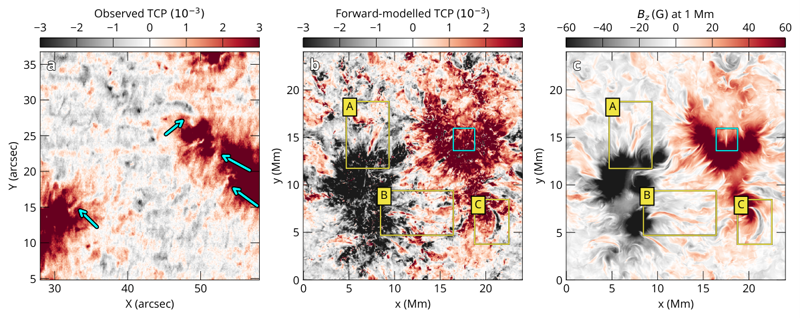
Figure adapted from Ondratschek et al. 2026 (arXiv 2609.20933), reused under CC BY-SA 4.0.
Most of the Sun is uneventful, and that is exactly the problem. Sunspots get the headlines, flares get the coverage, and the rest of the surface, the part astronomers call the quiet Sun, gets treated as background scenery. Yet a magnetic field still threads every one of those quiet patches, and it has to carry energy upward into a corona that reaches temperatures above a million kelvin. A balloon-borne telescope that spent six and a half days above the Arctic Circle in July 2024 has now delivered the sharpest look yet at what that field is doing in the places nobody was looking. Three papers published this summer describe a magnetic canopy over a quiet region that is nothing like the simple expanding arch that textbook models have assumed for decades. The canopy turns out to be full of narrow threads, some of them running against the grain of the surrounding field, and a companion simulation says those threads are twisted ropes of magnetic flux, the same kind of structure that powers flares.
Why the quiet Sun earns this much attention comes down to area and plumbing. Quiet-Sun regions cover most of the solar disk, so whatever they do, they do almost everywhere. Their magnetic fields are weak, an order of magnitude below the values in active regions, which is why ground-based telescopes struggle to measure them: atmospheric turbulence blurs exactly the fine structure that matters. The chromosphere, the thin atmospheric layer sitting on the visible surface, is also where the Sun’s energy problem lives. Something has to move energy from a surface too cool to power the corona into a corona with temperatures above a million kelvin, and the candidate answers all involve magnetic fields that are far more tangled than a smooth model would suggest. Spicules, the narrow jets that shoot up from the surface, have been promoted in recent years as the main carriers of mass and energy into the upper atmosphere, yet their magnetic field strength has never been pinned down with confidence. As Universe Today notes in its coverage of the papers, the true strength inside those jets had resisted measurement. If the quiet Sun turns out to be full of twisted flux ropes, then the same structures that set off flares in active regions are threaded through places the Sun barely seems to be doing anything at all.
The instrument that cracked this open was built by people who wanted a telescope with a mirror no space agency was likely to fund. Sunrise III is a one-metre solar telescope hung under a helium balloon that floated at roughly 35 kilometres, above nearly all the air that distorts solar observations from the ground. It lifted off from the Esrange Space Center near Kiruna in Sweden on 10 July 2024 at 6:24 in the morning CEST, after several weather delays, and over the next six and a half days it tracked westward along the Arctic Circle and across the Atlantic while the Sun never set (Max Planck Society launch release). The observatory weighed about three and a half tonnes, the balloon expanded to around 130 metres across, and the instruments aboard returned roughly 200 terabytes of data, enough to resolve structures as small as 50 kilometres on the solar surface (NAOJ on the first images). Four space probes and ten ground telescopes watched the Sun at the same time as part of a coordinated campaign. The payload was an international suite, including SCIP, the Sunrise Chromospheric Infrared spectroPolarimeter, a near-infrared instrument built and led by Japan’s National Astronomical Observatory of Japan, which measures the full polarization state of several spectral lines at once and can follow the magnetic field continuously from the photosphere up through the chromosphere (NAOJ release on the results).
Three papers from that flight appeared in the Astrophysical Journal Letters over the summer, released together by NAOJ and the National Institute for Natural Sciences, with Masahito Kubo of the NAOJ SOLAR-C project, Yoshihiro Naito of the Graduate University for Advanced Studies, and Yukio Katsukawa of the NAOJ solar science observatory named as the contact authors. Kubo and colleagues report on a quiet region near disk centre, mapped in a single uninterrupted scan of 107 minutes with a field of view 58 arcseconds on a side and a polarimetric precision of three to four hundredths of a percent of the continuum (Kubo et al. 2026). Their maps show elongated thread-like magnetic structures above the internetwork, the darker lanes between the bright network lanes, and no obvious counterpart directly below them in the photosphere. The threads are narrower than an arcsecond, which on the Sun is a distance of roughly 700 kilometres, and their line-of-sight field strength under the weak-field approximation comes out 10 to 20 gauss weaker than the canopy around them. In the clearest cases the polarity of a thread is the opposite of the canopy it sits inside.
The other two papers deal with the rest of the puzzle. Ondratschek and colleagues, working with a chromospheric extension of the MURaM magnetohydrodynamic model built at the Max Planck Institute for Solar System Research, fed the observed magnetic map into a three-dimensional radiative simulation and reproduced the fine structure in the synthetic polarization signal (Ondratschek et al. 2026). In the model, the opposite-polarity features appear about a megametre above the surface, running for two to seven megametres with widths near one megametre, and they belong to twisted flux ropes that persist through most of a 21-minute sequence. Naito and colleagues looked instead at the solar limb, where off-limb spicules can be seen against the sky, and measured their fields directly (Naito et al. 2026). Their line-of-sight values reach 20 gauss and stay roughly constant over the first three arcseconds above the limb, then spread out to about 40 gauss between three and six arcseconds, and the way the line profiles change shape with height says the wider number is really a statement about how deeply the line-forming layer can see into a forest of overlapping spicules rather than a measure of any one jet.
The measurement behind all of this is old physics applied with new precision. A magnetic field splits the wavelengths of a spectral line into components, and the polarization of those components, described by the four Stokes parameters, encodes the field’s strength and direction. Because Ca II 854.2 nanometre light forms in the chromosphere and Fe I 846.8 nanometre light forms in the photosphere, observing at both wavelengths shows how the field changes with height. What a balloon buys is the freedom to do that without the atmosphere smearing the finest structures, and the numbers reflect it: a ten-second dwell at each slit position and a polarimetric noise floor of a few hundredths of a percent is enough stability to invert a single line for a magnetic field and trust the result. The MURaM-ChE model then handles interpretation, taking a three-dimensional field configuration, computing what an observer would actually measure, and matching that synthetic signal against the real one.
What the three papers together say is that the Sun’s least active regions are not simple. The magnetic field above them is organized into tight, twisted substructures that can carry the opposite polarity to their surroundings, embedded in the apparently ordered canopy that springs from the network. That has a direct consequence for solar physics beyond the quiet Sun, because twisted flux ropes are the structures that reconnect and release energy, and they are usually associated with flares in active regions. Finding them in the quiet Sun suggests the inventory of twisted field on the disk is much larger than anyone assumed, and that small-scale reconnection may be an ordinary part of the quiet atmosphere rather than an exceptional event. The instruments also have limits worth naming: six and a half days is a short window, the balloon could observe only a narrow band of wavelengths compared with a space telescope, and one field of view cannot map the whole Sun. Still, the data volume will keep feeding the community for years, and the next step is a dedicated space observatory built for the same job, SOLAR-C, which NAOJ already runs as a project and which can watch the same tangled field for months instead of days.
 Subscribe to our RSS feed









There are no comments.
Add A Comment