


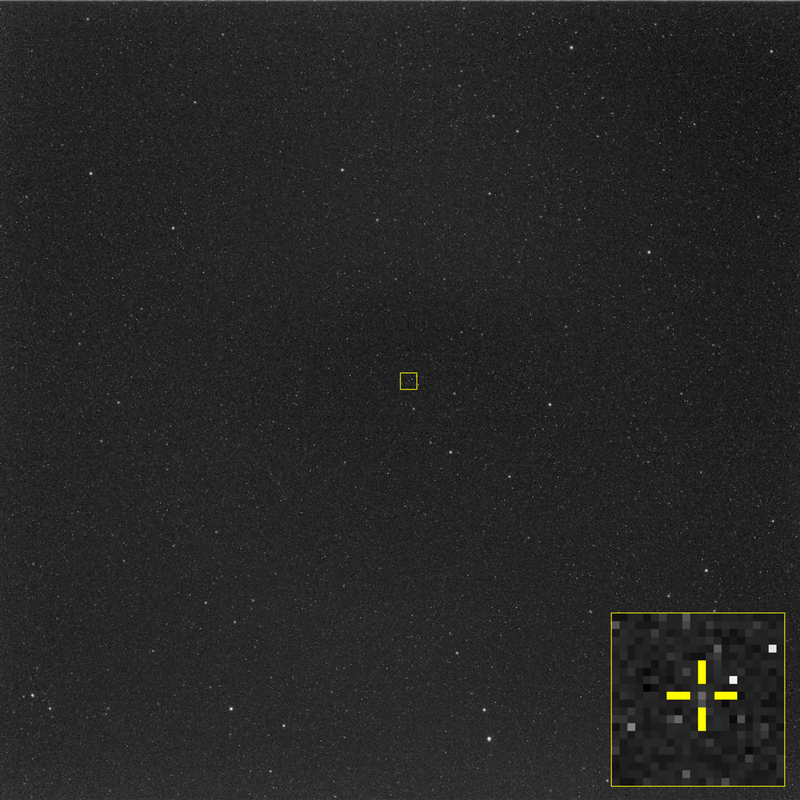
Two years after it left Cape Canaveral on a Falcon 9, the European Space Agency’s Hera spacecraft turned its main science camera toward the place it has been chasing across the inner solar system and saw, for the first time, what it came to see. Didymos appeared as a single bright pixel in a 1020-by-1020 image, surrounded by background stars that the camera was tracking to subtract out. The asteroid was 236,500 kilometers away at the time, far enough that the image looked almost like a software test pattern. The date was 7 October 2026, exactly two years after launch. The first braking maneuver, BRM-1, is scheduled for 15 October 2026, the mission’s 12 km/s relative velocity has been bleeding away in tiny burns, and full arrival at the binary system is planned for next month, almost a month earlier than the original timeline. The image, published by ESA in early October 2026, is the first resolved optical sighting of the asteroid whose small moonlet Dimorphos NASA hit with the DART impactor four years ago, and it is the start of the science campaign the whole mission was built around, covered in a fresh Universe Today feature by David Dickinson and in ESA’s own early-arrival announcement.
The reason Hera is going to Didymos is the question DART left open. In September 2022, NASA crashed a refrigerator-sized kinetic impactor into Dimorphos at roughly 6.6 kilometers per second, in the first deliberate attempt by any space agency to change the trajectory of a celestial body. The impact shortened Dimorphos’s 11 hour 55 minute orbit around its parent by about 32 minutes, a much larger change than the pre-impact models had predicted. The extras came from ejecta, the spray of rock and dust thrown off the surface at the moment of contact, which acted like an unpropelled rocket exhaust pushing the moonlet the other way. The pre-impact momentum budget was therefore incomplete, and the right number to plug into a future deflection plan depends on details that ground-based telescopes could not measure: the mass of Dimorphos before the hit, the size and depth of the crater DART carved, the porosity of the surface, the density of the interior. Hera’s job is to measure all of these, with enough precision that the next time the world considers deflecting a real asteroid, the engineers will know what the impact will do.
Hera almost did not happen. The original plan, in the early 2010s, was a joint ESA-NASA mission called AIDA, in which NASA would supply DART and ESA would supply an orbiter called AIM that would arrive at Didymos first and watch the impact happen in real time. ESA cancelled AIM in 2016 because the agency’s member states would not underwrite the cost, and for several years the only follow-up to DART was a network of ground-based observatories that the LICIACube flyby camera and Hubble time had to substitute for. ESA’s member states eventually funded a stripped-down replacement called Hera in 2019, and the agency awarded the prime contract to OHB in Bremen, with a launch contract to SpaceX. The spacecraft left Earth on 7 October 2024 from Cape Canaveral’s SLC-40, riding a Falcon 9 first stage, booster B1061-23, that had already flown 22 missions and was expended to give Hera enough energy for a direct transfer, as documented in the mission’s Wikipedia timeline.
The cruise was longer than a Mars transfer and shorter than a trip to a comet. Hera flew by Mars on 12 March 2025, using the planet’s gravity to bend its trajectory and align it for the Didymos encounter, and took the opportunity to image the smaller Martian moon Deimos from a few hundred to a thousand kilometers away, the closest observations of that body since Viking 2 in 1977. Those images later fed a Nature Astronomy study in 2026 arguing that Deimos is a rubble-pile body reshaped by an oblique impact of a 320-meter asteroid, useful as a sanity check on the radar instruments aboard the Juventas CubeSat. Through 2025 and the first half of 2026, the spacecraft’s flight dynamics team used Hera’s Asteroid Framing Camera, a pair of baffle-protected 1020-by-1020 monochrome sensors built by Jena-Optronik in Germany, to practice the eventual arrival on two main-belt asteroids, Otero and Kellyday, that happened to be near the spacecraft’s line of travel. Tracking Otero for three hours and the much fainter Kellyday in July 2025 taught the team how to keep a tiny, slowly-moving point of light centered in a camera designed to image objects thousands of times closer, in the camera test ESA reported in August 2025. In October 2025, with the cruise going smoothly, ESA announced that the arrival had been pulled forward by a month. In March 2026, Hera performed its largest single deep-space maneuver, burning 123 kilograms of hydrazine for a 367 m/s change in velocity. In June and July 2026 the flight software was upgraded, the asteroid phase began.
The arrival sequence itself starts with the first pixel and ends with a network of small spacecraft hovering above a pair of dark, fast-spinning rocks. On 2 October 2026, controllers executed a short test burn to verify the braking configuration. BRM-1, the first real braking maneuver, is set for 15 October 2026, two days after the publication of this post, and a series of further burns will put Hera into orbit around Didymos. From orbit, the spacecraft will map both bodies in detail. The Asteroid Framing Camera, working alongside the Thermal Infra-Red Imager TIRI and the Planetary Altimeter PALT, will return global shape models of Didymos at a few-meter resolution and a 10-centimeter view of the DART impact site, the first close-up of the crater NASA made. The HyperScout-H visible and near-infrared mapper will look for compositional fingerprints across the surface. A Radio Science Experiment will track Hera’s orbit closely enough to pin down the gravity field of the binary, which is the cleanest way to get the mass of Dimorphos and therefore the cleanest measurement of the momentum DART actually transferred.
The CubeSats will do the part of the science Hera cannot do from a safe orbit. Juventas, built by GomSpace in Luxembourg, carries a low-frequency radar called JuRa, a laser altimeter, and a gravimeter, the first radar sounder ever aimed at an asteroid’s interior, and the data it returns will tell the team whether Dimorphos is a uniform rubble pile, a fractured monolith, or a coherent body with a deep layer of regolith over a denser core. If conditions allow, Juventas will also touch down on the surface and use its accelerometers to measure the mechanical response of the regolith, the first in-situ measurement of asteroid surface stiffness. Milani, built by Tyvak International in Italy, is a hyperspectral imager that will survey the surface mineralogy of both bodies and characterize the dust around the binary. Both CubeSats will be released after Hera is in a stable orbit and will operate on their own for a few months before their trajectories carry them away. Once the science is done, the plan is to repurpose the mission as a software laboratory for autonomous deep-space operations, running new code on the spare core of the spacecraft’s LEON3 processor and using the binary system as a long-duration test bench.
The reason the planetary defense community is watching this closely is that the DART impact was a real-world test of a method that only existed in textbooks before 2022, and the textbooks are being rewritten. If Hera measures a momentum transfer close to the simple mass-times-velocity prediction, the kinetic-impactor method works about as well as the engineers hoped, and a future asteroid on an Earth-crossing orbit could be pushed off course with a single heavy spacecraft launched a few years in advance. If the momentum transfer is much larger, the ejecta boost is doing more of the work than the impactor itself, and the design of a real deflection mission should emphasize surface coupling rather than impactor mass. The point of Hera is to give the answer in numbers that can be written into a flight plan. Didymos, a 780-meter rock discovered by the Spacewatch survey in 1996 with a 151-meter moonlet found seven years later, is the laboratory. The first photograph of it from the spacecraft built to study it is, on its own, just a single bright pixel. The work begins now.
 Subscribe to our RSS feed









There are no comments.
Add A Comment