


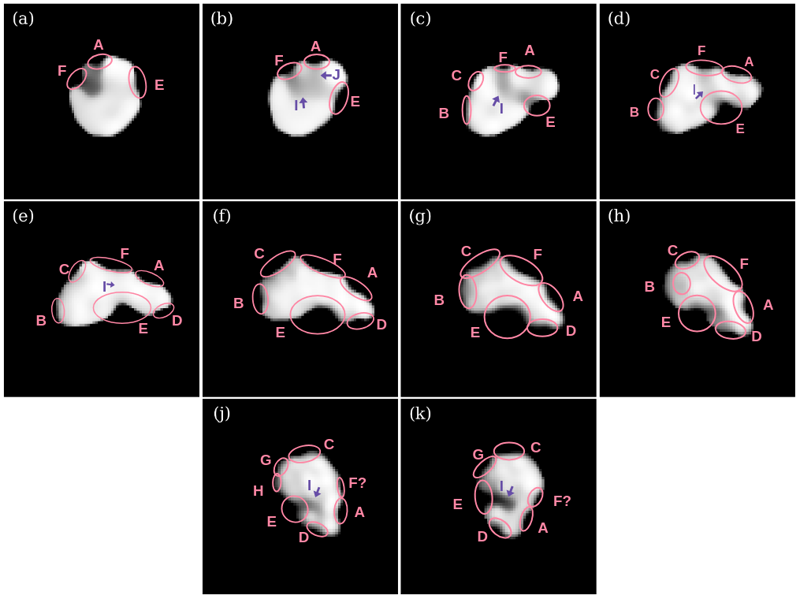
For most of its 6.42-hour rotation, asteroid 44 Nysa is just a bright point in a telescope image. On the best nights, though, that point opens into something much stranger: a broad primary body with deep, wraparound valleys and a faint speck moving nearby. The new observations do not show a tidy, single rock. They suggest that Nysa may be a contact trinary, three pieces that came together slowly enough to remain joined, with a small moon circling the outside.
That conclusion is still provisional. The paper is a preprint, and the authors leave room for a different answer: Nysa could be one unusually strong, heavily fractured body whose surface only looks divided into lobes. Either way, the result is a reminder that many asteroids are known from their changing brightness long before their actual shapes can be resolved. In Nysa’s case, a century of indirect clues has finally been paired with images sharp enough to test them.
Figure adapted from Minker et al., “Unmasking (44) Nysa: Evidence for a trilobate structure”, used under the arXiv-hosted CC BY-NC-ND 4.0 license; labels and layout are unchanged.
Asteroids are fragments, but “fragment” does not mean simple. Their shapes retain evidence of collisions, gravitational settling, rotation, and the weak forces that bind rubble together. A contact binary, such as the two-lobed objects visited by spacecraft, can form when separate bodies collide at low speed and stay together. A three-lobed contact object would add another step to that history. It would give researchers a particularly clear test of whether several pieces can remain attached through later impacts and through the long-term stresses of rotation.
Nysa is also useful because its composition is unusual. It is one of the larger E-type asteroids, a rare group associated with enstatite-rich meteorites. Those meteorites resemble material thought to have formed in the hot inner part of the young solar system. The link is not a direct sample return, and the authors are careful about what can be inferred from a spectrum, but the object offers a chance to connect surface chemistry with internal structure. If its three lobes came from one parent body, their similar appearance may preserve a record of how that parent was broken and reassembled.
The moon matters for a more practical reason: its orbit can eventually provide Nysa’s mass. Shape and brightness alone leave density uncertain. A measured mass combined with the paper’s size estimate would help distinguish a coherent, dense object from a looser aggregate of fragments. That number could turn an intriguing silhouette into a physical model.
Nysa has been observed for more than a century. Earlier work used light curves, stellar occultations, radar, and the Hubble Space Telescope’s Fine Guidance Sensor to look for clues about its form. Those methods pointed toward an elongated body, perhaps with a large companion or a pronounced concavity, but they could not settle the question. A spinning asteroid changes brightness as different faces rotate into view; converting that change into a three-dimensional shape is useful, but several shapes can produce similar light curves.
The new campaign attacked the problem directly. The team led by Kate Minker of Lowell Observatory observed Nysa with SHARK-VIS on the Large Binocular Telescope on February 15 and March 21, 2026. They also used SPHERE/ZIMPOL on the European Southern Observatory’s Very Large Telescope during ten observing epochs between March 9 and April 5. The instruments work at visible wavelengths, where the asteroid is bright, and combine high-speed imaging with adaptive optics to correct for turbulence in Earth’s atmosphere. The Lowell Observatory release and the study describe these as the highest-resolution images yet obtained of Nysa. (Lowell Observatory research release)
The images show two shadowed valleys that appear to run around the asteroid’s narrowest directions. The researchers call these structures colli, using a geological term for neck-like connections. In their preferred reading, one neck joins two larger lobes and a second divides the smaller lobe, producing a three-lobed primary. The paper’s shape model has a volume-equivalent diameter of about 75 kilometers and reproduces the disk-resolved images, light curves, and several stellar occultation silhouettes. (Nysa preprint)
The same processing uncovered a satellite. It appears in residual images left after the bright halo around Nysa was modeled and removed, and it was recovered independently in data from both LBT observing nights. The point source moved across the sky while remaining fixed relative to Nysa for more than three hours on each night, which argues against a background star. The authors estimate a diameter of about 1 +/- 0.5 kilometers and projected separations of about 180 and 170 kilometers in February and March. The provisional designation is S/2026 (44) 1.
Those measurements support the binary-system conclusion, but not yet a final origin story. The authors discuss a battered single body, a contact trinary, and a hit-and-run collision followed by slow reaccumulation. They also note that an impact capable of making several large pieces in Nysa’s present orbital neighborhood should leave more enstatite-rich debris than has been observed. Further orbital work is therefore not a footnote. It is the part that may decide which history survives.
The central engineering problem is angular resolution. A telescope does not see an asteroid’s surface directly; it sees a blurred pattern set by diffraction and by the atmosphere. The angular scale of diffraction is roughly 1.22 lambda/D, where lambda is the observing wavelength and D is the telescope aperture. Larger apertures help, shorter wavelengths help, and a turbulent atmosphere can erase both advantages unless its distortion is measured and corrected.
Adaptive optics uses a wavefront sensor to estimate that distortion and a deformable mirror to compensate for it many times per second. SHARK-VIS works with the LBT’s adaptive-optics system for high-contrast visible imaging. SPHERE is an extreme adaptive-optics and coronagraphic facility; its ZIMPOL camera is designed for sharp visible-light images and polarimetry. (LBTO instrument overview) (ESO SPHERE description)
Even corrected images contain a problem that is especially severe for a small moon: Nysa is much brighter than its satellite. The team used short exposures, image stacking, lucky-imaging selection, blind deconvolution, and a version of principal-component angular-differential imaging adapted from exoplanet searches. Blind deconvolution estimates both the object and the point-spread function, allowing the bright adaptive-optics halo to be subtracted. PCA-ADI builds a model of quasi-static background structure from images taken as the sky rotates, then looks for a source that moves with the target rather than with the detector.
The shape model adds a separate constraint. The ADAM algorithm combines the resolved images with photometric light curves, adjusting a three-dimensional surface until its projected silhouettes and changing brightness agree with the observations. The final model used 1,600 vertices and 3,200 facets. That does not mean every facet is a mapped piece of ground. It means the model is detailed enough to reproduce the data without adding unsupported internal information. In particular, the authors note that their regularization fixes the model’s center of mass, so the reconstruction cannot reveal how mass is distributed inside Nysa.
The useful result is not that Nysa has been definitively declared a three-headed asteroid. It is that two independent kinds of evidence now meet in the same object: resolved images show two possible necks, while light curves and occultations agree with a lopsided, rapidly rotating shape. A faint satellite adds a future mass measurement.
The next step is patient work rather than a dramatic flyby. Repeated observations can refine the moon’s orbit, turn separation into mass, and test whether the apparent lobes remain dynamically stable. If the contact-trinary interpretation holds, Nysa will offer a rare ground-based laboratory for studying how large asteroid fragments join and survive. If a coherent body fits better, that would be just as interesting. Either answer would replace a century of suggestive shadows with a more constrained physical history.
 Subscribe to our RSS feed









There are no comments.
Add A Comment