


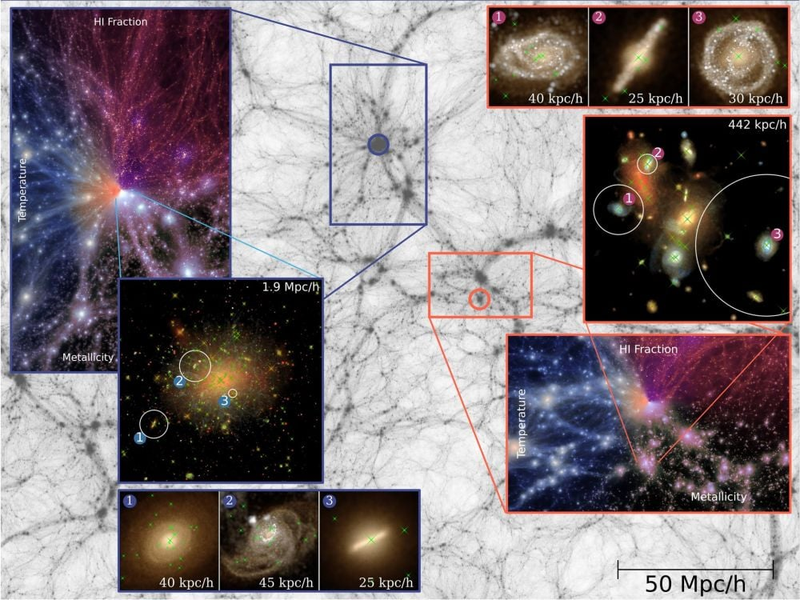
On a Texas supercomputer this summer, a 370 Mpc/h cube of dark matter, gas, and stars finished a 13.5-billion-year journey. The run began at redshift z=99, when the cosmos was a thin hydrogen-helium plasma and the first stars had not yet ignited. It ended at z=0, with galaxy clusters, supermassive black holes, and the cosmic web we see today. The team calls the simulation ASTRID, and the final z=0 dataset was published in The Astrophysical Journal in February 2026, with a public release coordinated through the Texas Advanced Computing Center on August 27, 2026 (Zhou et al., ApJ, 2026).
The headline numbers are easy to recite. ASTRID evolves 2 × 5500³ ≈ 0.33 trillion particles in a 370 Mpc/h box. Each simulation snapshot totals 30 TB. The archived state across the run is measured in petabytes. Less obvious is what those numbers actually buy the cosmologist at the other end of the keyboard: a single dataset that connects the universe’s first black hole seeds to the billion-solar-mass monsters sitting in galactic centers today.
JWST keeps pulling ancient quasars and “Little Red Dots” out of the early universe that do not fit the old growth timelines. The first JWST surveys suggested that 10⁹ M☉ black holes already existed at z > 8, hard to reconcile with seed models from a decade ago (Naidu et al., 2024, and follow-ups). To make sense of those objects, theorists need a model universe that can track baryons, gas cooling, star formation, and black hole accretion from cosmic dawn to the local universe, all at high enough resolution to capture the small dark-matter halos where the first quasars lit up.
Cosmological simulations do that, but they are expensive. Each box has to be large enough to contain rare massive clusters, dense enough to track small galaxy halos, and long enough to evolve them across 13.5 Gyr. Few projects manage all three at once. ASTRID does.
Yihao Zhou, a PhD student at Carnegie Mellon University’s McWilliams Center for Cosmology and Astrophysics, led the run. His advisor, Tiziana Di Matteo, is the principal investigator and the center’s director. The team used the NSF-funded Frontera system at the Texas Advanced Computing Center (TACC) under a 2024 Leadership Resource Allocation (TACC press, August 27 2026).
The run sits in a crowded field. MillenniumTNG’s flagship covers 740 Mpc per side, roughly eight times the volume. IllustrisTNG-300 uses a similar box size with less dark-matter resolution. Eagle is smaller but uses higher resolution per particle. MassiveBlack-II covers 533 Mpc with far fewer particles and no full hydrodynamic run to z=0. ASTRID’s pitch is that no other published run combines this particle count, this box size, and a continuous evolution to z=0 with a complete black hole sub-population (Zhou et al., 2026).
That black hole population is the part astronomers care most about. ASTRID carries massive black holes (MBHs) spanning 4 × 10⁴ to 2 × 10¹¹ M☉, the range from putative seeds to the heaviest known monsters. Earlier ASTRID snapshots have already shown up in papers on Little Red Dot analogs (Hassan et al., Open Journal of Astrophysics, 2025) and on black hole merger rates that match LISA predictions. Mock JWST and Euclid light-cones built from the simulation give observers a template to compare against real survey catalogs, which is how the team plans to constrain the seed-black-hole mass in the next round of analyses.
ASTRID is a smoothed-particle hydrodynamics (SPH) simulation, which means the gas and dark matter are discretized into Lagrangian particles that move with the flow. The code solves the Euler fluid equations coupled to a particle-mesh gravity solver. Long-range forces use a coarse mesh; short-range forces use a hierarchical Barnes-Hut octree that drops subtrees whose multipole moments fall below an opening-angle tolerance θ.
The sub-grid physics is where most of the engineering sits. Gas above a density threshold around 0.1 cm⁻³ is converted into stars using a Kennicutt-Schmidt-style surface-density law, Σ_SFR ∝ Σ_gas^n with n ≈ 1.4. Black holes are seeded in dark-matter halos above ~5 × 10¹⁰ h⁻¹ M☉ and accrete via a Bondi-Hoyle-Lyttleton prescription capped at the Eddington rate:
Mdot_BH = min( Mdot_Bondi, Mdot_Edd ) = min( 4π G² M_BH² ρ / (c_s² + v²), L_Edd / (ε c²) )
Feedback comes in two flavors. Thermal quasar-mode kicks in at high accretion (≳1% of Eddington), kinetic jet-mode at low accretion. That thermal-versus-kinetic split is what produces the bimodal color sequence between star-forming blue galaxies and quiescent red ones.
The dynamical-friction submodel is the piece most relevant to LISA. When two galaxies merge, their central black holes are flung into a wide orbit. Chandrasekhar’s formula determines how fast each black hole sinks into the merger remnant:
df/dt = -4π G² M_BH² ρ(r) ln(Λ) f(v) / v²
The Coulomb logarithm Λ runs ~3-5 for galaxy mergers. Without this term, ASTRID would smear the merger-rate signal that LISA wants to hear.
LISA’s sensitivity band runs from ~10⁻⁴ Hz to ~10⁻¹ Hz, the regime populated by MBH mergers of 10⁴ to 10⁷ M☉ across cosmic time. Di Matteo’s earlier work (Ni et al. 2022) projected ~30 MBH mergers per year detectable by LISA out to z ≈ 10. The full z=0 ASTRID data set should sharpen that number, and provide a sky-position catalog that future gravitational-wave observers can cross-match against electromagnetic transients (Zhou et al., 2026).
On the engineering side, Frontera is the largest NSF open-science cluster in the United States. Built around Intel Cascade Lake Xeon nodes with ~60 PB of Lustre storage, it absorbed ASTRID’s 30 TB snapshots without complaint (TACC user guide, August 4 2026). The team’s next target is TACC’s Horizon system, the NSF Leadership-Class Computing Facility machine deploying in two phases (GPU first, then CPU) later in 2026. The ASTRID code is currently CPU-only; Zhou and colleagues are rewriting the gravitational and black-hole feedback kernels to run on NVIDIA GPUs.
For years, astrophysicists have asked how supermassive black holes got so big, so fast. ASTRID does not answer that on its own, but it gives the community a 0.33-trillion-particle laboratory to test the answers against.
The next year or two will bring a GPU port to Horizon, plus companion runs at higher resolution or with varied cosmological parameters. By the time LISA Pathfinder’s successor launches around 2035, theorists will want catalogs like ASTRID’s to interpret the gravitational-wave sky.
What comes out of a simulation like this is rarely a single discovery. It is a reference. A way for theorists to ask whether their model matches what we should see, with enough resolution to be honest about the mismatch. ASTRID is now that reference for the next decade of SMBH and gravitational-wave cosmology.
 Subscribe to our RSS feed









There are no comments.
Add A Comment