


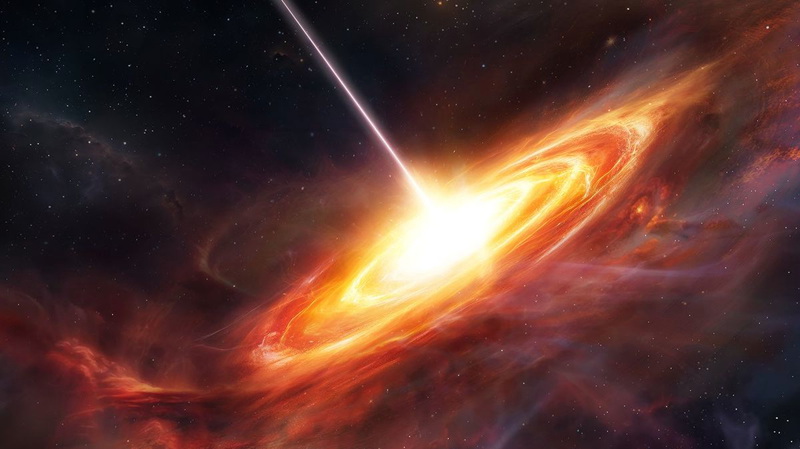
On 6 July 2026, a team led by the European Space Agency reported that Euclid, a wide-field infrared space telescope launched in July 2023, had catalogued 31 of the oldest quasars ever documented. Two of them broke the redshift record outright. The most distant, named EUCL J172902.75+641018.1, sits at a redshift of z = 7.77, meaning the light that just reached us left when the universe was about 670 million years old, roughly 5 percent of its current age. The runner-up, EUCL J125308.55+705432.3, clocks in at z = 7.69. Both names and numbers come straight from the ESA release and the new paper in Astronomy & Astrophysics, led by Daming Yang of Leiden University, also covered by Universe Today and Astronomy magazine.
For scale, the previous redshift record for a quasar was z = 7.64, set in 2021. Euclid broke that bar twice in the same data set.
Quasars are not just bright. They are unreasonably bright. They run on the gravitational energy of matter falling onto supermassive black holes at the centers of galaxies. The disk of in-falling gas and dust is heated by friction and tidal forces to millions of degrees, and radiates more energy than every star in the surrounding galaxy combined. When you find a quasar at z > 7, you are not just finding a bright dot. You are finding evidence that a black hole of a billion solar masses or more already existed when the universe was younger than its present-day span allows for under the simplest models of growth.
That is the source of the quiet excitement around this kind of result. The “seed” black holes that became today’s supermassive monsters must have formed quickly and grown fast. Finding them when they were already radiating as quasars places hard constraints on the formation channels that can deliver a million- to billion-solar-mass object so early. Every additional z > 7 quasar adds a new anchor point.
The second reason this matters is methodological. Euclid was not designed to chase the earliest quasars. It was selected and built to image billions of galaxies across most of the sky, in order to chart the effect of dark energy on the universe’s expansion rate. That the same data set, plus a relatively small amount of follow-up spectroscopy, turned up the two most distant quasars ever found is the kind of bonus payload a wide-field survey delivers almost by accident. NASA, which contributed the near-infrared detectors and sits on the science team, is framing these finds as a preview of what its Nancy Grace Roman Space Telescope will do at higher resolution when it launches later this decade.
Euclid launched on a SpaceX Falcon 9 from Cape Canaveral on 1 July 2023. It settled into a halo orbit around the second Sun-Earth Lagrange point, about 1.5 million kilometers from Earth, where its thermal environment stays stable. The mission carries two instruments: a visible-light imager (VIS) and a near-infrared photometer and spectrometer (NISP). For the quasar hunt, what matters is NISP’s three near-infrared filters (Y, J, H), which together reach out to about 2 micrometers.
The trick for finding high-redshift quasars is simple in principle. As the universe expands, light from distant objects is stretched to longer wavelengths. A quasar that emitted visible light when the cosmos was 670 million years old arrives at Earth as near-infrared light. By selecting sources that are bright in the infrared Y, J, and H bands but vanishingly faint in visible light, you isolate candidate ancient quasars from the much larger population of nearer, red stars.
That is exactly what Euclid’s early data sets (the Early Release Observations from May 2024 and the Quick Data Release 1 in March 2025) have been collecting since routine science operations began in late 2023. The new study, summarized in the ESA release, started with a much larger pool of candidates drawn from these releases, then narrowed them down using ground-based spectroscopy at facilities including Keck, Magellan, and the Large Binocular Telescope, plus archival data from other observatories. Of the candidates that survived the cuts, 31 sit at high enough redshift to count as the oldest known quasars, and 12 of those are older than 770 million years post-Big-Bang. Two fall inside the first 670 million years.
The two record-holders are ten to a hundred times fainter than the famous z = 7.5 quasars found by ground-based surveys in the past decade, which is precisely the reason they had escaped detection until now. Euclid’s wide area is what makes it possible to find rare needles in a haystack: a small telescope pointed at a tiny patch of sky cannot see them, but a one-square-degree imager can sweep enough volume to make faint objects common enough to catch.
Redshift is a direct measurement of how much the universe has expanded since the light left its source. The relationship is not linear, because cosmic expansion accelerates, but a useful short-hand for objects at cosmological distances is: divide the speed of light by the Hubble constant to get a rough distance, then correct for expansion. For z = 7.77, the light-travel time works out to a little over 13 billion years. The physical distance to the quasar today is much larger, because the intervening space has been stretching the whole way.
For a supermassive black hole to power a quasar at that brightness so early, models generally require the seed object to be either a roughly ten-thousand-solar-mass “direct collapse” black hole, or a stellar-mass seed that has been fed at the maximum possible rate (the Eddington limit, where radiation pressure balances gravity and accretion cannot go faster). Real observations keep finding that black holes at z > 7 sit at or near the Eddington limit, which is itself a clue about how gas gets delivered to them in the early universe.
Euclid’s near-infrared setup is what unlocks the detection. At a redshift of 7.77, the rest-frame ultraviolet emission lines that astronomers use to identify quasars (such as the Lyman-alpha line at 121.6 nanometers) are stretched to roughly 1.06 micrometers, well within NISP’s range. The visible-light emission is redshifted beyond 0.6 micrometers and falls into NISP’s J and H bands. Euclid takes both visible and near-infrared images of every part of its survey, which means the same patch of sky has both the color information needed to flag candidates and the morphological information needed to distinguish a point-like quasar from an extended host galaxy.
The catalog is preliminary. Of the 31 confirmed quasars, roughly the top third have detailed spectroscopic measurements already, and the remainder are still awaiting deeper spectra. The lead author, Daming Yang at Leiden University, expects follow-up observations with JWST to push the redshift record further and to measure the masses of the central black holes directly.
Quasars at z > 7 are also useful as back-lights. Light from a background quasar passing through foreground gas clouds leaves absorption lines imprinted on the quasar spectrum, which is how astronomers map the gas between galaxies. Euclid has found many back-lights that future quasar-absorption-line studies will use.
The bigger picture is that Euclid is roughly three years into its nominal six-year mission. The dark energy mapping it was built for, which will use weak gravitational lensing and baryon acoustic oscillations to pin down the equation-of-state of dark energy, is the headline science. The early-universe quasars are a side benefit. We have about three more years of survey data to go before the nominal mission end, and the team’s spectroscopy is still catching up to the imaging. The second Euclid data release is scheduled for late June 2026 and the first full public catalog in October 2026, which means the survey area that the next quasar search can draw from roughly doubles.
Euclid is now an established finding machine. Whatever the next catalog delivers, it will be the result of more pixels across more sky, not a change in strategy.
 Subscribe to our RSS feed









There are no comments.
Add A Comment