


On 15 September 2026, a graduate student at the Harvard and Smithsonian Center for Astrophysics posted a 32-page preprint to arXiv announcing the first radio detection from a planet outside our solar system. The team, led by Kevin Ortiz Ceballos with co-author Edo Berger at Harvard and Yvette Cendes at the University of Oregon, had used the MeerKAT radio array in South Africa to pick up rapid, repeating, and strongly circularly polarized bursts coming from Beta Pictoris b, a 12-Jupiter-mass gas giant orbiting its host star at roughly ten astronomical units (Ortiz Ceballos et al. 2026, arXiv:2609.16720). The signal, picked up at frequencies between 0.85 and 3.5 gigahertz, was coherent, variable on timescales of seconds, and beamed. The most plausible source was auroral electron-cyclotron-maser emission generated in the planet’s own magnetosphere. From the highest observed frequency, the team inferred a magnetic field of at least 1.25 kilogauss at the emission site, the first direct magnetic-field measurement ever made on an exoplanet.
This matters for a reason that has nothing to do with technosignatures or aliens, even though those were the first things many readers searched for in the headlines. A planet’s magnetic field controls how its atmosphere weathers the wind of charged particles blowing off its host star. Earth has held onto its atmosphere for billions of years in part because its 0.5-gauss dipole field deflects the solar wind. Mars, with no global field to speak of, lost most of its. Measuring magnetic fields on exoplanets is therefore a prerequisite to asking whether any of them could be habitable, and until last week, every attempt to do so directly had failed.
The reason the failure rate was so high starts with the difference between magnetic activity on a star and magnetic activity on a planet. Both produce radio emission, and stars, especially young and magnetically active ones, are much louder than the planets that orbit them. Pinning a radio signal to a planet rather than its star requires angular resolution finer than the orbital separation, and Beta Pictoris b is the best natural laboratory available. Its host, Beta Pictoris, is an A6V star about 19.6 parsecs away in the constellation Pictor, magnetically quiet, with an upper limit of roughly 0.3 kilogauss on its dipole field. The planet itself sits about ten astronomical units out and reaches a peak angular separation near 0.55 arcseconds over its 24-year orbit, wide enough for a long-baseline radio interferometer to disentangle. The MeerKAT array in the Karoo desert is a 64-dish precursor to the Square Kilometre Array, and its sensitivity at decimetre wavelengths is the highest of any currently operating radio telescope in the southern hemisphere. The team observed Beta Pictoris four times between February 2025 and May 2026, twice in the L band between 0.856 and 1.712 gigahertz and twice in the S band between 1.75 and 3.5 gigahertz. The first epoch was a wide survey for quiescent radio emission from brown-dwarf and exoplanet analogues. It found a source. A nine-hour follow-up confirmed it, and subsequent S-band campaigns with the array split into two sub-bands pinned the emission to the planet’s coordinates relative to background quasars (Astrobiology.com summary, Sept 24 2026).
Two properties of the signal cinched the identification. First, it was highly circularly polarized, with the strongest S-band burst roughly 70 percent polarized in one handedness and the L-band bursts showing variable handedness between epochs. Coherent radio emission with that level of polarization and rapid time variability is the signature of the electron-cyclotron maser instability, a process in which electrons spiralling in a magnetic field release their kinetic energy as electromagnetic waves at the local cyclotron frequency. Incoherent gyrosynchrotron emission, the alternative mechanism, produces only modest circular polarization and cannot generate brightness temperatures above about 10^8 kelvin. The team’s brightest L-band burst of 307 microjanskys at 1.28 gigahertz, if it came from a region the size of the planet, would correspond to a brightness temperature above 6 times 10^10 kelvin. Second, the upper edge of the emission frequency mapped directly to the magnetic field strength at the source. For fundamental electron-cyclotron-maser emission, the cyclotron frequency is about 2.8 gigahertz per kilogauss, and the team observed emission extending all the way to 3.5 gigahertz, the top of their S-band coverage, which requires a field of at least 1.25 kilogauss at the emission site (Live Science, Sept 23 2026). That is roughly 290 times stronger than Jupiter’s surface field of 4.3 gauss and about 2500 times stronger than Earth’s, and it is consistent with the predictions of energy-flux dynamo scaling for a young, hot, super-Jupiter. The host star cannot produce it: its measured upper limit is a quarter of a kilogauss, and A stars do not generally host kilogauss surface fields anyway. The mechanism is the same one that powers Jupiter’s aurorae, scaled up. Jupiter’s aurorae, the brightest in the solar system after the Sun’s, are driven partly by the interaction of its magnetic field with the solar wind and partly by the tidal stripping of its volcanic moon Io, which loads the magnetosphere with plasma. Beta Pictoris b has no Io and probably no moon, but it orbits a young A star that is itself a few hundred times more luminous than the Sun and emits a correspondingly stronger wind. Charged particles streaming from the star are funneled along the planet’s magnetic field lines into the polar regions of its upper atmosphere, where they radiate. The result is the same pattern seen in brown-dwarf ultracool dwarfs that host similar kilogauss fields: coherent radio bursts at the rotation period, with circular polarization that flips sign depending on the orientation of the magnetic axis. The team also notes that previous weak X-ray emission attributed to the star may in fact originate from the planet, which would put Beta Pictoris b on the same radio-to-X-ray correlation as ultracool dwarfs and brown dwarfs, a unified scaling law that has held up across more than two orders of magnitude in magnetic field strength.
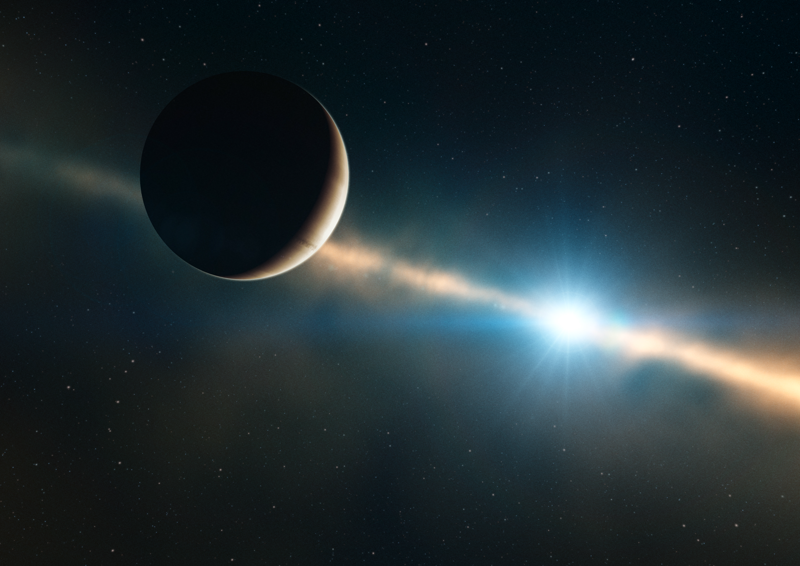
The implications extend beyond Beta Pictoris. Suzanne Aigrain of Oxford, who was not involved in the study, told Live Science that the detection “hopefully paves the way for many more,” and that future instruments will be able to make similar measurements for smaller planets (Live Science, Sept 23 2026). The Square Kilometre Array, currently under construction in South Africa and Australia, will be roughly an order of magnitude more sensitive than MeerKAT, and its low-frequency coverage will reach further into the parameter space where cooler, lower-mass planets generate their radio emission. By the end of the decade, magnetic-field measurements on Neptune-mass planets around nearby M dwarfs may be routine, and the question of which of those planets can hold onto an atmosphere will be answerable from observation rather than from theory. The preprint is not yet peer-reviewed, and the authors are careful to point out that no radio detection has previously been unambiguously localized to an extrasolar planet rather than its host star, with the previous tentative cases including the 2023 YZ Ceti bursts unable to fully exclude a stellar origin. The Beta Pictoris result rules that out by combining milliarcsecond astrometric localization with the polarization and timing structure, and Wired’s coverage flags the same caveat (Wired, Sept 24 2026). For now, the preprint remains the first clean detection, and a proof of concept for a method that will dominate exoplanet characterization once the SKA comes online. The image below shows the system as ESO imagined it before this result, with the planet a dark crescent in front of the bright star and the debris disk crossing edge-on. What the picture cannot show is what the MeerKAT data now adds: a kilogauss magnetic field wrapped around that crescent, the first one ever measured on a world beyond our Sun.
 Subscribe to our RSS feed









There are no comments.
Add A Comment