


The spare eye that almost stayed classified: NASA’s Roman Space Telescope, six weeks from launch
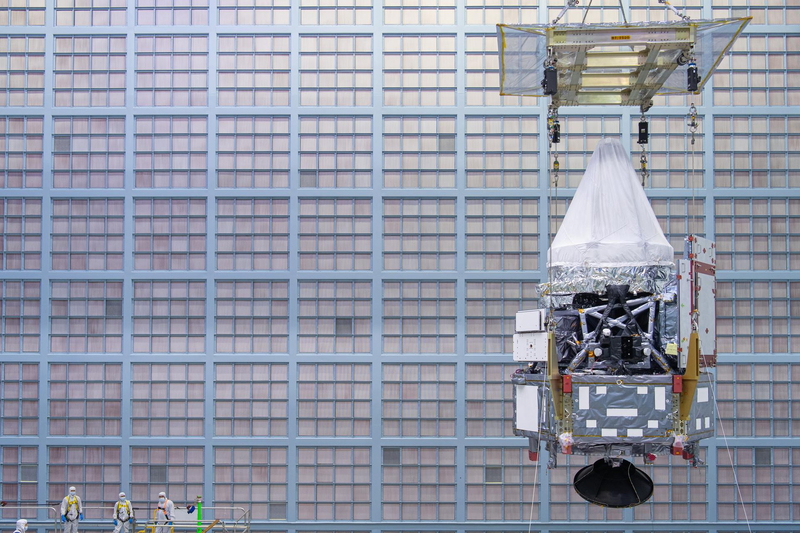
The 2.4-meter primary mirror sitting inside the Payload Hazardous Servicing Facility at Kennedy Space Center has traveled a stranger path to space than most astronomy hardware. It was ground in the late 1990s for a classified U.S. reconnaissance satellite. When the National Reconnaissance Office shut the parent program down, the optic spent more than a decade in a cleanroom. In 2012, the NRO handed two of these surplus mirrors to NASA. The agency coated them in vapor-deposited silver, polished them to a surface roughness of roughly 1.2 nanometers, and built the next flagship astrophysics mission around the spare (NASA, “Telescope Mirrors”; NASA Science).
That mission is the Nancy Grace Roman Space Telescope, and its Falcon Heavy payload fairing closes around Booster B1091 sometime in the early morning of August 30, 2026, from Launch Complex 39A. The “NET” caveat is real; range conflicts and pre-flight testing routinely slip a few days. As of mid-July, technicians were cleaning the spacecraft’s two deployed booms inside the servicing facility after the observatory arrived at Kennedy by barge on June 21 (NASA/John Kraus, KSC-20260621-PH-AJN01 series).
Roman is not a “next Hubble” in the usual sense. Hubble stares at small patches of sky with extraordinary sharpness. Roman goes wide. The Wide Field Instrument pairs the 2.4-meter mirror with an infrared detector mosaic that delivers a 0.281-square-degree field of view, roughly 100 times Hubble’s infrared footprint, at comparable angular resolution (NASA, “WFIRST AFTA Final Report”). In raw survey speed, the gain is closer to a factor of a thousand for the kind of cosmology Roman is built to do.
That speed unlocks three programs no other planned mission can do in this decade. The first is a statistical answer to the “is the dark energy equation of state changing?” question, traced through Type Ia supernovae and weak lensing across billions of galaxies. The second is a first homogeneous census of cold, snow-line-and-beyond exoplanets via gravitational microlensing toward the galactic bulge. The third is an in-space tech demo for high-contrast direct imaging of exoplanets at contrast ratios near 10⁻⁸, a step toward the Habitable Worlds Observatory the 2020 decadal survey recommended for the 2030s.
The community paid for this with patience. Roman’s cost cap famously bobbed around the $3.2 billion mark in the mid-2010s as the coronagraph scope grew. Launch slipped several times. The most recent beat was a pull-forward: NASA’s June 3 announcement moved the target from September 2026 to August 30, 2026, almost a full year earlier than the May 2027 baseline (NASA, June 3 2026 release).
Roman’s lineage runs through three programs. The first was a 2010 decadal-survey flag, the “Wide-Field Infrared Survey Telescope,” then budgeted at around $1.6 billion. By 2013, the design had accreted a coronagraph for exoplanet imaging. Then the 2012 NRO mirror gift let engineers scale the aperture from 1.5 meters to 2.4 without breaking cost caps. The “AFTA” (Astrophysics Focused Telescope Assets) study is the document that locked in the present configuration (NASA, 2013 AFTA report).
Flight hardware assembly moved to Goddard Space Flight Center in the late 2010s. The Coronagraph Instrument, built at JPL, hit thermal-vacuum contrast demonstration at roughly 4 × 10⁻⁸ in 2023, an order of magnitude better than its threshold (JPL, 2023 milestone reports). The integrated observatory passed pre-shipment review in early 2025, was sealed into its shipping container, and rode NASA’s Pegasus barge down the Intracoastal Waterway from Maryland to Florida over several weeks in mid-2026.
The arrival was a quiet milestone. Most of the work ahead is procedural: hydrazine load, fairing encapsulation, Falcon Heavy stacking, a wet/dry rehearsal, and a launch period that runs through the equinox, chosen because the mission’s primary microlensing field, the galactic bulge, is best observed in spring and fall from a Lissajous orbit around the Sun-Earth L2 point (Penny et al., 2019, ApJS).
Three pieces of the Roman design carry the science weight.
The mirror. At 410 pounds (186 kg), the ULE (ultra-low expansion) glass mirror is less than a quarter of Hubble’s mass for the same diameter (Lyman et al., “Roman 2.4-m mirror,” 2018). Silver rather than aluminum gives it higher infrared reflectivity between 0.5 and 2.0 µm. The 1.2 nm surface figure is not symbolic; for a coronagraph designed to suppress starlight, the residual wavefront error is what leaks planet photons into the stellar halo.
Wide Field Instrument. Eighteen H4RG-10 detectors feed the 300-megapixel focal plane, read out every 1.4 seconds in the wide-filter survey mode. With a 0.281 deg² footprint, Roman can map a square-degree in a single orbit, a task that took Hubble weeks. For the Galactic Bulge Time Domain Survey, the cadence is fifteen minutes in the W146 wide filter across seven fields totaling 1.97 deg², for six 72-day seasons over the five-year prime mission (Zasowski et al., 2025, “GBTDS Final Design”). Each microlensing event detected in this campaign will have simultaneous near-infrared photometry, which breaks the degeneracy that ground-based optical campaigns leave behind.
Coronagraph. Roman carries the first active coronagraph to operate beyond Earth orbit. Two deformable mirrors with thousands of actuators run a closed-loop low-order wavefront sensor at sub-nanometer correction rates. The instrument combines a Hybrid Lyot design and a Shaped Pupil design, switching by a filter wheel. Threshold contrast is 10⁻⁷ at a 3 λ/D inner working angle; expected performance is 10⁻⁸ to 10⁻⁹ for visible-light observations (Trauger et al., 2016; Poberezhskiy et al., 2024). That will not image an Earth twin. It will image Jupiter and Saturn analogs in reflected light around the nearest sun-like stars, and prove that the deformable-mirror algorithms the Habitable Worlds Observatory would inherit actually survive launch and L2 thermal cycling.
The gravity-lens math that makes the exoplanet survey work is the same Einstein formula that confirmed general relativity in 1931. The lensing cross-section for a solar-mass star peaks near the Einstein radius, roughly:
θ_E ≈ sqrt(4GM / c² × (D_ls / (D_l D_s)))
For a typical galactic-bulge observation, θ_E corresponds to about 1–10 AU projected separation, the snow-line region of the lens system. Roman’s 1-milliarcsecond astrometric precision from the same focal plane measures the centroid shift of the lensed images during the event, which lets astronomers recover the lens mass directly instead of fitting degenerate light-curve models (Koshimoto et al., 2025).
Roman will not arrive at L2 alone. Its ride to Earth-escape trajectory costs about 1,940 meters per second, comfortably inside Falcon Heavy’s margin. After a thirty-day transit and a four-month commissioning window, Wide Field Instrument first light should land in early 2027. The first coronagraph frames will follow, and with them the proof that the next generation’s “terrestrial-planet imager” is a plausible line item rather than a wish.
The deeper lesson is older than the mirror itself. The hardware that almost stayed classified is now the wide eye NASA needs to weigh the matter the universe is mostly made of. In astronomy, almost all of the interesting answers since 1998 have come from instruments that fit on one airplane pallet. Roman is the next one to fly.
 Subscribe to our RSS feed









There are no comments.
Add A Comment