


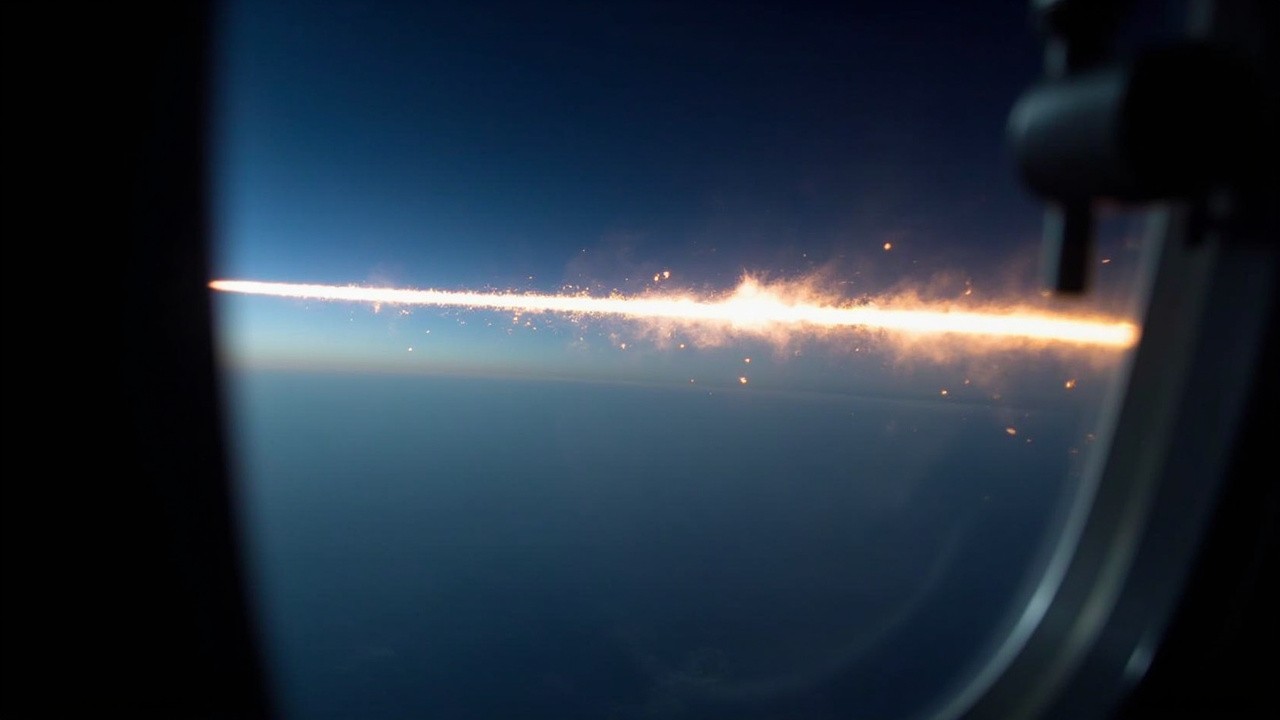
Illustration of the view from the ROSIE observation aircraft during the Tango reentry on 1 September 2026; a generated image, not a photograph of the event.
At 21:30:31 UTC on 1 September 2026, a thread of glowing aluminium and titanium began to lose coherence somewhere above the South Pacific and slid into a long, ragged line of fire. A chartered aircraft that had lifted off from Tonga banked hard at the right moment — the pilot contributing, by ESA’s later account, a few extra seconds in the cockpit’s favour — and twenty-nine of its thirty instruments tracked the breakup for about fifty seconds across the darkening sky. Back at the European Space Operations Centre (ESOC) in Darmstadt, the flight control team had already lost the spacecraft’s signal through Kourou about fifteen minutes earlier. Cluster II’s longest-running act was over. Samba had gone the day before, on 31 August at 17:39 EDT. Twenty-six years of magnetospheric science, four burning satellites, one airborne chase that ESA is now turning into design rules for an entire decade of constellation launches.
The Cluster finale marks the deliberate marriage of two ideas that have spent decades talking past each other: orbital debris mitigation and atmospheric-entry science. Until recently, design for demise — building satellites that burn up cleanly, with minimal surviving fragments and minimal aluminium-oxide pollution in the upper atmosphere — was almost entirely a laboratory exercise. Engineers sent components into plasma wind tunnels, like the arc-heated facility at the German Aerospace Center (DLR) in Cologne, and inferred how a whole spacecraft would come apart. The Cluster campaign is the first time four real, retired satellites have been observed in their actual death throes on a repeatable schedule (ESA, 2 September 2026).
The mission itself began in failure and ended in patience. ESA’s original four-satellite Cluster was destroyed in June 1996 on the maiden flight of Ariane 5 (Flight 501). The rebuilt Cluster II launched in pairs aboard two Soyuz-Fregat rockets from Baikonur on 16 July and 9 August 2000, each Soyuz upper stage releasing two 1,200-kilogram, 2.9 by 1.3 metre spinning cylinders — Rumba, Salsa, Samba, and Tango — built by Dornier (now part of Airbus). Each carried 71 kilograms of magnetometers, wave experiments, particle detectors, and electron-drift instruments drawing 224 watts from their solar cells (Wikipedia, Cluster II spacecraft; ESA, 2000). The quartet went into a highly elliptical orbit with perigee near four Earth radii (~25,500 km) and apogee near 19.6 Earth radii (~125,000 km), inclined close to 90° so that every other pass would cross the dayside magnetopause and every other would dive through the magnetotail on the night side. The orbital period was about 57 hours (HandWiki, Cluster II; Wikipedia, Cluster II). Twenty-four years is the formal mission duration; science operations were formally closed out in March 2024 to give ESA time to choreograph the end.
Cluster’s enduring scientific contribution was something earlier missions could not do: simultaneous, three-dimensional sampling of the same plasma event from four separated platforms. Cluster showed, with measurements from a tetrahedral formation spaced from a few hundred to a few thousand kilometres apart, that what looked like a single flux transfer event or substorm onset was usually a structured three-dimensional phenomenon with different signatures at different points (ESA, Cluster mission archive). NASA’s MMS mission and the joint CNSA-ESA Double Star mission eventually built themselves out from the Cluster playbook.
The deliberate end of life began in November 2024. ESA’s flight dynamics team fired a handful of small thruster burns on Salsa and Rumba, lowering their perigees and rotating the timing of their next atmospheric passes so that any surviving fragments would fall over an uninhabited stretch of the South Pacific — and so that an aircraft packed with sensors could be waiting. Salsa reentered on 8 September 2024; Rumba followed on 22 October 2025; in late January 2026, the same team nudged Samba and Tango to align their reentry footprints within twenty-four hours of each other and within reach of an aircraft staging out of Tonga (astronomy.com, 4 September 2026; ESA, Cluster reentry ground tracks, August 2026). ESA calls this operation “targeted reentry.” Nobody in the space-debris community had done it four times in a row before.
The ROSIE airborne observation campaign — Reentry Science Observatory for the Ionosphere and the Atmosphere, run by Astros Solutions under ESA contract — packed optical cameras, infrared spectrometers, photometers, and high-frame-rate imagers from the University of Stuttgart’s HEFDiG group and several European partners onto a single airframe. Twenty-nine of thirty instruments worked for both reentries. On Tango, the pilot banked the plane at the calculated moment to keep the disintegrating streak centred in the instruments’ field of view for an extra few seconds. The accuracy was, by ESA’s own description, “to the second” (ESA, 2 September 2026; phys.org, 2 September 2026).
The orbital mechanics of getting a magnetospheric constellation to die on cue is a problem of its own. Earth’s oblateness, expressed through the J2 zonal harmonic of the geopotential, precesses the orbit’s node at about 7.5° per year; lunar and solar third-body perturbations cycle the perigee distance through a roughly twelve-year pattern in and out of the denser atmospheric regime (Wikipedia, Cluster II; ESA mission materials). Cluster’s perigee originally sat near 25,500 km; by a 2014 epoch, perigee had dropped to around 16,000 km and apogee to about 117,000 km (Wikipedia, Cluster II infobox, 13 March 2014 epoch). That migration is why the finale was possible at all: by waiting for perigee to swing low, the team could count on natural drag to do most of the breakup work and use only small nudges to steer the ground track to a known-empty patch of ocean.
What actually happens to an intact satellite at the moment of atmospheric entry is poorly constrained by theory. The standard engineering heuristic for stagnation-point heating is Sutton-Biblarz’s approximation, in the form q ∝ sqrt(rho / R_n) * v^3, where rho is local atmospheric density, R_n is the leading-edge nose radius, and v is the entry velocity. For Cluster’s penultimate perigee dips to about 110 km altitude at relative velocities above 10 km/s, the stagnation heating rate lands in the neighbourhood of tens of megawatts per square metre of forward-facing surface (Sutton & Biblarz, Rocket Propulsion Elements; astronomy.com, 4 September 2026). The way a real satellite comes apart depends on which joints fail first — tank welds, harness connectors, solar-array hinges — and on small differences in alloy, paint, and thermal mass, which is exactly what single-part wind-tunnel tests cannot reproduce.
Cluster’s early reentries already produced two concrete findings. Stijn Lemmens, ESA’s acting head of space debris, reports that the upper-atmosphere models used to predict where the satellites would break up underestimated the local density by about twenty per cent — a small error at high altitude that compounds into a larger miss at the breakup point. Salsa also began to disintegrate earlier than conservative models predicted, with structural joints letting go at a higher altitude than expected (ESA, 2 September 2026). Both findings flow into ESA’s design-for-demise guidance for future spacecraft, with the goal of avoiding the two failure modes that worry planners most: titanium fragments landing on shipping lanes and aluminium-oxide particulates persisting in the stratosphere.
The follow-up is already in build. The Draco mission — Destruction and Re-entry Consolidated Observation — is scheduled to launch in 2027. Draco is essentially an instrumented test article: more than two hundred sensors, four cameras, and a hardened capsule to bring the data home after the spacecraft itself has disintegrated. ROSIE will fly underneath for a fourth campaign. With three real-satellite practice runs in hand, the airborne team will finally be able to match what the outside saw with what the inside felt (ESA, 2 September 2026; phys.org, 2 September 2026).
Cluster II’s last command to Tango, sent from the Kourou ground station minutes before the link died, was not the end of a mission. It was the opening argument for a new routine: spacecraft designed from the start to die on schedule, in known places, in ways that scientists can see coming. Low Earth orbit is on track to triple its mass by the early 2030s, which means atmospheric reentry will move from occasional accident to industrial throughput. ESA turned Cluster’s natural decay into a scheduled experiment; the four-satellite, four-year, four-burning-run dataset will feed directly into the design rules for the next decade of constellation launches — better joint choices, better materials, fewer surprises in the stratosphere. Twenty-six years of magnetospheric science, then four years of being studied on the way down. That is a hard record for any mission to argue with.
 Subscribe to our RSS feed









There are no comments.
Add A Comment