


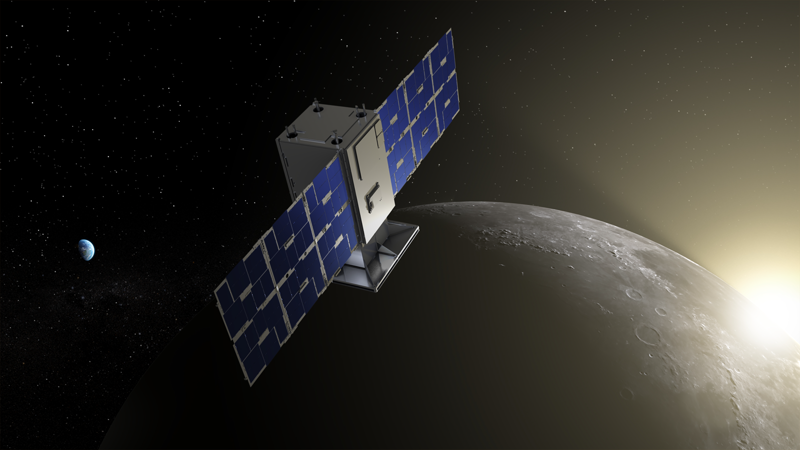
CAPSTONE in cislunar space, in a rendering by Daniel Rutter for NASA.
Every deep space mission depends on a phone call home. NASA’s Deep Space Network runs three antenna complexes at Goldstone in California, Madrid in Spain and Canberra in Australia, spaced roughly 120 degrees of longitude apart so one is usually looking at a distant spacecraft as the Earth turns (SpaceDaily). More than 40 spacecraft lean on that network, and demand has outrun what the antennas deliver. A 2023 audit by NASA’s inspector general found tracking requests running ahead of available antenna time by as much as 40 percent at times (the OIG audit). Network manager Brad Arnold warned at a 2021 planetary science meeting that new dishes were not keeping pace with demand, so missions should expect less availability (Space.com). Artemis II took priority during its 2026 crewed lunar flyby. The new capacity at Goldstone is a 34-metre dish, Deep Space Station 23, in service since 3 August 2026 and tracking the Chandra X-ray Observatory. Antenna time is still scarce. A research group went looking for a measurement that needs no dish.
Cislunar space is about to get crowded, which makes that arithmetic worse. NASA developed the Gateway station from 2017 until 2026 and then paused it, with the administrator calling it paused rather than cancelled and money moving toward a surface base (Wikipedia). The polar near-rectilinear halo orbit Gateway was to fly is now a proving ground for others, and NASA’s Artemis architecture is shifting toward landings that need their own guidance. Autonomous navigation is the usual answer, and every version of it wants hardware on board: a camera for optical tracking of surface features on the Moon, a second spacecraft in view for cross-range ranging, a wide field of view for X-ray pulsar navigation. The approach a Texas A&M and Advanced Space team took needs none of that. Every spacecraft already measures how much power its solar arrays produce, because power telemetry is how operators know the vehicle is alive. When that number collapses, the vehicle is in shadow. The team showed that the exact timing of the collapse, and of the return, is enough to pin down where a spacecraft is.
The paper is Eclipse Observables for Navigation in Cislunar Space, posted in October 2026 by Ian M. Down of Advanced Space, James McElreath of Space Exploration Engineering and Manoranjan Majji of Texas A&M (arXiv record, full text and figures). The geometry is textbook. A body blocking the Sun casts a penumbra, where light is only partly cut, and an umbra, where it is cut off completely. The boundaries of those cones are what a spacecraft’s power curve betrays. The team turns each detected transition into an implicit zero-measurement on the cone surface, then pushes it through an unscented Kalman filter alongside the usual dynamics. What they had to get right was how precisely the crossing can be timed. Their test case was CAPSTONE, the 12U CubeSat that became the first spacecraft to fly a near-rectilinear halo orbit around the Moon and finished its extended mission in June 2026 (NASA’s mission page). On 11 January 2026, inbound toward perilune, CAPSTONE passed through the Moon’s shadow. The array input voltage on both of its maximum power point tracking units sat near 23 volts in sunlight, fell to roughly 0.5 volts inside the umbra, and came back with a 31 volt overshoot as the panels cooled and briefly grew more efficient. The telemetry arrived on a 14.9 second interval, time tagged in GPS time, which needed an 18 second correction to line up with UTC. Timing the two umbral crossings straight off the power curve put them within 0.37 and 6.04 seconds of the geometric contact times computed from the delivered orbit solution. The root mean square error was 4.3 seconds, close to what the sampling interval alone predicts. The method was described for a wider audience in November (Universe Today).
Those contact times are not as clean as they look, and the paper spends much of its length on why. The model treats both the Sun and the occulting body as spheres, which loses three effects that matter. Earth’s atmosphere scatters and refracts grazing sunlight, enlarging the shadow and softening its edge, and a reduction of 22,539 crater and limb timings recorded at 94 lunar eclipses between 1842 and 2011 by Herald and Sinnott found the extra shadow sitting at a mean height of 86.9 kilometres above the surface, steady across lunar distance, season and solar cycle. Earth’s shape is next: oblateness projects the silhouette as an ellipse rather than a circle, and treating the position angle as unknown gives an effective radius uncertainty of 6.69 kilometres at the halo eclipse studied, using GRS80 flattening values. The Moon’s own relief is the last: features on the limb depart from a sphere by about 6 kilometres either way, inside the plus 10.78 to minus 9.12 kilometre range the Lunar Orbiter Laser Altimeter measured. The team folded all of this into an event-time uncertainty budget rather than modelling each effect precisely, alongside the telemetry sampling term, which contributes 4.33 seconds at a 15 second interval. The total comes out at 8 seconds for the halo’s penumbral contacts, 10 seconds for its umbral ones, and 5 seconds for CAPSTONE’s lunar umbral contacts. That number becomes the weight the filter gives each measurement, and it is why the halo result comes out weaker than the CAPSTONE one.
Everything here turns on what happens when the ground solution has gone stale. Starting from a fresh tracking solution, the two umbral contacts for CAPSTONE shaved 6.3 percent off the 3-sigma position error, because there was little left to fix. Start from a degraded solution instead, the kind a missed tracking pass produces, and there is far more error to remove. Scale the delivered covariance up to 5.33 kilometres of initial position uncertainty and the same two contacts remove 60.8 percent of the error at the 5 second timing budget; from 1.6 kilometres they remove 28.4 percent. In the 5.33 kilometre case the 3-sigma position error falls from 46.41 kilometres open loop to 18.17 kilometres, and the velocity error from 6.224 to 2.531 metres per second. The estimated covariance matches the sample error at a ratio of 1.00, and the Mahalanobis distances at the two contacts are 0.93 and 1.57. The simulated Earth-Moon L1 halo shows the same shape at larger scale: four contacts remove 33.3 percent of the 3-sigma position error from a 346 kilometre starting uncertainty. In the covariance run behind that number, the 3-sigma error drops from 1078.59 kilometres open loop to 718.81 kilometres, a 33.4 percent reduction, and the velocity error from 5.714 to 4.944 metres per second. Four contacts do not beat two because of the geometry: the cone normals at the four crossings lie within 2 to 11 degrees of one another, so the later measurements are largely redundant with the first. A reduction of at least 25 percent needs an initial position uncertainty of 86.6 kilometres. The benefit decays. For CAPSTONE the covariance reduction falls to 8.7 percent ten hours after the last contact, and the filtered uncertainty catches up with the open loop one after 22.7 hours. The halo retains more, staying between 22.9 and 53.5 percent for a week, because its unstable dynamics inflate the open loop error from 1076 to 8767 kilometres over that week while the filtered solution needs 1.83 days to climb back to where it started.
Two scalar contacts can only constrain two directions of a six-dimensional state, so this supplements radio tracking rather than replacing it. It costs nothing to run: no new hardware, no camera, just the power signal the spacecraft already produces, plus an ephemeris kernel to compare against. It matters most in the gap after a tracking pass is missed, the failure mode that bites hardest when the antennas are oversubscribed. The cost is sparsity: cislunar eclipses are rare enough that a spacecraft may wait a long time between them, and the paper is explicit that this cannot compete with a ground station track. What it can do is keep a solution from drifting into uselessness while the ground waits for a slot on a dish.
 Subscribe to our RSS feed







There are no comments.
Add A Comment