


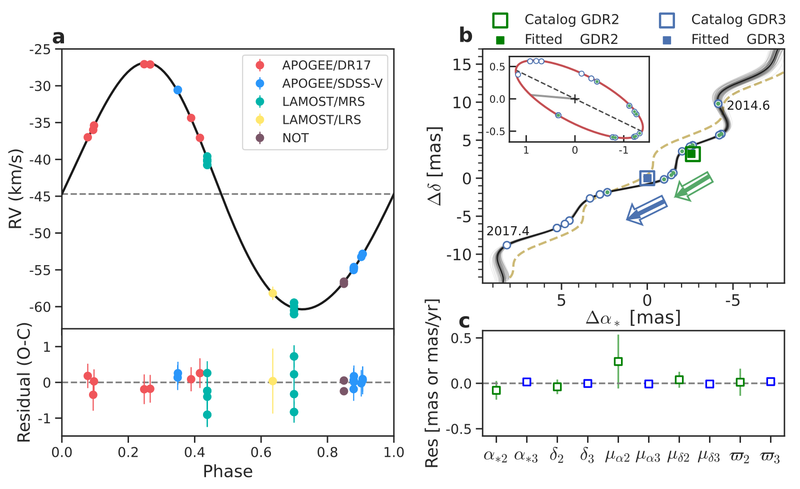
Image source: Figure 2 of Zhao et al. 2026, arXiv:2611.14998.
About 1,465 light-years away, a red giant shines at roughly sixteen times the Sun’s luminosity and circles an invisible companion on a three-and-a-third-year orbit. The companion has never been seen. It gives off no visible light, no X-rays and no radio pulses, yet it is heavy enough to bow the red giant’s path into a slow wobble of 16.75 kilometres per second. On 11 November 2026, Xinlin Zhao and nineteen colleagues led by the National Astronomical Observatories in Beijing published what they call the discovery of a likely supermassive neutron star, accepted by Science Advances. Their system, catalogued as Gaia DR3 2546630699873483008 and designated J0008+0128, hosts an object whose best-fit mass is 2.20 solar masses, landing in the narrow strip of the mass distribution where neutron stars and black holes are not supposed to overlap.
How do you weigh something that emits nothing? You watch what it does to a star that does shine. The red giant’s absorption lines shift blueward and redward on a cycle of 1,217.19 days, and a Keplerian fit to those shifts gives a semi-amplitude of 16.75 km/s and a binary mass function of 0.587 solar masses. That last number is a minimum, because a mass function assumes the orbit is seen edge-on, and every mass scales with the sine of the inclination. So the measurement needs a second trick: watching the red giant’s position against the background stars.
That trick is what Gaia does: J0008+0128 appears in the astrometric orbit catalogue of Data Release 3. Fitting the joint radial velocity and astrometric solutions from DR2 and DR3 gave an inclination near 73 degrees, with 11 degrees of uncertainty, and with it a companion mass of 1.8 to 2.8 solar masses, best estimate 2.20 (Zhao et al., Science Advances, November 2026). The same joint fit also moved the distance, from the 1,423 parsecs Gaia quotes alone to 1,464.56.
The number 2.20 is why the system was worth a paper. Neutron stars arrive in tidy clumps: ones never recycled by a companion sit near 1.33 solar masses, and ones spun up and fed by a donor pile up near 1.54 (Ozel and Freire, 2016). Above two solar masses, dense matter runs out of support and gravity wins. GW170817 puts that ceiling at 2.15 to 2.30 solar masses for a star that is not spinning fast (Margalit and Metzger, 2017). A 2.2 solar mass neutron star is not merely heavy. It is heavy enough to squeeze the hardest constraint on ultradense matter we have.
Heavier objects have been claimed before. The 2.6 solar mass secondary in GW190814, the first merger with a mass gap between its components, is usually called a black hole but might have been a fast-spinning neutron star (LIGO-Virgo collaboration, 2021). PSR J0514-4002E, an eccentric millisecond pulsar in the globular cluster NGC 1851, was reported in 2024 to carry a companion of 2.09 to 2.71 solar masses (Barr et al., Science, 2024). Both sit in the gap between the heaviest neutron stars confidently weighed and the lightest black hole candidates. J0008+0128 is the widest of the family by some distance: 1,217 days against 7.44 for PSR J0514-4002E and 639 for Gaia NS1, the neutron star Gaia astrometry turned up in a wide binary (El-Badry et al., 2024).
Showing that the companion is dark took more than a wobble. The team gathered sixteen infrared spectra from APOGEE, nine optical spectra from LAMOST and two from the Nordic Optical Telescope, measuring radial velocities by cross-correlating each against a template. The visible star is a modest red giant of 1.67 solar masses, consistent with an evolutionary mass near 1.5 and an age of about 2.5 billion years. A main sequence star of the companion’s mass would shine at 11 to 81 solar luminosities and would have dominated a spectrum whose total light is about 16. No trace appears. The decisive test was spectral disentangling, which splits blended light into its components: the red giant’s lines separate cleanly and the companion’s spectrum comes out flat and empty of features.
Other escape routes close too. Had the red giant been stripped by past mass transfer, its Roche lobe filling factor of about 2 percent would be far too small, and its mass would fall to roughly 0.6 solar masses, pulling the companion down to 1.3 and making it bright in the Gaia bands. A 9,421-second target-of-opportunity observation with the Follow-up X-ray Telescope on the Einstein Probe on 30 June 2025 found no source within two arcminutes at three sigma, capping the X-ray luminosity at 8.8 times 10 to the 30th ergs per second for a power law of index 1.5. Wind accretion would give only 10 to the 26th or 10 to the 27th ergs per second, and a neutron star this heavy cools below that limit within a thousand to a hundred thousand years. FAST found no emission down to about 2 microjanskys between 1.05 and 1.45 gigahertz, which fits a non-recycled pulsar in a wide orbit.
The harder problem is not what the object is but how it got there. A neutron star is born in a supernova, and the explosion ejects mass asymmetrically, knocking the system off circular. For a circular orbit that becomes an eccentricity of roughly e = ΔM / (M_G + M_NS), where ΔM is the helium core minus the neutron star. An eccentricity of 0.09 means the progenitor lost under 10 percent of its mass, roughly 0.4 solar masses, leaving a helium star of no more than about 2.6 solar masses. Stellar evolution models build a 2.2 solar mass neutron star from stripped helium stars of 6 to 8 solar masses, so this progenitor should have been more massive. The supernova kick has to be tiny as well, below about 20 km/s, to preserve the gentle orbit.
So the authors ran POSYDON, a population synthesis code, over roughly 300,000 simulated solar-metallicity binaries. Nothing turned up. The route that survives is a hierarchical triple: two massive stars in a tight inner binary, a third further out, and Kozai-Lidov oscillations dragging the inner pair together until it merges. A neutron star spiralling into a giant’s envelope can build a Thorne-Zytkow object and accrete onto itself, or two neutron stars can merge and leave a heavier remnant. Mergers are nearly kickless, which fits the low eccentricity, and the same channel has been invoked for GW190814’s 2.6 solar mass secondary (Lu, Beniamini and Bonnerot, 2021). One caveat remains: the hidden object could be an unresolved inner binary, though REBOUND simulations rule out inner periods longer than about 20 to 30 days, and TESS excludes anything shorter.
What this leaves is a candidate rather than a confirmation. The measured range still reaches 2.8 solar masses, which would make it a low-mass black hole instead. The direction is clear enough. Gaia did not exist when the last census of neutron star masses was taken, and its astrometric orbit catalogues are turning stellar archaeology into a census of the dark. The two heaviest candidates so far have landed in the one place the physics says they cannot be. If J0008+0128’s 2.20 solar masses survive the next round of spectroscopy, the equation of state of ultradense matter has to be stiffer than the GW170817 analysis allows, and a decade of clean detections in this narrow band will say by how much.
 Subscribe to our RSS feed









There are no comments.
Add A Comment