


Two Satellites, One Cusp: TRACERS Settles the Reconnection Question
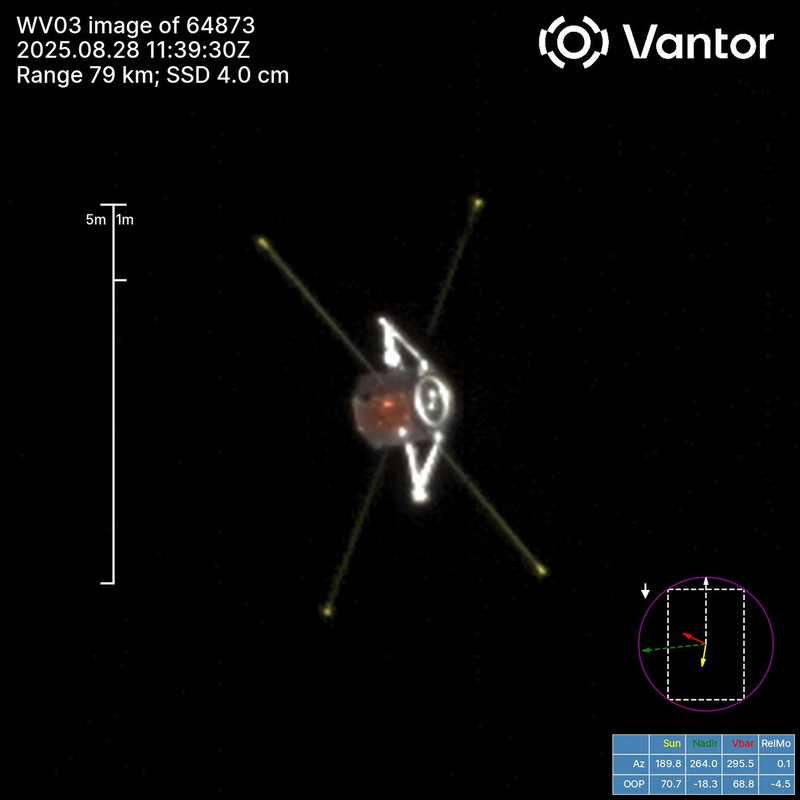
At 590 kilometres above Earth, two identical satellites cruise in tandem through the polar cusp, one trailing the other by ten seconds to two minutes. Their orbit takes them over the magnetic poles several times a day, and every time they pass they do the same thing: fly into a funnel-shaped region of Earth’s magnetic field and watch what the solar wind does to it. What they record is not a picture but a signature, a spreading of ion energies that shows where the Sun’s magnetic field is being stitched onto Earth’s. On 29 October 2026, a team working from those measurements published the first statistical answer to a quarter-century-old question: when magnetic reconnection happens at Earth’s magnetopause, is the event driven mainly by where it occurs in space, or by how it changes with time? The answer, from 207 matched pairs of cusp crossings, is mostly where.
Reconnection is the process that lets the solar wind get inside Earth’s magnetic shield. The Sun’s field arrives embedded in a continuous stream of charged particles, and where it butts against the magnetopause, two field directions that point opposite ways have to resolve themselves. They do it by breaking and reconnecting, and the breaking dumps stored magnetic energy into plasma motion. The rate at which that happens is the reconnection electric field, E_rec = v_rec * B, and it drives the aurora, inflates the magnetotail during a geomagnetic storm, and pushes charged particles down into the polar upper atmosphere.
The hard part is that reconnection does not happen at one tidy point. It happens in patches, at different places along the magnetopause, at rates that shift as the solar wind pushes. And a single spacecraft cannot sort out which is which. Any trace a satellite records on its way through fits two stories: a structure evolving in place over the seconds the crossing took, or a structure that varies from one spot to the next while the spacecraft sweeps across it. Physicists call this the spatiotemporal ambiguity of reconnection, and for more than two decades the agreed way out has been to fly two spacecraft close together along the same track, so each acts as a control on the other.
TRACERS is that experiment. It began as a proposal from Craig Kletzing at the University of Iowa, and it carries him in its wiring: the instrument electronics box on each spacecraft has one of his purple guitar picks mounted inside (Miles et al., 2025). Kletzing died in 2023, before launch. NASA picked TRACERS for the Small Explorer programme in June 2019, and the pathfinder was a pair of sounding rockets, TRICE-2, launched on 8 December 2018 into the northern cusp with the ancestor of the same instrument package. The satellites rode a Falcon 9 out of Vandenberg on 23 July 2025, stacked as a two-high cake topper on the rideshare.
Two days after launch, one of the pair, Space Vehicle 1, stopped answering. The fault was in the power system, and the diagnosis was grim: the battery no longer held a charge. Without one the spacecraft could run only while its solar panels saw sunlight, which turned its orientation in orbit into a requirement. Contact was restored in September by pointing SV1 at the Sun, and the observing plan was rewritten around the constraint (NASA, December 2025). Where the mission had been designed to work in the northern cusp, alongside radar facilities on Svalbard, it would work in the southern cusp instead, so each spacecraft could charge on the dayside before reaching its target.
The first results landed on 29 October 2026. Researchers took every window from 7 November 2025 to 28 February 2026 in which both spacecraft recorded a cusp crossing, matched the pairs, and asked how the ion signatures compared between leader and follower. Of 207 paired encounters, 129 were dominated by spatial variability, 48 by temporal variability and 30 could not be classified cleanly (Fuselier et al., 2026). The structures TRACERS sees in the cusp are set mostly by where the spacecraft happens to be looking rather than by reconnection pulsing on and off at a fixed spot. That matters because the reconnection rate sets how much energy the solar wind hands to the magnetosphere at any moment.
Measuring it takes plasma instruments and patience. The Analyzer for Cusp Ions on each spacecraft is a top-hat electrostatic analyzer that samples 47 energy channels between 8 and 20,000 electron volts across the full sphere of directions, delivering a complete velocity distribution every 312 milliseconds. The electron instrument beside it works at 50 milliseconds. Compare that with the Defense Meteorological Satellite Program, whose ion and electron instrument sweeps once per second through a 90-degree field of view, smearing the pitch angle distribution. The background field comes from a fluxgate magnetometer sampling 128 times a second, and a two-axis electric field instrument on wire booms yields the E * B flow velocity.
The signature is old. When magnetosheath plasma is injected along newly opened field lines, the faster ions pull ahead of the slower ones and the population arrives spread out in energy. The lower edge of that spread, the energy at which the flux falls to about a tenth of the spectral peak, is what the team tracks; how fast it changes along the track stands in for the rate at which field lines open. Turning that into an electric field runs through Faraday’s law and a correction for how flux tubes widen between the magnetopause, where the field is around 50 nanotesla, and the spacecraft. For the 30 September 2025 storm, the first big one after launch, which bottomed out at a Dst index of minus 129 nanotesla, the team picked out 21 dispersion events and derived reconnection rates of 0.1 to 1.5 millivolts per metre (da Silva et al., 2026), a little below what DMSP has produced and in line with the in-situ measurements from Polar.
The pair is also separated on purpose, and the separation is treated as a measurement. TRACERS flies in a sun-synchronous polar orbit, the two spacecraft trailing each other by 10 to 120 seconds along the track, which at their 590-kilometre altitude and 96-minute period is roughly 75 to 900 kilometres. That range lets the team size the structures they are chasing: a signature that shows up on both craft after a short delay is one small structure the pair crossed twice, while one appearing on only one spacecraft is either bigger than their spacing or was changing while they waited. The spacecraft are plain spinning cylinders on a Millennium Space Systems bus, passively stabilised at 10 revolutions per minute, their spin axes steered along the local magnetic field by small torque-coil manoeuvres. Over twelve months they were expected to cross the cusp more than 3,000 times.
What comes next is largely a matter of waiting, and of geography. The extension approved in September 2026 carries TRACERS into spring 2027, and the team still wants the northern cusp, with its Svalbard radars, for whatever stretch the power constraint allows. What exists so far is a preliminary paper with 207 encounters behind it, in a mission built to deliver thousands. Eventually the archive opens up, since each day’s downlink is mirrored by the Science Operations Center at Iowa and released publicly, and other missions attack the same problem from the other end, with Magnetospheric Multiscale at the magnetopause and PUNCH and EZIE in low orbit. The more of those pieces that fit together, the closer a geomagnetic storm forecast comes to being a number rather than a probability.
 Subscribe to our RSS feed









There are no comments.
Add A Comment