


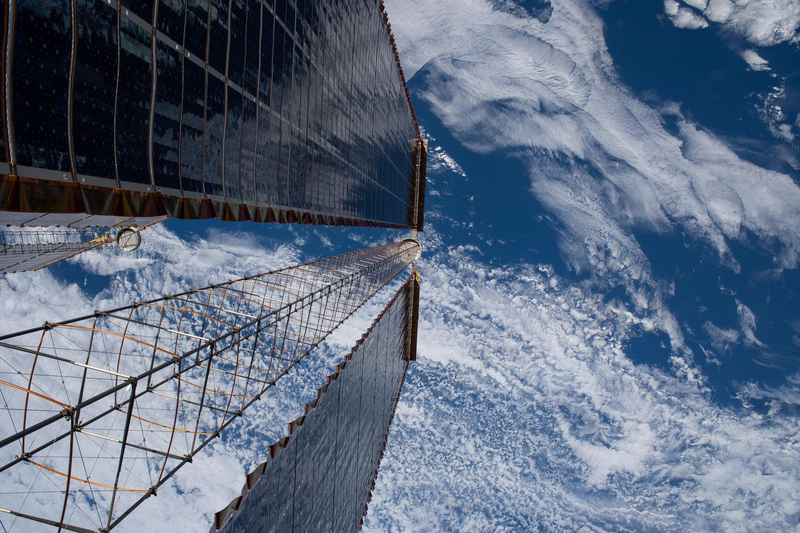
A roll of solar cells sat outside the International Space Station for two weeks, strapped to a carrier on the port side of the truss, waiting for two people to collect it. On October 29, 2026, NASA astronaut Anil Menon and Canadian Space Agency astronaut Joshua Kutryk switched their suits to battery power at 7:57 in the morning and floated out through the Quest airlock to fetch it. Seven hours and eleven minutes later they were back inside, and the seventh of the station’s new roll-out solar arrays lay stretched in sunlight in front of one of the original wings. The eighth and final array goes up on November 5. What is unusual about the hardware is not the photovoltaic layer but the way the blanket opens: no motor, no winch, no hand crank. It unfurls itself, the way a tape measure snaps out of its case, driven by tension stored inside composite booms wound tight for the trip to orbit.
The station’s eight original Solar Array Wings were built for a 15-year service life, and the first pair went up in December 2000 on STS-97 (NASA). Twenty-six years on, radiation and micrometeoroid damage have dulled their photovoltaic blankets. Meanwhile the station kept growing: more modules, commercial crew, more research payloads, and NASA technology demonstrations in orbit for trips to the Moon and Mars. All of it wants electrons. The roll-out arrays exist because of that squeeze: the fix had to be light, installable by two people in a spacesuit, and large enough to matter.
Replacing the old wings was never on the table. Each hangs from a mast can at the end of a truss segment, driven by a beta gimbal assembly that tracks the Sun and wired into a power channel with its own switching. Swapping them would have meant new structures, new gimbals, new cabling and a launcher with shuttle-class cargo capacity. NASA took the cheaper route and mounted smaller arrays in front of the old ones. Each new blanket covers a little more than half the length of the wing behind it and feeds the same channel, so the new panel makes its own power, the old wing keeps making power from the strip that is not shaded, and the original hardware is never touched (NASA, Oct. 15, 2026). The price of that arrangement is arithmetic. A panel in front of a panel earns less than the sum of its parts.
The seventh array had been aboard since October 15, when a SpaceX Cargo Dragon launched on a Falcon 9 docked at Harmony with the final pair folded in half on a carrier in its unpressurized trunk (NASA). Menon and Kutryk unbolted it free. Menon then locked his boots into a foot restraint on the end of the 58-foot Canadarm2 and rode the array out along the truss while flight controllers Jessica Watkins and Luke Delaney flew the arm from inside. One practice changed since the earlier installs: the arm now pivots about the array’s center of mass instead of the astronaut’s, taking the load off the person holding 340 kilograms of it (Spaceflight Now, Oct. 28, 2026). The spacewalk began in orbital darkness, which is when this work has to happen. Connectors on a solar array run hot and cannot be handled with sunlight on the blanket, so the four cables tying the new array into power channel 2A were mated in the dark. Kutryk noted the conditions from the airlock: “the night is dark and full of wonders.” Four hours and 23 minutes in, the station crossed back into sunlight, Menon released the last restraint with a power tool, and the blanket began to unroll, reaching full length over about ten minutes with nobody pushing it.
It was the 100th U.S. spacewalk and the 285th supporting station assembly, maintenance and upgrades since 1998 (NASA, Oct. 29, 2026). Menon, an Air Force lieutenant colonel and emergency physician, had three spacewalks before this one. Kutryk, a Royal Canadian Air Force colonel and test pilot who boarded the station in October on Crew-13, made his first, the fifth Canadian to walk in space and the first since David Saint-Jacques in 2019. The eighth array is the harder placement. It goes on the 3B channel at the far end of the truss, past the reach of the robot arm, so on November 5 the two of them will pass it between foot restraints in a handoff the team calls the leapfrog, then repeat the sequence of unfolding, cabling in the dark and letting the booms go (Spaceflight Now).
The power arithmetic gives the upgrade its shape. An International Space Station Roll-Out Solar Array, or iROSA, is rated at about 28 kilowatts at beginning of life and weighs roughly 340 kilograms folded, about 10 feet long, unrolling to about 60 feet (NASA STMD; Spaceflight Now). Its net contribution is much smaller than 28 kilowatts, because the wing behind it makes less than it used to. NASA’s accounting puts the station’s orbital-daylight capacity at up to 160 kilowatts before the upgrade and about 215 kilowatts after all eight arrays are installed, a gain near 30 percent (NASA, Oct. 15, 2026). What the new hardware actually adds has been closer to 8 kilowatts per array: station output moved from roughly 152 kilowatts before the first roll-out array flew to about 200 kilowatts with six installed (CBS News, Oct. 29, 2026). Eight arrays that each make 28 kilowatts and each add 8 is the upgrade in one line.
The array’s spine is a pair of stiff composite booms, built like split tubes, flattened and rolled lengthwise. Rolled that way they hold their shape and store strain energy, the way a bent ruler holds its bend. Released, they want to straighten, and as they do they drag the photovoltaic blanket out of its canister like a measuring tape. No motor means no gearbox and no powered latches to jam at the wrong moment. Flight director Garrett Hehn compares the result to a snap bracelet that “just continues rolling out steadily” (CBS News, Oct. 29, 2026). The design came out of Deployable Space Systems, a startup that turned NASA Small Business Innovation Research money starting in 2009 into a roll-out array before Redwire absorbed it in 2021 (NASA STMD). The first flight test on the station in 2017 was meant to last a week. The array deployed on June 18, 2017, but the crew tried three times to fold it back and could not get the blanket to line up evenly, so the station released it rather than risk the hardware (NASA, June 26, 2017). Two roll-out arrays powered NASA’s DART spacecraft on its flight to a test asteroid in 2021, and a pair will power the Power and Propulsion Element that NASA’s Gateway lunar outpost depends on (NASA STMD).
What the extra power buys is time and margin. Roughly 55 kilowatts more than the station started with will cover life support, research payloads and visiting vehicles through the outpost’s remaining years, and some of it will still be doing work on the day the station is flown into the atmosphere in 2030 (Spaceflight Now). The oldest hardware in the station has been asked to outlast its own design life by more than a decade. The answer was to build something that opens itself, hang it in front of the part that is failing, and send two people in white suits out to bolt it on. On November 5 they will do it one final time.
 Subscribe to our RSS feed









There are no comments.
Add A Comment