


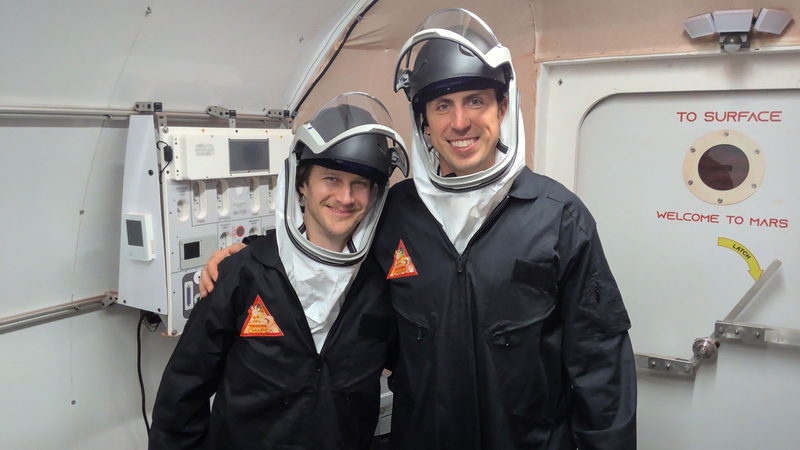
On Saturday afternoon four people will step through a door in a hangar at NASA’s Johnson Space Center in Houston and see daylight for the first time since October 2025. The door is marked “TO SURFACE” above a round porthole, with “WELCOME TO MARS” painted underneath. Ross Elder, Ellen Ellis, Matthew Montgomery and James Spicer passed through it on Oct. 19, 2025, and they have been on Mars since, in a 1,700-square-foot habitat printed out of concrete and surrounded by red soil and a fake cliff line (NASA, October 2026).
The spacecraft is not there, and neither are radiation, three-eighths gravity or the perchlorate dust that would coat a real outpost. What the hangar does provide is harder to model: four people in a small volume, a finite pantry, equipment that fails on a schedule, and a radio link to Earth that never answers fast enough to be called a conversation. NASA’s Crew Health and Performance Exploration Analog, or CHAPEA, exists to put those stressors under a roof where instruments can watch them. The second crew walks out on Oct. 31, 2026, and spends the two weeks after that in post-mission evaluation and debriefing before going home (NASA, October 2026).
Analog research is old business. The longest confinement experiment ever conducted is MARS-500, a psychosocial isolation study run from 2007 to 2011 by Russia, the European Space Agency and China at the Institute of Biomedical Problems in Moscow, where six crew lived 520 days inside a sealed mock-up (ESA/Roscosmos). Antarctic stations and NASA’s Human Exploration Research Analog cover other corners of the same map. What CHAPEA adds is latency, and latency is the one stressor no polar station can offer.
The physics is unremarkable. Earth and Mars are separated by between roughly 55 million and 401 million km, so a radio signal crosses that gap in about three minutes at closest approach and as many as 22 minutes at the farthest point. A question asked over breakfast comes back after breakfast is over (NASA, 2025). NASA’s technical memorandum on the state of communication-delay research states the operational figure: Mars missions will meet a 22-minute one-way, 44-minute round-trip delay at maximum distance from Earth, and the agency’s Human Systems Risk Board has already assessed the risk that comes with losing live ground support (NASA TM-20250003885). CHAPEA enforces that delay on a schedule, and partway through the mission the crew worked through a simulated two-week blackout with no contact with Earth at all.
NASA picked its second crew with roles that mirror a real flight: Elder as commander, Ellis as medical officer, Montgomery as science officer, Spicer as flight engineer (NASA, October 2026). The year arrived in milestones the agency marked in public: photographs at 100 and 300 days, an update at 200 days on what half a year of isolation had taught the team, and a statement at 365 days that the crew would exit on schedule (NASA/JSC, 2026). Inside, the workload was NASA’s whole point: simulated spacewalks in pressure suits, crop stations growing peppers and tomatoes, geological sample handling, habitat maintenance, blood draws, medical monitoring and daily exercise. Principal investigator Grace Douglas said she was “extremely proud of the crew for their commitment and achievements over the last year” (NASA, October 2026).
The agency put real engineering into the box. The structure was printed by ICON with its Vulcan construction system using Lavacrete, a proprietary cementitious mix, and designed by Bjarke Ingels Group, whose architects called the habitat Mars Dune Alpha. The layout runs on a gradient of privacy: four private crew quarters at one end, workstations, a medical station and food-growing stations at the other, shared space between them, under an arching shell that changes ceiling height from room to room. Lighting, temperature and sound are adjustable and the furniture moves, so the crew can tune the environment instead of living inside a fixed set of moods (ICON, 2021; NASA, 2026). In floor area that is 158 square metres for four people, roughly 39 each, and every bit of it holds sleeping, food growing, exercise, medicine, repair and work. The reason to print rather than launch the structure is the reason Martian outposts would be printed at all: building materials are cheap in orbit and ruinously expensive to fly, while regolith is simply where you are standing. NASA’s own argument is blunt: additive construction would remove the need to launch large quantities of building material on multiple flights (NASA, 2026).
By NASA’s own assessment, the least realistic part of the simulation is the part that matters most when something breaks. The communication-delay memorandum surveyed two decades of research and found a “general lack of fidelity in studies of mission-critical tasks, including problem solving, emergency response, maintenance, and complex procedure execution,” which the authors attribute to analog missions putting safety and mission objectives ahead of fidelity (NASA TM-20250003885). The same review argues for countermeasures aimed at the problem: training that includes communication delay, and tools for asynchronous collaboration, where a crew writes its plan down, sends it, and works the answer instead of waiting for it. It also flags a gap that matters for the Moon rather than Mars, since one-way delays of 3 to 14 seconds are possible on lunar missions and almost nobody has studied them under conditions that resemble actual operations (NASA TM-20250003885).
Suit work is where a Mars mission burns its budget, and the analog crew spent hours on the version of it a real crew would do differently. A 2026 study in Frontiers in Psychology put 14 participants through simulated surface extravehicular activities on an integrated virtual-reality and treadmill rig, then made geological sample identification harder. Subjective workload rose, cognitive performance fell, physiological responses shifted and performance on core EVA tasks dropped (Anderson et al., 2026). The result is narrow, and it is the kind of number a mission designer wants: the deciding variable is not the suit, it is how hard the geology is while the suit is on.
None of this makes the analog optional. An ESA topical team that surveyed the field concluded that analogs remain the only way to study mental and social variables under conditions close to a real mission, and it catalogued what they cannot do: they do not reproduce hypogravity or radiation, they cannot be left unsupervised, and their culture of safety distorts the emergency behaviours researchers most want to observe (De la Torre et al., 2024). The practical consequence is that CHAPEA produces bounds rather than answers, which is why a third and final one-year run is already scheduled. One crew is one crew, and a second run partly exists to find out whether the first was typical.
On Saturday the crew gets its own data back, and the instruments start working. The next two weeks of evaluation and debriefing will tell NASA how the year actually felt, and the answers feed the agency where it is about to spend real money: the food system, the mass and volume budgets of future vehicles, and the resource trades that decide how much hardware a crew can carry. As Michael Stenger, chief scientist for NASA’s Human Research Program, put it, the point is to “translate the knowledge from these experiences to Moon Base and beyond” (NASA, October 2026). For a crew that one day lands on Mars, that translation comes down to waiting. The radio lag, the missing spare part, the long silence between one decision and the next are not side effects of the mission. They are the mission, and until Saturday four people had not been allowed to find out what that does to them.
 Subscribe to our RSS feed









There are no comments.
Add A Comment