


Six Metres of Shade, and a Telescope That Hunts Asteroids
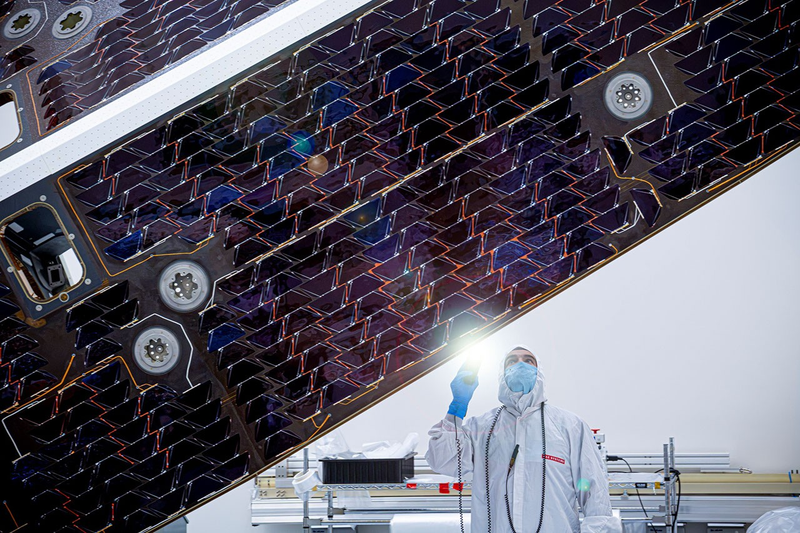
In a clean room in Boulder, Colorado, a technician in a white coverall held a lamp up against six metres of dark solar cells and checked them for defects. The panel is the largest single structure NASA will fly to hunt for asteroids, and it has to do two jobs that pull against each other: block the Sun so the telescope behind it can get cold enough to work, and catch the Sun to make the power that runs everything else. On 26 October 2026, NASA said the sunshade for the Near-Earth Object Surveyor mission had finished its solar-cell integration and passed functional and performance testing of the array (NASA, 26 October 2026). Nearly every advantage of hunting asteroids from space rests on this one piece of hardware.
Asteroids are dark. Their surfaces reflect something like 5 to 30 percent of the light that hits them, and a ground-based optical telescope sees that reflected light, which means it sees the sunlit face of an object, and only when that face happens to be pointed our way. Anything approaching from near the Sun presents an unlit face against a glare-blasted sky. On 25 July 2019 a 100-metre asteroid called 2019 OK passed 65,000 km from Earth’s surface, about a fifth of the way to the Moon. It was first spotted by the Southern Observatory for Near-Earth Asteroids Research in Minas Gerais, Brazil, about a day before the flyby. Pan-STARRS and ATLAS had in fact photographed it in the weeks beforehand, but the rock crawled so slowly that their software did not recognise it (ESA, August 2019). An object of that size strikes Earth on average once every 100,000 years.
That near miss landed in a policy argument that has run for two decades. The George E. Brown, Jr. Near-Earth Object Survey Act of 2005 directs NASA to detect more than 90 percent of all near-Earth objects larger than 140 metres by 2020 (U.S. Congress, 2005). Researchers estimated that only about 40 percent of that population had been found, and the shortfall is not for want of telescopes. The Catalina Sky Survey and Pan-STARRS use 1- to 2-metre mirrors at visible wavelengths and turn up between 2,500 and 3,000 new near-Earth objects a year, but only about 450 of them are in the large-object range that matters (Mainzer and Masiero, 2023). A 140-metre impactor carries the equivalent of roughly 200 megatons of TNT.
The difficulty with ground surveys is the sky itself. Within a few tens of degrees of the Sun, daylight and twilight wash everything out, and that is exactly where the objects on the most circular, Earth-like orbits tend to sit. NASA’s Wide-field Infrared Survey Explorer changed the arithmetic for a while. WISE launched in December 2009 with a cryogenically cooled 40-centimetre telescope and four infrared bands at 3.4, 4.6, 12 and 22 microns. Its hydrogen cryogen ran out in September 2010, the mission continued four more months on the two shortest bands, and the spacecraft was put into hibernation in February 2011 having detected more than 158,000 minor planets, including over 34,000 new discoveries (NEOWISE, IPAC/Caltech). It came back in 2013, worked until July 2024, and burned up in November 2024. What it could never do was look toward the Sun, because its short sunshade and low orbit kept its field of regard away from the region NEO Surveyor was built to cover.
So the replacement is being assembled the long way round, one industrial contract at a time. Applied Aerospace built the sunshade structure in Stockton, California. SolAero Technologies covered it with 864 interconnected solar cells in Albuquerque in January 2026, the assembly then went through environmental testing in a commercial thermal vacuum chamber in El Segundo in March, and it reached BAE Systems Space & Mission Systems in Boulder in May, ahead of schedule (NASA, 26 October 2026). The structure stands 20 feet, roughly 6 metres, tall and is 8 feet wide at the base, formed from two flat panels joined at a 23.5-degree angle. Coarse Sun sensors and temperature sensors have since been integrated onto it, and the array can produce up to 2 kilowatts, enough to charge the batteries that run the spacecraft.
That shade exists for one specific number. NEO Surveyor’s telescope is a 50-centimetre three-mirror anastigmat with a 1.68 by 7.08 degree field of view and no central obscuration, feeding two infrared channels through a germanium beamsplitter. The short channel, NC1, spans 4 to 5.2 microns and is there to find stars, which is how the mission knows where it points; the long channel, NC2, spans 6 to 10 microns and is where the science happens, because a near-Earth asteroid at 200 to 300 kelvin radiates most of its heat in that range. Each focal plane is a four-by-one array of 2048 by 2048 pixel mercury cadmium telluride detectors, and the pair builds a 16-megapixel mosaic of the sky (Mainzer and Masiero, 2023).
Staying useful at that wavelength is a thermal problem with a hard threshold. The detectors have to stay below 40 kelvin or their dark current swamps the faintest signal the survey will ever look for, and the telescope itself has to hold below 57 kelvin. Heat arrives from four directions: the Sun, the roughly 300 kelvin spacecraft bus, the electronics that read out the arrays, and the zodiacal dust glow of the solar system, which is the background the mission must see through. The sunshade kills the first. A shield underneath the instrument catches radiation from the spacecraft bus. Three radiators coated in high-emissivity black paint on the back of the telescope dump the rest into deep space, and the chain runs passively, with no cryogen tank and no cryocooler. The design comes straight from Spitzer.
Everything about that shade is aimed at one number: 45 degrees, the closest NEO Surveyor will look toward the Sun. A 6.15-metre sunshade buys that inner edge of the sky, and it is a geometric trade rather than a free win, because the panel that blocks sunlight also throws a shadow across the field. The survey’s field of regard runs from 45 to 120 degrees in longitude from the Sun and stops at plus or minus 40 degrees of ecliptic latitude, with the instrument able to point anywhere from 45 to 125 degrees out, including both ecliptic poles (Mainzer and Masiero, 2023). The spacecraft sits in a halo orbit around the Sun-Earth L1 point, which keeps a large arc of Earth’s orbit in view, including the near-Sun regions ground observers cannot reach. L1 was picked over L2 because the Moon intrudes less on the field of regard there and the high-gain antenna does not have to ride on the sunshade.
From that perch the telescope does the same thing every night for years. A visit is six 30-second exposures stepped about 10 arcseconds in a rough hexagon, stacked into a 180-second frame, and each patch of sky is covered four times over six to nine hours. The detectors are collecting photons 56.7 percent of the time; the rest goes to camera readout, to slews between pointings, and to daily housekeeping. Across the five-year baseline survey that adds up to roughly 630,000 visits. At IPAC/Caltech, a pipeline descended from the ones built for WISE and the Zwicky Transient Facility links those detections into tracklets and ships them to the Minor Planet Center two or three times a day, typically within 72 hours of the last observation in a set (Mainzer and Masiero, 2023). Main-belt asteroids outnumber the near-Earth ones by roughly a thousand to one near the ecliptic, so the filtering is the hard part.
The scale of the payoff is the reason the shade was worth building bigger than the telescope. NEO Surveyor must find two thirds of all potentially hazardous asteroids larger than 140 metres within its five-year baseline survey, and reach the 90 percent completeness the 2005 law asked for if it can stay in business for 12 years. That should mean between 200,000 and 300,000 new near-Earth objects down to sizes of about 10 metres, plus thousands of comets, and a far sharper estimate of how often Earth actually gets hit. The spacecraft launches no earlier than September 2027 (NASA/JPL). The structure that makes all of it possible has already been built, tested and delivered early.
 Subscribe to our RSS feed









There are no comments.
Add A Comment