


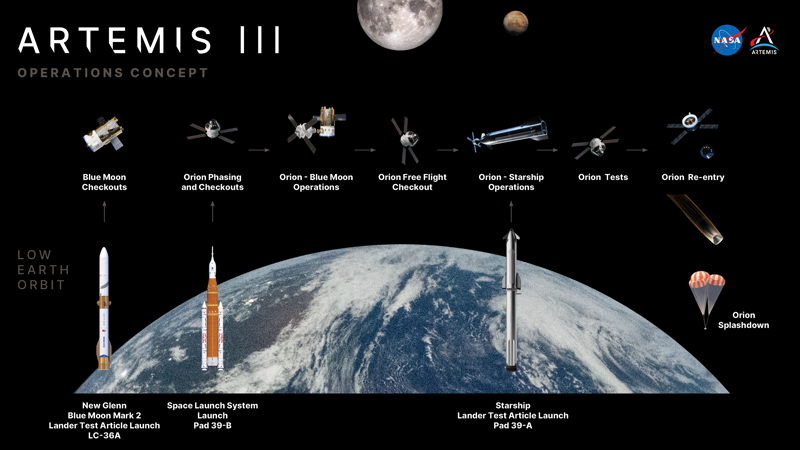
Getting American astronauts back to the lunar surface now depends on three rockets that mostly do not look alike, and on the fact that all three are changing at once. On 23 October 2026, at a press conference at Kennedy Space Center, NASA laid out how Artemis III will be flown, and the answer was a rehearsal, not a landing. Four astronauts will launch on the Space Launch System in 2027, dock with a test Blue Moon lander and a test Starship in Earth orbit, and come home. The landing itself moves to Artemis IV in 2028, and the first crew on the surface since Apollo 17 will ride on whichever of the two commercial landers proves ready first (NASA’s release on the revised plan).
That rework set off a hardware sprint across three launch pads. Each vehicle is getting a new upper stage, a new engine, or a whole new configuration, and the changes are not interchangeable. SLS is losing the upgrade it was supposed to get and gaining a different one. Starship is getting a docking adapter, a tanker fleet and an upper stage for its own lander. New Glenn is getting a bigger first stage, a rebuilt pad and a four-launch plan that was not in the original design. Side by side, the three are three answers to one question: how do you get a crew to the Moon and back without flying the same hardware twice?
The reordering also exposes an uncomfortable schedule. NASA Administrator Jared Isaacman announced the new sequence roughly a month before Artemis II lifted off in April 2026, and officials now describe Artemis III as an Earth-orbit test in mid-2027, with Artemis IV and Artemis V both aimed at landings in 2028 (SpacePolicyOnline on the schedule). The South Pole remains the destination, justified by water ice thought to be accessible in permanently shadowed terrain, though the agency concedes it needs more data from robotic landers before committing. The suits are being built by Axiom Space. One detail is significant: the docking test happens in low Earth orbit rather than near the Moon, letting NASA learn the hard parts of rendezvous while a crew is still a quick flight from the splashdown.
The Space Launch System is the odd one out, the only one of the three being simplified. NASA’s original plan was a Block 1 rocket with the Interim Cryogenic Propulsion Stage for the first missions, then a Block 1B with Boeing’s larger Exploration Upper Stage and a Block 2 with new solid boosters. That ladder was dropped in February 2026; the agency settled on a standardized configuration and picked ULA’s Centaur V as the upper stage to replace the interim stage from Artemis IV onward (Space.com on the upper-stage selection). Centaur V has flown on Vulcan since 2024 and holds roughly twice the propellant of the interim stage, and NASA is working with ULA on an extended version for the low-lunar-orbit role the new architecture calls for (Ars Technica on the revised architectures). For Artemis III itself, SLS will fly without a propulsion stage at all, using a non-propulsive spacer instead, since the mission never leaves Earth orbit.
Starship’s contribution to the same plan is the most expensive one, and the most contested. Under the revised concept, tanker variants of Starship fill a depot ship in low Earth orbit, the lander and Orion dock there, and the lander performs the burn that sends the combined stack toward the Moon (NASA’s release on the revised plan). How many tankers that takes is the argument. At a NASA Aerospace Safety Advisory Panel meeting, panel member and former astronaut Charlie Precourt put the estimate at around 22 flights, noting the large number of firsts stacked against Artemis IV. Elon Musk responded that the real figure would be closer to six to eight (Ars Technica on the tanker estimate). The gap is not just numerical. It depends on how much cryogenic methane and liquid oxygen boil off in orbit and how efficiently the transfer works, neither yet demonstrated. Even at a twice-weekly launch rate by the end of 2027, Ars Technica’s analysis puts the time to fuel a single depot at roughly three months.
New Glenn is the third rocket, and it is carrying the most physical damage. On 28 May 2026, a static fire at Cape Canaveral destroyed a fully stacked New Glenn and much of Launch Complex 36. Blue Origin traced the anomaly to the main liquid oxygen valve on one of the seven BE-4 engines in the first stage, with the root cause still open at the time of reporting, and began rebuilding the pad in June with a public target of returning to flight before the end of 2026 (KeepTrack on the LC-36 explosion and recovery). The rebuilt pad, LC-36A, flies the current 7×2 configuration, while LC-36B is being built for the heavier 9×4. New Glenn has flown three times, its third on 19 April 2026 ending with the loss of the payload, and its November 2025 ESCAPADE booster reused on that attempt. All of that sits underneath a lander campaign that needs the rocket to fly four times.
The engineering behind the new variants is where the three programs diverge most sharply. New Glenn 9×4 replaces the current 7×2 with nine BE-4 engines on the first stage and four BE-3Us on the upper stage, carries a fairing widened from 7 metres to 8.7 metres, and lifts roughly 70 metric tons to low Earth orbit against 45 tons for the original configuration, with the engine upgrades phased in starting with the third mission (Space.com on the 9×4 variant). Starship’s lunar lander and its depot ship shed hardware rather than adding it: neither re-enters Earth’s atmosphere, so both drop the heat shield and the fins, and the lander keeps six Raptor engines for ascent and landing while separate high-thrust engines in the mid-body burn gaseous oxygen and methane to avoid blasting the regolith (Wikipedia on the Starship HLS vehicle family). Blue Moon takes the opposite approach, keeping liquid hydrogen and liquid oxygen with a solar-powered system that holds propellant near 20 kelvin to fight boiloff, which matters for a lander meant to sit on the Moon rather than leave (Wikipedia on the Blue Moon lander family). And beneath all of it, the crew rocket changes hands: from Artemis V, NASA plans to transfer SLS production and launch operations to Deep Space Transport LLC, a Boeing and Northrop Grumman joint venture, hoping commercial customers spread the cost (Wikipedia on Deep Space Transport LLC).
The three vehicles have also started flying. Starship reached orbit for the first time on 28 September 2026 on flight test 14, deploying 26 operational Starlink V3 satellites after one of the six second-stage engines shut down early, which cut the planned six-orbit profile short but not the orbit itself (SpacePolicyOnline on the first orbital flight). For Artemis III, the sequence runs to a 14-day nominal mission: New Glenn goes first with the Blue Moon test article, SLS launches the crew next, and Starship flies on about flight day six to dock on day eight, with the Blue Moon docking on day three at roughly 273 miles (Space.com on the concept of operations).
What ties the three together is the 2028 landing, and what separates them is how each program pays for it. Blue Origin chose the conservative route, deferring in-orbit propellant transfer and instead flying three transfer stages built from existing Mark 1 and Mark 2 hardware ahead of the Blue Moon Mark 2 Alpha lander, which assembles in Earth orbit and departs for an elliptical polar orbit around the Moon. That is four New Glenn launches with no spacecraft-to-spacecraft refueling, on a booster whose pad was vaporized in May. SpaceX chose the opposite, betting that orbital refueling works well enough that a handful of tanker flights will cover the lander, a bet its own safety advisory board thinks is off by more than a factor of three. NASA bought optionality by choosing neither, flying both dockings in Earth orbit in 2027 and deciding the landing provider from what the data shows. The next real milestone is not a landing but a docking, and the hardware that has to make it work is still in pads and test stands.
NASA’s Artemis III operations concept graphic, showing the three launch vehicles and the docking sequence in low Earth orbit.
 Subscribe to our RSS feed









There are no comments.
Add A Comment