


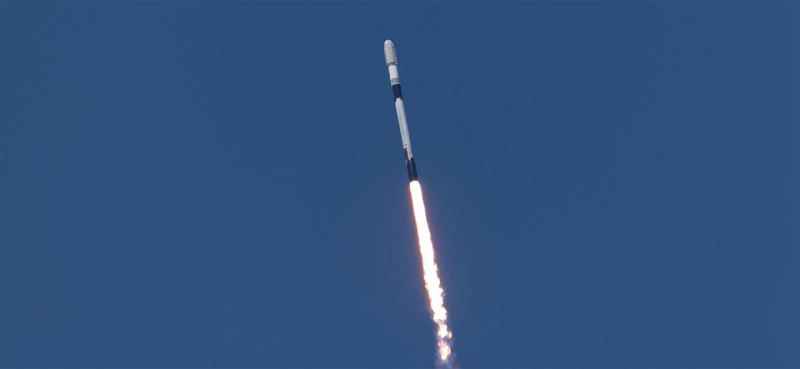
A Falcon 9 lifted off from Space Launch Complex 4E at Vandenberg Space Force Base at 11:32 a.m. PT on Thursday, October 1, 2026, carrying 130 satellites and hosted payloads into a sun-synchronous orbit on SpaceX’s eighteenth dedicated rideshare mission. It was one of three Falcon-family flights SpaceX flew that day, sandwiched between the Crew-13 astronaut launch from Florida in the morning and a National Reconnaissance Office Falcon Heavy from the Cape that night, and the size of the manifest made it the most diverse single launch of the year so far.
Transporter missions are SpaceX’s standing answer to the question “where do smallsats go?” The SmallSat Rideshare Program sells slots on quarterly Falcon 9 flights to SSO for as little as $350,000 per payload for up to 50 kg, with the cadence locked far enough in advance that customers can plan a satellite around a specific quarter instead of buying a dedicated rocket. The eighteenth such mission brought the program’s all-time tally past 1,800 payloads delivered to orbit, per SpaceX’s official mission page, a number that captures how the commercial smallsat industry is built as much on shared buses and shared launches as on the satellites themselves.
The first stage that flew Transporter-18 had already done this twice. It was the booster’s twenty-fifth flight, with a previous log that included NROL-126, Transporter-12, SPHEREx, NROL-57, USSF.366, and fourteen Starlink flights. Seven minutes and thirty-two seconds after liftoff it touched down on Landing Zone 4 at Vandenberg, returning to the same pad complex from which it had departed a few minutes earlier, in the kind of same-pad turnaround that has become routine for the West Coast booster fleet. Residents of Santa Barbara, San Luis Obispo, and Ventura counties may have heard one or more sonic booms as the booster came back through the denser lower atmosphere.
Inside the fairing, the manifest ran from cubesats to hosted payloads to two reentry vehicles and four orbital transfer vehicles that will deploy 41 of the 130 payloads at a later time. That architecture is the quiet structural innovation of recent rideshare flights: instead of forcing every customer into the same orbital plane on the same timeline, SpaceX has absorbed the role of mission manager. The OTV providers (D-Orbit, Exolaunch, Maverick Space Systems and others) now offer “deploy on a different day, at a different altitude” as a service to the payload builders. The Falco trade Via Satellite’s coverage of Transporter-18 describes a manifest where, for example, Tomorrow.io’s two weather satellites and Satellogic’s four optical Earth observation satellites ride along on the same Falcon 9 but can be dropped into different local times of day on station by their respective OTVs.
Several of the 130 payloads were firsts for their operators, which is what made Transporter-18 worth covering as a single story rather than as a pile of separate launches. Planet Labs flew the prototype satellite for Project Suncatcher, the joint effort with Google to test how Google machine-learning models and Google Tensor Processing Units behave when run in orbit rather than on the ground. Planet was the largest single customer on the flight, and in addition to the Suncatcher prototype it also flew the second Tanager methane-tracking satellite (Tanager being the methane mapper Planet developed with the CarbonMapper coalition), plus 18 SuperDove imagers manifested by SEOPS. StarCatcher flew Protostar, billed as a first-of-its-kind power-beaming node designed to demonstrate transferring electrical power between two free-flying spacecraft using optical links; a separate payload from Cowboy Space called Reason-1 is testing high-power laser energy transfer from low Earth orbit down to a ground receiver. Two demonstrations of moving watts around with light, on the same rocket, a few hours after the first ground-to-orbit ML inference test.
Starfish Space sent its first Otter servicing vehicle. It will run a NASA mission under the Small Spacecraft Propulsion and Inspection Capability acronym (SSPICY), and the flight is the company’s first operational satellite. CesiumAstro sent Element, its first full satellite built on the company’s own phased-array antennas, software-defined radios and onboard processors; Unseenlabs sent a pair of next-generation radio-frequency monitoring satellites, one to add capacity to its first-generation constellation and a BRO (BRO-32) to expand RF detection coverage across sea, land and space. Dhruva Space integrated LEAP-2, its second commercial mission, hosting multiple in-orbit demonstration payloads including units from Sodern ArianeGroup and the India-based Satleo Labs TAPAS-1.
The mission also carried two reentry vehicles from Varda Space Industries, continuing the company’s program of returning pharmaceuticals manufactured in microgravity, and the eight-satellite IRIDE Eaglet II cluster for Italy’s national Earth observation constellation. Constellation refreshes dominated the rest of the manifest: four ICEYE synthetic-aperture radar satellites, four Satellogic optical satellites, five Sateliot IoT nodes, two GHGSat methane monitors manifested by SFL Missions, and Tomorrow.io’s two weather satellites. According to the SpaceWatch.Global launch report and the NASASpaceFlight mission preview, the deployment sequence began at T+54 minutes and 22 seconds with the NASA-manifested Sprite cubesat and ran for the next hour through 89 individually sequenced deployments, with SpaceX confirming the deployment sequence had concluded at 3:41 p.m. ET.
What makes Transporter-18 worth thinking about beyond the manifest is the layering of three different kinds of space activity on the same rocket. There are constellation refreshes, which are now a steady, repetitive part of the smallsat industry the way cellular tower upgrades are a steady part of the telecoms industry. There are first-of-kind demonstrators: the Project Suncatcher ML-in-orbit prototype, the StarCatcher and Cowboy Space optical power-beaming tests, the Starfish Otter servicing mission. Their operational lifetimes may or may not turn into recurring revenue depending on what the data shows. And there are hosted payloads and secondary slots that let a university lab or a small country’s space agency get a satellite into orbit for the price of a rideshare ticket, which is what turns a quarterly launch cadence into infrastructure for everyone who builds the future of space hardware.
The next Transporter flight will not be far behind. Rideshare customers now plan their satellites around a known quarterly cadence from Vandenberg and the Cape, and a mission profile with 130 payloads, an OTV captain, and a twenty-fifth-flight booster is no longer an exception to the rule. It is what a normal Falcon 9 launch looks like in late 2026, and the question worth watching is not whether the next rideshare can carry this much, because the manifest will only grow. It is whether the long tail of secondary payloads can keep its quality bar as the cadence accelerates, and whether the experimental demos like Suncatcher and Protostar turn into recurring programs that share the same quarterly rocket on its own.
 Subscribe to our RSS feed









There are no comments.
Add A Comment