


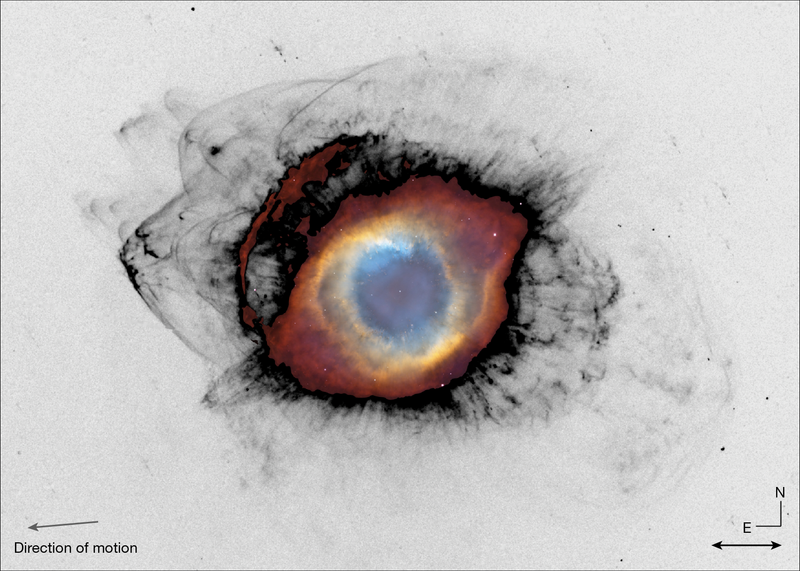
At roughly 650 light-years from Earth, the Helix Nebula is close enough to show structure that most planetary nebulae conceal. Its famous bright ring is the part that grabs the eye: a vast, blue-green disk of ionized gas surrounding a dying star. A new image from the partially built MOTHRA telescope reveals a quieter feature outside that ring. On the eastern side of NGC 7293, the gas forms a line of at least 22 arcs and partial arcs, each one a bow shock in the faint outer halo. (van Dokkum et al., Nature, 12 August 2026)
The image is not a new portrait of a planetary nebula’s familiar face. It shows the boundary where the nebula stops behaving like an orderly expanding shell and begins to dissolve into the surrounding interstellar medium (ISM). The arcs are the traces of dense fragments of material shed during the star’s asymptotic giant branch (AGB) phase. They are moving through gas faster than sound, compressing and heating the material in front of them.
That boundary is important because the final stage of a star is not the end of its influence. A star can spend much of its life returning its outer layers to the galaxy. The elements forged in the star, along with newly formed dust, eventually become part of new clouds, planets, and stars. The Helix gives astronomers a nearby place to watch that return in progress.
Stars lose mass long before they become white dwarfs. During the AGB phase, a modest-sized star develops a dense, slow wind and expels a shell rich in carbon, dust, and other products of nuclear processing. The planetary nebula is the visible aftermath: a fast flow catches up with that older material and lights it up. Later, the material has to join the much thinner, turbulent gas of the galaxy. That last handoff is hard to observe because the fragments become faint and widely spread.
The Helix is a useful natural laboratory for studying it. Gaia measurements place its central white dwarf about 198.6 parsecs away, close enough to resolve features a few hundredths of a parsec across. The new study found that the coherent bow-forming fragments have a characteristic survival time of about 10,000 years. That is a useful number for models of how galaxies circulate gas and metals. Simulations often treat this transfer as subgrid mixing, because no calculation can represent every cloud and filament inside a galaxy. (van Dokkum et al., Nature, 12 August 2026)
The result also shows how a purpose-built instrument can answer a question that ordinary photographs cannot. MOTHRA, the Modular Optical Telephoto Hyperspectral Robotic Array, uses many Canon 400-millimeter telephoto lenses instead of one enormous mirror. Its official design calls for 1,140 lenses on 30 mounts, with an optical system equivalent to a 4.8-meter f/0.08 refractor. The system is optimized for low-surface-brightness light, the kind of diffuse glow that disappears against the sky, foreground stars, and scattered light. (MOTHRA project, 2026)
The story begins with a late-AGB wind. Some of the material from that wind lies in clumps rather than a smooth shell. Over time, those clumps travel outward. The material now producing the eastern arcs appears to have been expelled earlier than the nebula itself: its velocity and distance imply ages of roughly 20,000 to 30,000 years, while the planetary nebula is about 12,000 years old. (van Dokkum et al., Nature, 12 August 2026)
The nebula is also moving through the local ISM. Gaia-derived measurements give a bulk speed of about 45 kilometers per second. A shock forms where that moving nebula meets material flowing into the opposite direction. The researchers estimate that the eastern bow shocks are traveling at 80 to 90 kilometers per second, with the western features moving more slowly, around 35 kilometers per second. The contrast is visible because the eastern fragments encounter the full combination of nebular expansion and ambient gas, while the western side is partly shielded by a turbulent wake.
A 20-minute-equivalent exposure by the completed MOTHRA array would have required 172.5 single-lens-equivalent hours with the five mounts used in 2025. The resulting image is striking for what appears at the focus of the arcs. There is no bright H-alpha, nitrogen, or oxygen emission at most of those locations. The fragments are likely mostly neutral, so the researchers identify them by the shocks they produce. This is the observational distinction that matters: the arcs are not a new population of objects. They are a map of invisible pieces of the old circumstellar envelope.
The fragments change as they move outward. The inner bows are broad, thin, and sharply bounded. Farther out, they become smaller, clumpy, and less distinct. Their radius of curvature falls by two orders of magnitude between about 0.4 and 1.4 parsecs. (van Dokkum et al., Nature, 12 August 2026)
MOTHRA is a lesson in designing for a measurement rather than for spectacle. A single huge lens is difficult to manufacture, mount, and keep aligned. A telephoto array uses commercially available lenses with excellent coatings and combines their light-gathering area. The trade is a wider field of view and a much more complicated calibration problem. Every lens must be timed, focused, and filtered consistently, and the detector image must be corrected for small differences in pointing and throughput. The Dragonfly project describes the system as a robotic array with a field of view larger than six square degrees, aimed at the faint circumgalactic medium and the cosmic web. (Dragonfly Telephoto Array, 2026)
The filters make the target visible. H-alpha is the hydrogen line at 656.3 nanometers, a useful tracer of ionized gas. MOTHRA uses a 0.93-nanometer H-alpha filter, whose width corresponds to a velocity spread of roughly 425 kilometers per second: Δv ≈ Δλ/λ * c. It also observes [N II] and [O III] emission and uses continuum filters with a narrow notch at the line wavelength. Subtracting the continuum removes much of the light that would otherwise drown the moving gas.
A bow shock is a supersonic interface. A useful first-order measure is the Mach number, M = v_shock/c_s. If the ionized gas has a sound speed near 10 kilometers per second, an 80-to-90-kilometer-per-second shock has M around 8 or 9. The flow compresses the gas, raises its temperature, and changes the strengths of its emission lines. The measured [N II]/H-alpha and [O II]/H-alpha ratios let the team distinguish a fast shock from a faint, slower feature.
The spatial trend provides the time measurement. A fit to the bow curvature can be summarized as R_c ∝ e^(-r / 0.27 pc). At the estimated expansion speed of about 40 kilometers per second, that corresponds to an e-folding disruption time of roughly 7,000 years. The result is a direct clue to the life of an AGB-shell fragment after it meets the ISM. The dense head shrinks through ablation and entrainment, while the surrounding gas carries its dust and elements into the larger galactic reservoir.
MOTHRA turns the outskirts of a familiar nebula into a test of stellar recycling. The 22 arcs are small individually, but their distribution lets researchers measure a process that is usually too faint to trace: the gradual loss of coherence by material shed from an evolved star. The Helix is not simply a glowing shell left behind by a white dwarf. It is a transition zone, where an old stellar envelope becomes part of the interstellar medium.
The completed array will search for similar fragment-driven shocks around other planetary nebulae. Astronomers can test whether the roughly 10,000-year disruption timescale is universal and look for molecular counterparts to the neutral clumps. Each new bow shock will add a coordinate to a still poorly measured stage of the galaxy’s life cycle. The next-generation instruments here are not making the universe look brighter for its own sake. They are revealing the slow, physical handover of matter between generations of stars.
 Subscribe to our RSS feed









There are no comments.
Add A Comment