


At 06:34 UTC on August 5, 2026, a hollow aluminum cylinder weighing roughly 3,900 kilograms crossed the last few hundred kilometers between Earth and the Moon at 2.43 km/s and stopped existing. The spent second stage of a SpaceX Falcon 9, cataloged as 2025-010D, slammed into the lunar surface near Einstein crater on the western limb and excavated a crater somewhere between 17 and 30 meters across. Almost no one on Earth saw it. The flash lasted less than a second, the impact site was on the sunlit side of the Moon during morning twilight for European and American observers, and the Sun-corona glare swamped any amateur telescope hoping to catch a thermal signature.
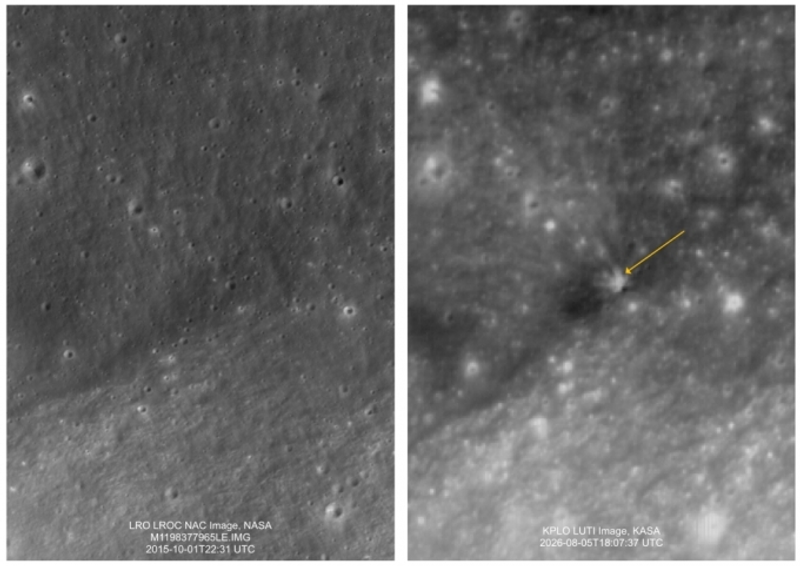
Eleven days later, the picture is clearer. South Korea’s Danuri orbiter published the first before-and-after images of the crater. Astronomers at Boston University working with the European Southern Observatory’s Very Large Telescope in Chile pulled a sodium and lithium line out of the ejecta plume. NASA’s Lunar Reconnaissance Orbiter is planning a follow-up pass that should image the fresh crater at half-meter resolution. For the first time in lunar science, the community has a controlled, predicted, multi-instrument observation of an artificial impact on the Moon.
The Chang’e 5-T1 third stage hit the Moon in March 2022 and the community was surprised by the double crater it left, because the shape implied more mass at the front of the rocket than the published payload would account for. The Falcon 9 stage is the second confirmed unintentional lunar impact, and the first that was on the near side, on the sunlit side, and watched in advance. About 100 lunar missions are planned over the coming decade, and each one leaves a spent upper stage in cislunar space unless the operator deliberately disposes it. SpaceX’s pre-impact statement was honest: on a translunar injection, almost all the propellant goes to the payload, and a controlled deorbit burn is not always possible. Solar radiation pressure and Earth-Moon perturbations then nudge the stage for months or years. The Falcon 9 stage launched in January 2025 carrying Firefly’s Blue Ghost-1 and ispace’s Hakuto-R Resilience; it took nineteen months for the Moon to catch it.
Most of the cameras were not pointed at the right pixel at the right fraction of a second. Jose Maria Madiedo at the Astrophysics Institute of Andalusia in Spain did publish ground-based video the next day, showing a faint plume rising above the lunar limb, but the impact point was hidden behind the Moon’s edge from his vantage. The VLT sodium and lithium detection came from Carl Schmidt, a Boston University planetary astronomer whose thesis work was on Mercury’s sodium exosphere. He had the right high-resolution spectrograph on the right telescope at the right time, and he caught a falloff of sodium and lithium emission extending tens of kilometers above the impact for five to ten minutes. The lithium is the smoking gun: the upper stage’s aluminum-lithium alloy tankage is the only plausible source.
The more satisfying story is Danuri’s. The Korean orbiter made a deliberate maneuver in mid-July to clear a worrying close approach with the incoming stage, then returned to its nominal orbit in time to take a pre-impact image at 3:01 p.m. KST on August 5, thirty-three minutes before the strike. Seven more imaging sessions followed over the next fifteen hours. The before-and-after comparison, released through the Korea Aerospace Administration on August 12, shows an unambiguous change in surface texture around the impact coordinates and a darker patch of ejecta extending some distance from the new crater. The LUTI camera has a resolution of a few meters per pixel, and the new crater is roughly the size of a single pixel or slightly larger.
The finer imaging will come from LRO. Mark Robinson, the LRO Camera principal investigator, told Inside Outer Space that the orbiter’s clean pass over the impact region on August 11 closed the acquisition cycle, with the crater in view at the LROC Narrow Angle Camera’s native 50-centimeter resolution. The high-resolution LROC imagery is expected to be published once the data is processed.
The science starts with the energy budget. A 3,900-kilogram object hitting the Moon at 2.43 km/s carries KE = 0.5 * m * v^2 ≈ 11.8 gigajoules of kinetic energy, equivalent to roughly 2.8 tons of TNT. By the standard point-source crater scaling for competent regolith, this corresponds to a transient crater about 17 meters in diameter and a final crater in the 20-30 m range once the walls have slumped, matching the predictions published by Fernando and colleagues (arXiv:2607.14625) and by Jo and colleagues at UT Austin (arXiv:2607.23904). The latter paper predicted an ejecta curtain extending 15-20 km above the surface, a central spike reaching 75-100 km, and a lateral spread of about 183 km. The central spike is the part that briefly exceeded the lunar escape velocity and would have scattered fine dust into cislunar space.
The interesting engineering question is what the hollow impactor did to the standard crater-scaling law. A spent Falcon 9 stage is mostly an empty propellant tank with a single Merlin Vacuum engine hanging off one end. Schmidt’s lithium detection is direct evidence that the stage broke up during entry rather than punching through as a coherent cylinder, because the lithium is locked inside the aluminum-lithium alloy of the tank bulkhead and would have vaporized before reaching the surface if the stage had stayed intact. The Chang’e 5-T1 double crater in 2022 told a similar story: a hollow rocket body, a mass distribution front-to-back that nobody had published, and a crater shape that surprised the modellers. Artificial impactors are not point masses.
The cislunar tracking problem is the bigger engineering gap. Ground-based optical and radar observations lose accuracy past about 0.1 AU because the radar return on a tumbling aluminum cylinder is weak and the optical signal is dominated by the Earth’s background. The Falcon 9 stage’s final weeks were tracked primarily by amateur astronomers using the Bill Gray Project Pluto pipeline and a handful of university observatories. The successful prediction and observation of this impact is a useful stress test of that network, and it came through. The next test, with about a hundred more lunar missions in the queue, will not be optional.
The Moon now has a second confirmed artificial crater, a fresh cislunar debris benchmark, and the first multi-instrument dataset of its kind. The VLT sodium and lithium detection is the cleanest engineering fingerprint of an artificial impact ever recorded, and Danuri’s images give crater-scaling models a calibration point they have not had before. LRO’s high-resolution pass on August 11 is expected to close the loop once the imagery is processed.
The less comfortable lesson is that cislunar traffic management is still a volunteer effort. The Falcon 9 stage was tracked, modeled, and observed by a coalition of amateur astronomers, two national space agencies, and academic research groups. There is no equivalent of the FAA for the volume of space between Earth and the Moon. As lunar launch cadence rises, that will have to change, because the next artificial impact will probably not be a quiet one with a known stage and a predicted trajectory. It will be a piece of hardware nobody realizes has drifted into the wrong orbit, and the only way to notice it in time is to be looking.
 Subscribe to our RSS feed









There are no comments.
Add A Comment