


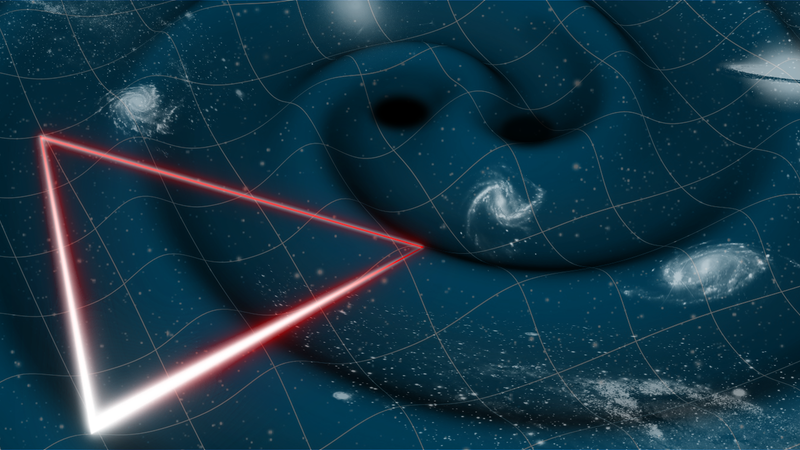
In a heliocentric orbit 50 million kilometers behind Earth, three spacecraft will fly in a triangle whose sides are longer than the Earth-Moon distance by almost seven times. At each vertex, a 46-millimetre gold-platinum cube will sit in near-perfect free fall inside a vacuum canister, while a one-watt laser reaches across 2.5 million kilometers of empty space to time-stamp its neighbour. The faintest change in that distance — as small as a few picometres, less than the diameter of a hydrogen atom — is the entire scientific signal. This is ESA’s LISA, the Laser Interferometer Space Antenna, and it is now in industrial construction with a launch set for summer 2035 aboard Ariane 6 (ESA, 2026).
LIGO’s 2015 announcement of a gravitational-wave detection ended decades of physics waiting for direct evidence (LIGO/Virgo, 2016). What gets reported less is the frequency window. Ground interferometers cannot measure below about 10 Hz: seismic noise, thermal creep of mirror suspensions, and shot noise from laser power all crowd out the lower bands. Earth-bound machines hear the final seconds and minutes of stellar-mass black hole mergers. They are deaf to the slow cosmic drum: supermassive black holes millions to billions of solar masses spiralling in over millions of years, white-dwarf binaries in our own galaxy ticking away for the age of the universe, and the primordial ripples left over from inflation or phase transitions (NASA LISA page, 2024).
The 0.1 mHz to 1 Hz band is where most of the gravitational-wave sky lives. LISA is built for exactly that band. It will measure strain noise S_h(f) on the order of 10⁻²⁰ Hz⁻¹/² near 1 mHz — a sensitivity roughly four orders of magnitude beyond anything reachable on the ground. Extreme mass-ratio inspirals (EMRIs), where a stellar-mass object plunges repeatedly through the curved spacetime around a supermassive black hole, will stay in LISA’s band for years of observation. Each such event produces a “treasure map” of the central black hole’s mass, spin, and quadrupole moment, mapping the near-horizon geometry in a way no electromagnetic telescope can match.
The empirical case that gravitational waves existed was settled in 1974. Russell Hulse and Joseph Taylor discovered the first pulsar in a binary system, PSR B1913+16, and over the following decades the binary’s orbital period shrank by exactly the amount general relativity predicts when gravitational radiation carries energy away from the system (Hulse & Taylor, 1975). The 1993 Nobel Prize in Physics marked that indirect detection. Three decades later, LIGO heard two black holes collide directly. Both milestones showed that the waves are real; neither could hear the ones that matter most for cosmology.
ESA has tried to fly a space detector since the 1990s. The earliest LISA design used six spacecraft instead of three. Two after the LISA Pathfinder test mission launched in December 2015, the mission delivered a physics result that pushed the formal adoption over the line. Between February 2016 and July 2017, two free-floating test masses inside Pathfinder’s 38-centimetre cavity kept a relative acceleration below 3 × 10⁻¹⁴ m s⁻²/√Hz at 1 mHz (Armano et al., 2017), and a year later the team reported measurements down to 20 microhertz that exceeded LISA’s planned drag-free requirement (Armano et al., PRL 120, 061101, 2018). ESA’s Science Programme Committee adopted LISA as the L3 mission on 25 January 2024. The agency signed the prime contractor deal with OHB System AG at the Paris Air Show in 2025: an €839 million award and the first time OHB has led an ESA flagship (ESA, 2025).
Industrial work began immediately. Phase 1 design kicked off in January 2025, with a System Preliminary Design Review due in late 2026 and Critical Design Review in late 2030. A 26.1 million euro contract to Thales Alenia Space, signed in May 2026, secured the Cassegrain telescope assemblies — the same optics that will send a 25 picowatt beam across 2.5 million kilometers and capture roughly the same amount of power back.
Funding politics complicated the schedule. The White House FY2026 NASA budget submitted in early 2025 proposed zero funding for LISA, which would have collapsed the U.S. instrument contribution. Congress reinstated an 80.5 million dollar line item for the year. ESA’s response, articulated by Director General Josef Aschbacher, was to begin building European replacements for the NASA-supplied lasers, telescopes, and charge-management devices, an insurance policy rather than a retreat. The LISA Pathfinder science consortium and OHB both work to a 2035 baseline launch.
The single hardest requirement is that each spacecraft must follow its free-falling test mass to within a few nanometres per second. Anything else — the gentlest puff of solar radiation, a photon from Earth’s albedo, the pressure of a passing cosmic ray — would jerk the test mass against the spacecraft wall and overwhelm the signal. The solution is a closed drag-free loop: an inertial sensor monitors the position of the cube relative to the spacecraft, and clusters of cold-gas micronewton thrusters fire to keep the chassis floating around it. Pathfinder demonstrated the thruster at roughly 0.17 microNewton per root hertz of white noise in flight (Armano et al., PRD 99, 122003, 2019), with the residual common-mode noise traced to the feed system rather than the thruster itself.
The strain signal that LISA will record, the dimensionless quantity h = ΔL/L for a passing gravitational wave, sits around 10⁻²¹ for a typical supermassive black hole merger at cosmological distance. Across 2.5 million kilometers, that strain produces an arm-length change of about 2.5 × 10⁻⁹ m, which is picometre territory. The interferometer must distinguish those changes from laser frequency noise, which would otherwise mask the signal because the round-trip light time of about 16.7 seconds means no two spacecraft see identical phase at the same instant.
This is why time-delay interferometry is mandatory. On the ground, equal-arm Michelson geometry cancels laser noise by symmetry. LISA’s arms are unequal and rotating, so the data pipeline algebraically combines six one-way links at given time delays — the familiar α, β, γ, ζ, and “second-generation” combinations — into virtual equal-arm observables whose frequency noise averages to zero to far better than the raw data (LISA Consortium technical notes, 2023). Without that post-processing, even picosecond timing is not enough.
The constellation orbit does the rest. All three craft fly Earth-trailing heliocentric orbits, 20 degrees behind Earth, with the triangle inclined about 60 degrees to the ecliptic. The arms breathe by roughly one to two percent over a year as the spacecraft trace out their cartwheel pattern. That slow modulation is itself a calibration tool, because its signature in the data is known to high precision.
By the mid-2030s LISA should be listening for gravitational waves from systems our species has never directly observed: a million solar mass merger from the early universe, a tight white-dwarf binary in the Milky Way halo, the slow, slow plunge of a small body into a galactic-centre black hole. Each detection will probe spacetime where its curvature is at its strongest and most dynamic. The hardware is large, slow, and quiet by design. Pathfinder showed that the drag-free concept survives the ride. The industrial build now underway will decide whether the triangle closes when it matters most.
Image credit: ESA, CC BY-SA 3.0 IGO (LISA-inspired artwork, hosted by University of Florida PSSL).
 Subscribe to our RSS feed









There are no comments.
Add A Comment