


The last time anyone wheeled across the Moon, Richard Nixon was settling into his second term and the Apollo program still had a flight or two to go. The astronauts were Eugene Cernan and Harrison Schmitt. The vehicle was the three-wheeled Lunar Roving Vehicle from Grumman. The run was December 11, 1972. After 35.7 km and a final tool-bag swap, the rover’s parking brake was released, the motor was left running, and the dust of Taurus-Littrow settled. No wheel has rolled on another world since. That is fifty-four years, give or take a lunar quarter.
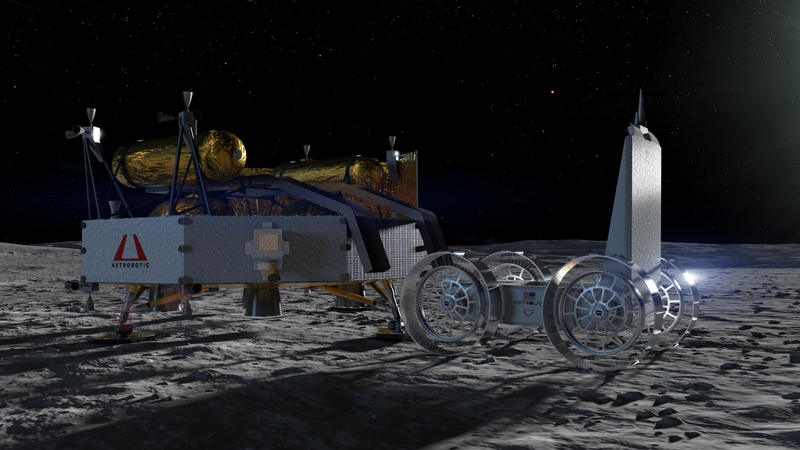
Watching for the next set of tracks is now a matter of commercial mission timing rather than national will. Currently scheduled for no earlier than July 2026, Astrobotic’s Griffin Mission One is meant to land a 625 kg payload on the rim of Nobile Crater near Mons Mouton at about 85°S, 53°E, and deploy the first wheeled explorer intended for that basin since Apollo 17 (Astrobotic, 2024; NASA CLPS updates, June 2026). The vehicle is the FLIP rover from Venturi Astrolab, a four-wheeled, 500 kg prototype that the company describes as a pathfinder for a much larger FLEX rover planned for 2027 or 2028. Two years and a couple of pivots ago, none of this looked likely. A NASA-sponsored rover meant to ride Griffin ended up canceled, then resurrected on a different lander, then carried home by a private-sector vehicle that almost did not exist in time.
Rovers are not a luxury in any plan to live on the Moon. The walking range of an Artemis astronaut in an EVA suit is a few kilometers per day, even on the best terrain. Anything beyond that hinges on a pressurized rover, an unpressurized rover, or a fleet of robotic scouts. With astronauts planned to land on Mons Mouton and other south polar sites in the late 2020s, the engineering question is not whether a vehicle should be on the surface first. It is what it should test.
The lunar south pole carries the strongest case for that urgency. Sunlight grazes the rim craters at angles so shallow that parts of their interior walls have not seen direct sunlight in billions of years. Permanently shadowed regions (PSRs) can reach 25 K, cold enough that water ice delivered by comets and volcanism over geological time has never sublimed away. NASA’s Moon Mineralogy Mapper (M3) on Chandrayaan-1 detected ice-bearing spectra at these latitudes in 2009. The LCROSS impact in October 2009 kicked up a plume with a clear water signature. Yet a remote detection is not an inventory. To decide whether to send a crew, mine regolith, or build a fuel depot, you need a rover that drills, measures, and survives the long polar night. CLPS is the on-ramp: each lander is one more bet that a company can land precisely enough to shrink future mobility risk (NASA CLPS program page, June 2026).
Astrobotic’s story starts with the company’s first flight. Peregrine Mission One launched on the maiden flight of ULA’s Vulcan Centaur in January 2024, then suffered a propellant leak that kept it from landing and forced the spacecraft to burn up over the South Pacific. Less than six months later, in July 2024, NASA canceled the VIPER (Volatiles Investigating Polar Exploration Rover) mission, which had been slated to ride Griffin. The agency cited cost overruns that had pushed VIPER past $450 million. The flight contract with Astrobotic was kept, because the agency still wanted a precise polar landing demonstration. The launch was bumped from late 2024 into 2025, then to 2026 (Astrobotic, 2024).
The mission that took shape goes like this. A SpaceX Falcon Heavy lifts the 4,500 kg Griffin lander from Launch Complex 39A at Kennedy Space Center. After a multi-day cruise, Griffin uses terrain-relative navigation and a pulsed main engine on liquid oxygen and liquid hydrogen to set down inside Nobile Crater. The flight avionics were proven against NASA’s Deep Space Network in a three-week test in late 2024, with telemetry flowing through DSN’s Goldstone, Canberra, and Madrid complexes (Astrobotic, October 2024). On the surface, Griffin will deploy Astrolab’s FLIP rover, a small Astrobotic CubeRover variant, the BEACON rover from Mission Control, and a stack of cultural and science payloads including Interlune’s helium-3 prospecting instrument.
The story behind the payload swaps is the more interesting angle. NASA reversed the VIPER cancellation in September 2025 and reassigned the rover to Blue Origin’s Blue Moon Mark 1 lander under task order CS-7, scheduled for late 2027. The same rover that was supposed to ride Griffin now goes elsewhere. Meanwhile, Astrolab, which had been working on a larger FLEX for the Lunar Terrain Vehicle competition, scaled down to a near-half-tonne demonstrator it could deliver in under twenty months. The narrowness of that window is why FLIP exists at all. Astrobotic’s Steve Clarke, in trade-press remarks, called the timing “the cleanest kind of opportunity.”
The dust problem drives more design choices than any other. Lunar regolith is roughly 20–100 µm grains of impact-shattered glass and mineral fragments. Electrons from the solar wind implant positive charge in the dayside top layer while the unlit subsurface stays negative, producing local electric fields that lift fine particles. The result is dust that clings electrostatically, abrades seals, frosts radiators, and fouls optical surfaces. FLIP carries METAL (Moon Exploration for Titanium with Active Lighting), a multicolor camera and radiometer from NASA Ames designed to estimate helium-3 concentrations in regolith, and LDES (Lunar Dust level sensor and Effects on Surfaces) from Johnson Space Center, which quantifies how dust degrades critical surfaces over time (NASA CLPS payloads, May 2026). The hyper-deformable wheels Venturi Space built in Switzerland are tuned to absorb impacts and shed dust by flexing the contact patch outward.
The thermal problem runs next. The Moon’s 29.5-day rotation means fourteen Earth days of sunlight followed by fourteen of dark at the equator. At the south pole the pattern is shorter and more chaotic, with some craters rim-locked in shadow for over seventy hours. FLIP’s high-performance batteries, built by Venturi Space in Monaco, are sized to keep avionics warm through a single night. Surviving multiple cycles is held in reserve for FLEX. Mons Mouton was picked because of ridge crests with safe-haven illumination that exceed the rover’s solar threshold for parts of each long polar night.
The mass problem is governed by Tsiolkovsky. For a stage with exhaust velocity v_e and mass ratio m_0/m_f, the budget is Δv = v_e * ln(m_0 / m_f). Translunar injection from low Earth orbit needs roughly 3.2 km/s on top of the launcher’s job, and Falcon Heavy delivers about 16.8 t to TLI fully expendable, 10.3 t with side-booster recovery. Griffin ships close to 4.5 t wet, well within margin even on a partly reusable Falcon Heavy profile. The lunar LiDAR demo from Marshall Space Flight Center is another flight-first: a hardened time-of-flight scanner for hazard detection, sized to feed terrain maps back to operators faster than orbital imagers can.
If Griffin lands cleanly and FLIP rolls, several quiet records fall in one season. The first American wheeled surface mobility since Apollo 17. The first precise landing at Mons Mouton, a site NASA has been circling for more than a decade. The first time a private company delivers another company’s rover on top of its own.
Worth watching next is not the headline. It is the dust log, the wheel telemetry, and whether the batteries survive a long polar night. By the time humans reach Mons Mouton, commercial rovers will have already mapped places no orbital camera can resolve.
 Subscribe to our RSS feed









There are no comments.
Add A Comment