


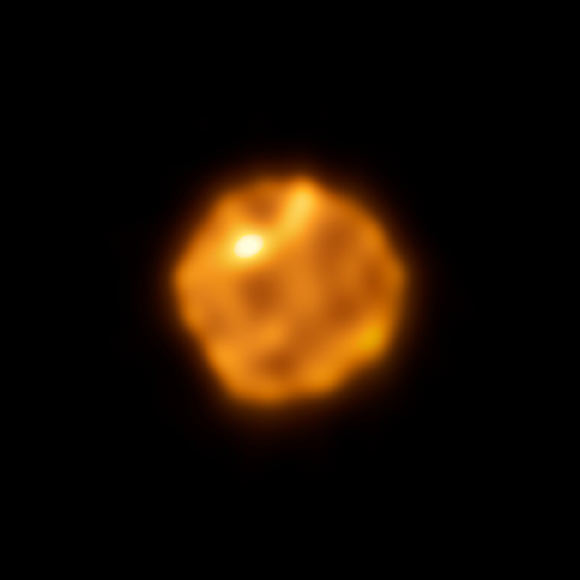
Astronomers using the Atacama Large Millimeter/submillimeter Array have resolved the surface of Betelgeuse closely enough to see two hot patches on its outer shell, one of them about 800 kelvin warmer than the surrounding gas, and the brighter one has not moved in seven years. That kind of stability matters because the standard picture of a red supergiant is a churning ball of plasma whose outer layers roil with bubbles rising and falling on timescales of months to a few years. A feature that survives for at least seven years without drifting or fading is a different class of object than a single convective plume, and the new ALMA images are forcing stellar physicists to redraw how a supergiant’s surface organizes itself.
The observations were taken in August 2023 using ALMA’s longest-baseline configuration, which gave the team angular resolution down to about 7 milliarcseconds at the shortest wavelengths. That is sharp enough to resolve structure at roughly 1.1 to 1.3 stellar radii, the inner part of the photosphere where most of the millimeter-wave light originates. Compared against a comparable 2015 dataset, the new view shows that Betelgeuse is not just irregular but persistently irregular, with a stable geometry that convection models have to reproduce.
Betelgeuse is the closest red supergiant to Earth that is bright enough to be imaged in this detail, and it is the prototype for an entire class of massive evolved stars that seed the interstellar medium with heavy elements when they explode. Anything we learn about how its surface is structured carries over to every other red supergiant we can see in nearby galaxies, and to how those stars shed mass in the centuries before they go supernova.
Until recently, the main puzzles about Betelgeuse were its brightness, which had an unexplained dip in late 2019 and early 2020, and the possibility that it might be hiding a smaller companion star, which a separate VLT team reported in July 2026. Surface structure is a third puzzle, and arguably the more physically interesting one, because the photospheric pattern tells you how mass is being transported from the deep interior out into space. If convection organizes itself into stable polar plumes, the mass-loss geometry of the entire star follows from that pattern. The new ALMA data show the NE hot patch sitting near one of the proposed rotation poles, which suggests convection may be funneled along the polar axis rather than scattered randomly across the surface.
For stellar physics, this is the first time anyone has tracked a hot patch on a red supergiant for as long as seven years and shown that it does not rotate with the surface the way sunspots do. That is a measurable signal that large-scale convection in these stars is anchored to something deeper than the photosphere, and the natural candidate is the rotation axis itself.
The new paper, ALMA high resolution observations of Betelgeuse: Persistent structure spanning the inner atmosphere by Bill Dent and colleagues at ESO and several partner institutions, was posted to arXiv on 19 August 2026 and accepted for publication in Astronomy & Astrophysics. The team’s lead author, Bill Dent, is an ESO astronomer who has worked on ALMA instrumentation since its commissioning era, and the paper combines a fresh long-baseline dataset with archival 2015 observations taken at the same wavelength and similar resolution.
Both datasets image Betelgeuse in millimeter-wave continuum light, where the emission comes from an optically thick shell of gas at the star’s effective surface. The 2023 run reached a synthesized beamwidth down to about 7 milliarcseconds at 0.6 millimeters and observed multiple molecular lines, including silicon monoxide and carbon monoxide isotopologues, that trace gas out to about 2.5 stellar radii. By comparing the two epochs, the team could measure how stable each feature was on a seven-year baseline, something earlier work could not do because no comparable 2015 image existed at this resolution.
The headline result is that the brightest hot patch, located to the northeast of the star’s center, is essentially unchanged in both position and intensity across the seven-year gap. A second, cooler patch to the southwest has held its position too, although its intensity is closer to the surrounding photosphere and harder to distinguish in single-epoch images. Beyond these hot regions, the team found radial corrugations in the apparent stellar radius of up to plus-or-minus 6%, concentrated in one sector, indicating that the star’s surface ripples gently rather than ballooning out uniformly. None of these features show the kind of rotation signature that a sunspot would, which is the part that surprised the team.
The physics underneath these images is the same convection problem that has occupied red-supergiant theorists for decades, and the new data let the team test specific models rather than argue from a single snapshot. In a typical convection simulation for a star of Betelgeuse’s mass and luminosity, the largest convective cells span roughly a third of the stellar radius and have lifetimes of months to a few years. A patch that survives for seven years is longer-lived than the deepest such cell in current simulations, which is one of the reasons the team is careful to call the features “persistent” rather than “stationary.”
The millimeter continuum emission that ALMA detects is sensitive to gas temperature near 2300K in Betelgeuse’s atmosphere. That is cooler than the visible photosphere at around 3600K, but it sits in a region where the gas is still optically thick, so the millimeter image effectively maps a shell slightly above the visible surface. The 800K enhancement in the NE hot spot, on top of a 2300K baseline, corresponds to a roughly 35% increase in local gas temperature, which is well outside the noise floor of the new observations and consistent between 2015 and 2023.
The second surprise is the orientation. Earlier interferometric work, including VLTI observations at infrared wavelengths, had constrained Betelgeuse’s rotation axis to lie roughly along a particular line on the sky. The NE hot patch sits close to one of the proposed poles, which suggests that polar convection in a rapidly rotating massive star may be more stable than equatorial convection. This idea has been around in theoretical work, but the new ALMA images are the first clean observational handle on it.
For the engineering side, the result is also a vindication of ALMA’s long-baseline capability. The longest baselines, stretching across the Chajnantor plateau at up to 16 kilometers, are what give ALMA its 7-milliarcsecond beam at submillimeter wavelengths. Most ALMA science is done at more compact configurations, where the resolution is much coarser and a feature like the NE hot patch would simply smear out. The team used the most extended configuration specifically to resolve structure at one to two stellar radii, and the fact that the same configuration was used in 2015 and 2023 is what makes the seven-year stability comparison possible.
The clearest single fact to take away from this paper is that Betelgeuse’s photosphere is not a uniform, churning surface: it has structure that has held its position for at least seven years, and the most prominent feature sits about 800K hotter than its surroundings. That is enough to update the textbook picture of a red supergiant from “uneven and roiling” to “uneven, roiling on short timescales, but with a small number of long-lived anchored features near the rotation poles.”
What comes next is a finer-grained temporal sampling. The 2015 and 2023 epochs bracket a seven-year gap that is much longer than the expected convective turnover time, so the team cannot yet say whether the hot patches are perfectly stable or drifting slowly. A second long-baseline observation in 2027 or 2028 would catch the star near the next seasonal alignment and tighten the upper bound on drift to a fraction of a stellar radius. That would let the team test whether polar convection in Betelgeuse is locked to the rotation axis over decades, or whether the patches are simply long-lived plumes whose anchoring is statistical rather than rigid.
The wider significance for stellar astrophysics is that millimeter-wave interferometry has now joined optical and infrared interferometry as a tool for resolving supergiant surfaces, and the combination is starting to produce constraints on the deep interior that no single technique could supply alone.
 Subscribe to our RSS feed









There are no comments.
Add A Comment