


When a solar storm meets a Martian dust storm, the lower atmosphere heats up
Lana Williams, a PhD researcher at Lancaster University, took the stage at the Royal Astronomical Society’s National Astronomy Meeting in Birmingham on July 21 with a result that nobody had set out to find. Her team had been doing a routine comparison: does a solar energetic particle (SEP) event (a pulse of high-energy protons and ions flung out by a solar flare or coronal mass ejection) change the temperature of Mars’ lower atmosphere? Of the five long-duration SEP events the team examined, four showed nothing. The fifth, which arrived while the 2018 planet-encircling dust storm was still expanding, showed a measured warming of roughly 50 °C (about 90 °F) at altitudes of 75 to 125 km. That is a large signal in atmospheric physics, and it appeared in the one event of five where Mars’ surface was already being scoured by a global dust storm (Royal Astronomical Society press release; Phys.org coverage).
The team used two complementary spacecraft that are normally thought of as studying different altitudes. NASA’s Mars Atmosphere and Volatile EvolutioN (MAVEN) orbiter, which has been watching the Sun-Mars interaction since 2014, contributed observations of how the incoming particles deposited their energy in the upper atmosphere. ESA and Roscosmos’ ExoMars Trace Gas Orbiter (TGO), in operation since October 2016, contributed the simultaneous thermal profile of the middle and lower atmosphere. By stacking the two datasets against the Mars Climate Database, the team could see whether observed temperatures diverged from the climatological mean (Sci.News).
Mars is not a protected planet. With no global magnetic field, its upper atmosphere takes the solar wind and SEP events head-on, and the planet’s atmospheric escape rate has been one of the long-running questions in comparative planetology. A radiation-driven temperature pulse in the lower atmosphere is a different kind of signal than the better-studied escape of hydrogen and oxygen from the top of the atmosphere. It means energy deposited above is being communicated downward into the region where dust, clouds, and weather live, and the existing models of that region do not necessarily assume such a connection.
If the pattern holds, the result has practical consequences. Dust storms are the worst time to be operating solar-powered equipment on the surface, and they already coincide with the kind of optical depth that ends rover missions, the 2018 storm being the one that finally silenced Opportunity. Adding a SEP-driven heating pulse on top of an already-stressed atmosphere changes the radiation environment and the upper-tropospheric temperature profile, with consequences for any future crew or uncrewed habitat. The work also offers a partial answer to a question that has been quietly bothering Mars atmospheric scientists: the models did not always match the 2018 TGO temperature record as well as one would like, and a SEP component may explain some of that residual.
Williams and collaborators at the University of Leicester and the Instituto de Astrofísica de Andalucía–CSIC in Granada selected five SEP events spread across the period when MAVEN and TGO were both returning science data. The event selection was the careful part: the team required each SEP to be long-duration, so that any thermal response would have time to propagate, and required both spacecraft to be making compatible observations at the same time. The first four events, occurring in quieter atmospheric conditions, did not produce a statistically meaningful divergence from the Mars Climate Database’s predicted temperature profile. In the team’s own words, “we expected that these highly energetic particles might have some effect on temperatures in Mars’ lower atmosphere, but in four of the five events we studied we found no clear evidence of heating.” The fifth, in June 2018, broke the pattern by a wide margin (Royal Astronomical Society press release; Tech Times).
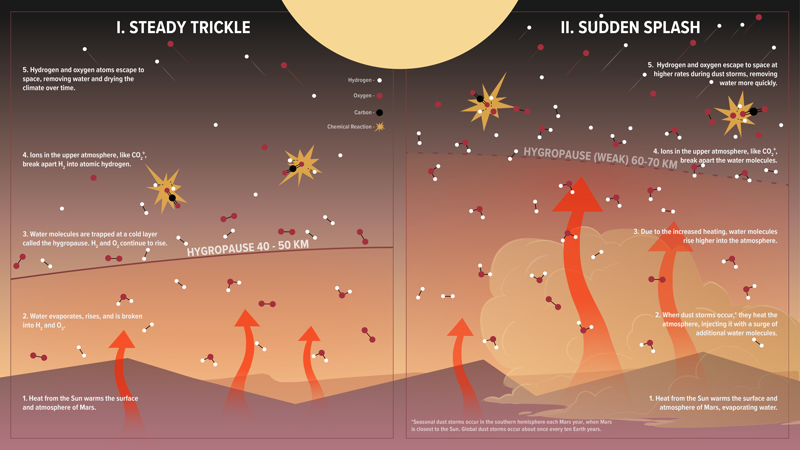
The June 2018 event is the storm that ended Opportunity’s mission. NASA formally declared the rover’s end in February 2019 after more than a thousand recovery commands went unanswered, and the global dust storm that began on May 30, 2018 grew into a planet-encircling event by mid-June, with optical depths in some regions reaching tau values of 5 to 10, enough to blot out direct sunlight at the surface (2018 Mars global dust storm, Wikipedia; Space.com retrospective). It is also the same storm during which MAVEN’s Neutral Gas and Ion Mass Spectrometer measured water vapor 20 times higher than usual, lifting moisture to altitudes where it could be broken apart by ions and lost to space. That measurement was published in 2020 and is now the standard reference for the role of dust storms in Mars’ long-term water loss (NASA SVS infographic, MAVEN team).
A second-order detail has to be acknowledged. NASA’s MAVEN lost contact with Earth on December 6, 2025, and a February 2026 review board concluded the spacecraft was not recoverable. NASA formally ended the mission in May 2026 (MAVEN, Wikipedia; Reuters, May 2026). The Lancaster study relies on archived MAVEN data, so the analysis itself is not affected by the spacecraft’s loss, but the result arrives at a moment when the only orbiter dedicated to studying the Sun-Mars interaction is no longer in operation. Future SEP-Mars coupling studies will lean even more heavily on TGO and on Mars Reconnaissance Orbiter’s continuing aeronomy observations.
The 50 °C / 90 °F warming at 75 to 125 km altitude is not, on the face of it, what one would expect. SEPs deposit their energy high in the atmosphere, mostly through ionization of CO₂, which is the dominant species on Mars. In a quiet atmosphere, that energy is radiated away or conducted to space faster than it can build a temperature signal in the middle atmosphere. The Lancaster team’s working hypothesis is that the suspended dust changes the radiative budget of the lower and middle atmosphere. Dust absorbs upwelling infrared and re-emits it; it also provides a denser population of ice-coated grain surfaces on which water can condense. The net effect is to keep the middle atmosphere warmer than the climatology would predict, so when an SEP event dumps a pulse of energy from above, the column is already closer to a thermal threshold and the additional heating becomes visible. This is a “two stressors, one signal” pattern that has analogues on Earth in stratospheric ozone chemistry and aerosol-radiation interactions, but the Mars case is cleaner because the two drivers are so well separated in time and altitude (Gizmodo coverage of the talk; Phys.org).
For the engineering side, the result matters because MAVEN and TGO were not designed to look for this signal. MAVEN’s strength is in-situ ion and neutral measurements in the upper atmosphere, with instruments like NGIMS and IUVS. TGO carries NOMAD and ACS for atmospheric spectroscopy, plus a radio-science experiment that uses the spacecraft’s occultation link to derive vertical temperature profiles. Putting the two together for an SEP-dust synergy study is the kind of cross-mission analysis that only became possible once both archives had matured. The lesson for future Mars exploration architecture is the same one that keeps coming back: the value of long-lived orbital assets is realized years after their prime mission ends.
A methodological caveat is worth flagging. The Lancaster team is presenting one matching event out of five. The result is suggestive but it is not yet a population-level claim. The Royal Astronomical Society’s framing, “first study hints,” is doing real work in the press release (Royal Astronomical Society press release). Confirming or refuting the synergy will require a second matching event, and global dust storms that produce them happen roughly once every three to four Mars years, so the next opportunity may not come until late in Solar Cycle 26 or into Cycle 27.
The take-home is that Mars’ lower atmosphere is not a passive target for whatever the Sun and the surface throw at it; it is a coupled system in which a dust-driven radiative perturbation can change the visibility of a solar-driven energetic perturbation. That coupling was not in the models in 2018, and it should be in the next round. The Lancaster team has put a concrete, well-instrumented case on the table and is asking the field to plan for the next match. The answer will come on a Mars year measured in years, not months, and the MAVEN and TGO archives are now the legacy infrastructure on which that answer will be built.
 Subscribe to our RSS feed









There are no comments.
Add A Comment