


A rocket company with no employees, no revenue and C$271,000 in the bank started trading on the Canadian Securities Exchange on 27 October. LUNR Aerospace Corporation, a Toronto startup, put its common shares on the exchange under the ticker FLY through a direct listing rather than a reverse takeover. It sold no new stock in the process, so the listing itself raised nothing for the company. Investors received a prospectus describing a launch vehicle that has not been built, on a launch pad that does not yet exist, with an engine that has never been fired.
That is an odd way to enter the market, and the reason sits with the federal government. Canada’s launch sector has just picked up a federal mandate, and LUNR is not the company being funded to fill it. Budget 2026, tabled on 5 November, directs the Department of National Defence to expand the Launch the North initiative from light-lift to medium-lift, build a national rocket propulsion ecosystem, and run dedicated government launch and testing infrastructure, all of it delivered through competitive, milestone-based support to industry. The medium-lift class the budget describes carries between 6,000 and 12,500 kilograms to low Earth orbit. By its own investor presentation, LUNR-01 would carry 250 to 350 kilograms. The first round of Launch the North money, run through the IDEaS programme in the spring, went to NordSpace, Canada Rocket Company and Reaction Dynamics at C$8.3 million each, according to TechTimes. LUNR was not in that round, and its vehicle sits a size class below the one Ottawa now wants funded. LUNR’s corporate site puts Canada’s space sector at C$5 billion and calls the country the only G7 member without sovereign launch capability, a gap Budget 2026 is written to close.
The company behind the ticker is young and small. Jeanue Chung, 22, picked up the idea in early 2024 while an astronomy and astrophysics student at the University of Toronto, then incorporated the business federally as LUNR Innovations Inc. on 1 April 2025 and renamed it LUNR Aerospace that June. The advisory roster includes Tony Clement, who once held the federal industry portfolio, and Dean Misterek, an 18 year Blue Origin veteran who worked on launch vehicle architecture and served as chief engineer. Neither draws a salary, though both can be granted options. There is nobody on the payroll at all. The work goes out to contractors, with propulsion lead Eligh Corchis-Scott giving the company about 75 per cent of his time. The prospectus filed on 22 October shows how the money arrived: roughly C$4.77 million across six rounds from April 2025 to June 2026. The price per share climbed from 2 cents for founder shares to 27 cents in the June 2026 subscription receipt round. About C$1.5 million of the total came from buying Vertical Partners, a company with no business and no assets beyond cash, for about 6 million shares at 25 cents each. The exchange’s own listing record shows 36,376,612 shares issued and outstanding, with another 16,160,000 reserved for issuance.
The rocket in LUNR’s October investor presentation is a two-stage vehicle about 20 metres tall burning methane and liquid oxygen. Its first stage carries five electric-pump-fed engines producing roughly 300 kilonewtons of thrust, and the stage is designed to be recovered and flown again. One pressure-fed vacuum engine handles the upper stage. Rocket Lab’s Electron does the same job on kerosene with nine Rutherford engines, and has flown 99 times since 2017. On that record LUNR-01 looks like an Electron with different propellant and an extra engine. LUNR’s own prospectus lists Rocket Lab among its “aspirational comparators” rather than competitors. The next milestone is a hot fire, somewhere between November and February, on a test stand sitting on licensed farmland in the Township of Amaranth north of Orangeville. As of the prospectus, the stand itself had been fabricated, the combustion chamber was in fabrication, the injector was still being designed and built, and grading and foundations for the propellant tanks were under way. The milestone carries a C$420,000 budget, of which about C$290,000 was already spent. Amaranth has signed off on the test work, and the company says that is the only sign-off this stage of the programme needs. The company’s listing announcement confirms the share sale began trading that same October morning.
The money behind it is thin. LUNR had C$271,000 of cash and no revenue at 30 September, plus C$2.14 million held in escrow from the June round and released on listing, giving it about C$2.6 million to cover the next twelve months. Some C$857,000 of that is set aside for engine milestones, test equipment and engineering contractors, and C$600,000 for investor relations, which tells you what the company thinks a new launch company has to spend to explain itself to the public. Around 11 million shares, roughly 30 per cent of the register, sit in escrow releasing in stages from late February next year out to early 2030. Chung owns about 2 per cent and no single shareholder holds more than 10. The company says it must raise more money within a year, and that a successful hot fire is what produces the data needed to write the larger cheque. SpaceQ says LUNR did not respond to questions sent on 2 November. The exchange bulletin confirms the basics: common shares approved for trading on 27 October under FLY, with the CSE describing LUNR as a company developing orbital launch systems and infrastructure.
The share price has run hard on very little volume. FLY closed at 75 cents on its first day and at C$2.40 on 6 November, a valuation near C$87 million against the roughly C$15 million target IPO market cap set out in LUNR’s own October investor presentation. About 90,000 shares changed hands in the first fortnight, so a handful of orders set that price. By 11 November the exchange quote stood at a C$2.90 bid and C$3.05 ask. Whichever way the next raise goes, the competitors are not waiting. Canada Rocket Company broke ground in October on a C$30 million engine test site in London, Ontario. Reaction Dynamics plans to raise C$350 million for a six-tonne rocket, and Payload reports that NordSpace could test-launch a suborbital demonstration this month. The Budget’s medium-lift shift is putting federal money behind a class of rocket LUNR has not committed to building. The injector was still being designed and built when the prospectus was filed, and that is the part that has to work first. The 2029 launch target, the larger LUNR-02 for 2032 and the next round of financing all sit behind it.
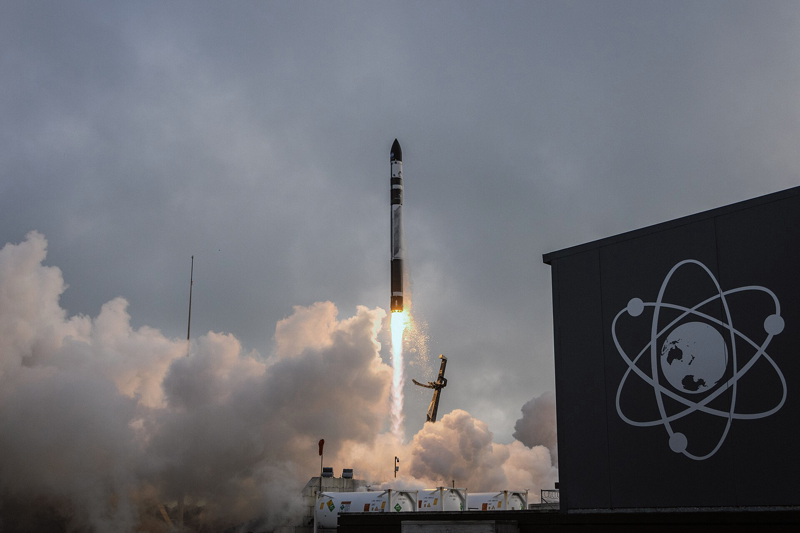
An Electron launch: the flight record LUNR-01 is aiming at, and the architecture its planned first stage copies.
A hot fire is the milestone ahead of LUNR, and the data it produces is what the company says it needs before it can raise the next round.
 Subscribe to our RSS feed








There are no comments.
Add A Comment