


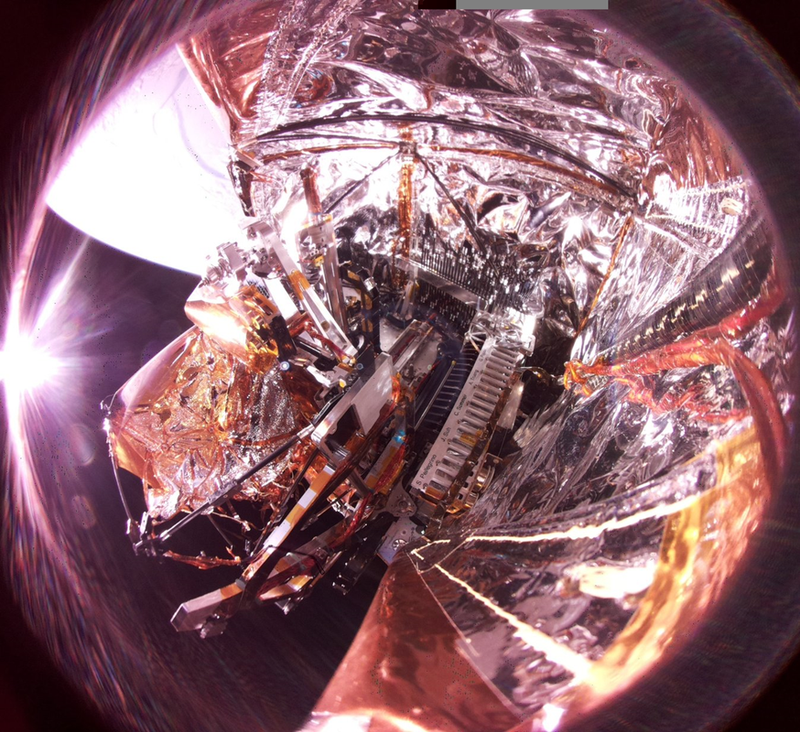
Image source: Caltech/Momentus.
Gold kapton, black composite tubing, and a crowded little mechanism: from a distance the ASTRA payload looks less like a satellite than a workbench that got photographed by accident. That is roughly what it was. On the morning of March 30, 2026, the hardware rode a SpaceX rideshare out of Vandenberg Space Force Base, and for six months it worked in low Earth orbit on a task no machine had performed there before: joining a structure together out of loose parts, with no astronaut and no spacewalk anywhere near it. The machine was Caltech’s Autonomous In-Space Tensioned Reflector Assembly, and the structure it was building was the perimeter truss of a 1.4-meter reflector antenna (Caltech, November 5, 2026).
Every large structure ever flown has been shaped by the inside of a rocket fairing. A mirror too big to launch has to be a mirror that folds. Astro deployable structures, the Shuttle-era solar wings, the space station’s photovoltaic arrays: each trades stiffness and precision for a package small enough to pass through a payload shroud barely five meters wide. The other answer is to fly the pieces up separately and let people put them together, which is how the Shuttle assembled the space station and how Hubble was upgraded. Both routes have a ceiling, and the ceiling is the rocket. DARPA set out to attack that gap in 2022 with a program whose name is a mouthful: Novel Orbital and Moon Manufacturing, Materials, and Mass-efficient Design, or NOM4D. Its stated ambition is to ferry raw materials from Earth for in-orbit manufacturing, so that structures are designed for the environment they will live in rather than for ground test and launch survival (DARPA program page).
Program manager Andrew Detor put the scale question bluntly in the agency’s November 5 announcement: “By ‘very large,’ I mean hundreds of meters or kilometers in scale. Nothing approaching that scale can be achieved today” (DARPA, November 5, 2026). Caltech’s own reference architecture for a robotically assembled observatory is a 100-meter segmented primary, carried on more than 300 deployable truss modules that robots would build in Earth orbit before the system flew out to the Sun-Earth L2 point (Lee et al., Journal of Astronomical Telescopes, Instruments, and Systems, 2016).
The demonstration hardware came from Sergio Pellegrino’s group at Caltech, which manages NASA’s Jet Propulsion Laboratory, and rode to orbit hosted by Momentus aboard the company’s Vigoride 7 vehicle, which carried ten payloads of its own on SpaceX’s Transporter-16, a rideshare that delivered 119 payloads to sun-synchronous orbit (Caltech, November 5, 2026; NASASpaceflight, March 30, 2026). The payload itself was roughly one cubic meter. Inside it were two truss bays already built and folded for launch, an arm-like manipulator, and motorized dispensers holding the struts and joints needed for everything that followed (Caltech, November 5, 2026).
Operations began with releasing launch restraints, then pushing the two prebuilt bays out of the builder, then asking the machine to assemble a third bay from parts it had never touched. Commands came from the ground, sent by Charles Sommer, Alan Truong, and graduate student Tara Venkatadri, and the only way to know whether any of it had worked was to download photographs from the payload’s eleven cameras and compare them against what should have happened (Caltech, November 5, 2026). Anomalies were plentiful. The workaround was to re-create the failure on a flight-spare copy of ASTRA sitting in Pellegrino’s lab, solve it there, and send the revised recipe up. There were only about seven or eight contact windows a day, each roughly fifteen minutes long, so the machine spent twenty-two hours of every twenty-four on its own. Six months in, the antenna was not finished. The truss was designed for eleven bays, and the demonstration had added one.
Two design decisions explain why it worked. The first is the manipulator. DARPA describes it as a gantry robot able to move along three linear axes, and that constraint does more work than it first appears (DARPA, November 5, 2026). A free-flying arm in orbit has to hold its own pose against a moving vehicle, and place a part accurately while reacting against the very structure it is building. Bolted to a rail, the arm inherits its position from the machine carrying it, and a hard control problem collapses into repeatable Cartesian motion. The gantry is not clever. It is a decision to spend the complexity on the joints instead of on the arm.
The second decision is the surface itself. The reflective layer ASTRA deploys is a perforated polyimide film, Kapton, co-invented with a group at the University of Pennsylvania led by Igor Bargatin, and it functions as two cable nets prestressed against one another by springs (Caltech, November 5, 2026). That geometry matters because a tensioned net holds its shape through tension rather than through stiffness. For a cable spanning a distance L under a distributed load q, the out-of-plane sag runs roughly as δ = qL²/(8T), with T the tension per unit length. Halve the tension and the sag doubles; a structure needing less prestress can therefore be built with less material holding it up. Knitted metallic mesh, the standard in furlable reflectors, asks a lot of prestress. Perforated film asks less, so the truss behind it can be lighter. In a program whose premise is that a kilometer of structure must stay affordable to launch, shaving prestress is not a detail. It is the budget.
Scale the demonstration up and the numbers get interesting. Eleven bays span the perimeter of a 1.4-meter aperture, a circumference of roughly 4.4 meters, or about two and a half bays per meter of edge. Carry that density to a 100-meter aperture and you need some 800 meters of truss, a few hundred bays, which is the scale the RAMST reference design assumes (Lee et al., 2016). Put the aperture against the diffraction limit, θ ≈ 1.22λ/D, and a 100-meter mirror working at 500 nanometers resolves roughly 1.3 milliarcseconds, against about 50 milliarcseconds for Hubble. That is the prize, and it is why the concept splits the observatory into parts: the primary mirror, an optics and instrumentation unit a few hundred meters away, a control unit beyond that, and a spider-like six-armed robot, a hexbot, that assembles the truss and then walks across it to install the mirror segments.
What ASTRA established is narrower than the headline and more useful. One bay, built autonomously, in six months, with a human verification loop running about two hours a day, proves the process rather than the product. The complementary half of NOM4D runs in parallel: the other Phase 3 team, at the University of Illinois Urbana-Champaign, uses a station module to harden carbon tubes in orbit, making the material up there instead of merely putting it together (Caltech, November 5, 2026). ASTRA’s mission winds down in December, with the team already pointing at the next round of simplification: fewer failure modes, less ground support, shorter sequences.
The open question is whether the limit on building in orbit is dexterity or bandwidth. ASTRA suggests bandwidth. The robot could pick and place, but every fifteen-minute window had to carry diagnosis, redesign, and a retest, and better hardware does not erase that arithmetic. The fairing has always been the ceiling on what we can put in space. The next twenty years will test whether a gantry, a box of tubes, and a few thousand contact windows a year can lift it.
 Subscribe to our RSS feed





There are no comments.
Add A Comment