


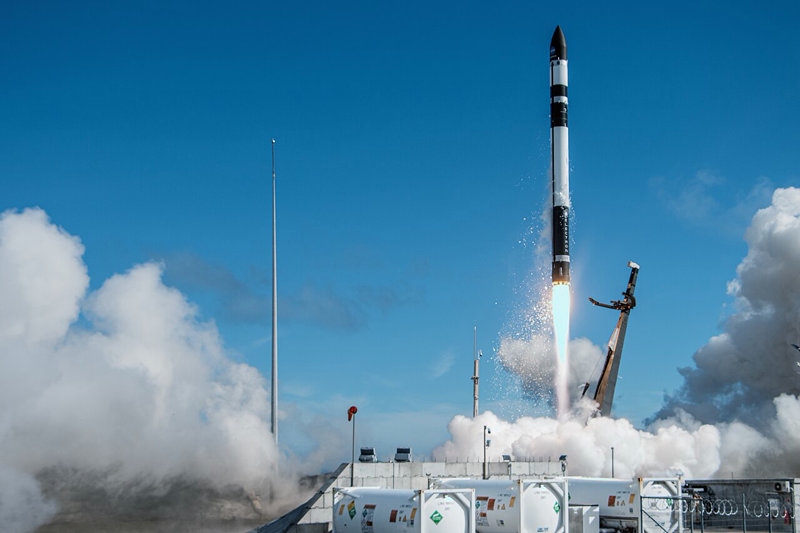
Rocket Lab’s hundredth Electron will not fly in plain black. On 10 November the company posted a photograph of the vehicle being readied for launch 100, and the stage wears a commemorative finish: gold stencil lettering and the company’s gold atom emblem across a black composite skin, a wide gold band around the tank, and gold paint on the bells of its nine first-stage engines. Rocket Lab’s caption paired the black rocket with a golden milestone and called Electron all dressed up for launch 100 (Rocket Lab post). The flight is set for 14 November from Launch Complex 1 on the Mahia Peninsula in New Zealand, with the window opening at 05:30 UTC, according to the company’s mission page (Rocket Lab mission page). That works out to 6:30 in the evening local time, 2:30 in the afternoon in Japan, and half past midnight on the East Coast of the United States. The mission is called The Mountain God Rises, and the payload is a single QPS-SAR satellite for the Japanese company iQPS, headed for a 575 km orbit at 42 degrees inclination.
A hundred flights is a long run for a company whose first Electron went up in May 2017 as a test, and the number on the badge needs a closer look. Wikipedia’s summary of the vehicle puts the total at 99 completed launches, 95 of them successful and four failures (Wikipedia on the Electron rocket), and nine of those flights were suborbital HASTE hypersonic test missions out of Wallops Island rather than orbital launches from New Zealand (Starlust on the 99th flight and the HASTE split). That makes the hundredth launch the hundredth flight of the vehicle family but only the ninety-first orbital Electron flight. A badge reading 100 counts flights of a different kind from the one that puts a satellite into orbit.
The milestone measures cadence rather than any single payload. Rocket Lab flew the rocket 21 times in 2025, its previous annual high (TechTimes on the iQPS radar missions), and it reached its 20th mission of 2026 with the 99th flight, which lifted off from Mahia on the morning of 3 November local time. That mission, The Sea God Surveys, put a radar-imaging satellite named WADATSUMI-II into a 575 km orbit on an inclination tailored to improve iQPS’s revisit times over the Asia-Pacific region, and it was the tenth consecutive flight for iQPS with 100% mission success (Rocket Lab release on the 99th flight). Eight more dedicated flights are already booked for iQPS to complete its constellation by 2030. Electron is the only rocket the company can currently fly, which is why a launch count carries more weight here than it would at a firm with two flying vehicles.
Rocket Lab sells a flight as an occasion, and the naming and the paint are part of that. Mission names follow a house style of gods and totems: The Sea God Surveys, The Lightning God Defends, The Nation God Navigates, and now The Mountain God Rises, with the satellite itself called YAMATSUMI-II, or QPS-SAR-19 (iQPS announcement for the QPS-SAR-19 satellite). The liveries have a history of their own: red stripes appeared on the first stage when it carried recovery hardware for splashdown tests, silver coatings came later, and the black has always been the carbon composite of the airframe showing through (Space Voyaging on the history of Electron liveries). Nothing about the airframe changes for a milestone. Wikipedia’s account of the rocket describes an 18 metre, two-stage vehicle built on a carbon composite structure, 1.2 metres across and 13,000 kg at liftoff, which is why the black is the material rather than a finish (Wikipedia on the Electron rocket).
The payload is the reason a dedicated small launch exists at all. iQPS’s QPS-SAR satellites carry synthetic aperture radar, which images the ground with radio waves rather than light, so they see through cloud and at night, and the company says its satellites weigh about one twentieth of a conventional SAR spacecraft and cost about one hundredth as much while it aims for a constellation of 24 by May 2028 (iQPS announcement for the QPS-SAR-19 satellite). TechTimes describes the current design in more mechanical detail: a 3.6 metre deployable antenna that stows down to 0.8 metres for launch, an X-band transmitter at 9.38 GHz pulsing with 2 kilowatts, and a spotlight mode that resolves ground detail to about 46 centimetres, with the full constellation planned at 36 spacecraft in four orbital planes of nine (TechTimes on the iQPS radar missions). The antenna is the hard part. A radar dish has to be physically wide to resolve fine detail, and a dish of that size cannot ride on a satellite of roughly 100 kg, so the radar instead records the echo at each point along the flight path and combines the returns coherently in processing, making a moving antenna behave as though it were one much larger dish. The method dates back to work Carl Wiley did at Goodyear in 1951, and it is why the antenna can stay small in transit and still deliver map-grade imagery from orbit. A high launch rate buys iQPS coverage rather than resolution: radar views of almost anywhere on Earth every ten minutes on average, which is a job for the geometry of a constellation rather than for any one spacecraft.
Getting that package to orbit takes a particular machine. Rocket Lab’s own specification lists nine sea-level Rutherford engines on the first stage with 311 seconds of specific impulse, and a single vacuum-optimised Rutherford on the second stage at 343 seconds, burning liquid oxygen and kerosene with electric pumps instead of a turbopump (Rocket Lab vehicle specifications for Electron). The kick stage above the second stage is the piece that lets a small satellite reach an orbit of its own rather than sharing one. The whole stack stands 18 metres tall, 1.2 metres wide, 13 tonnes at liftoff, and lifts up to 300 kg to low Earth orbit.
What to watch on 14 November is whether the flight happens at all and whether the date holds: the milestone launch was originally listed for 10 November and has already moved once (Wikipedia list of Electron launches). The round figure matters less than the manifest that follows it. With a hundredth flight behind them, the cadence claim rests on whether a single airframe type and a single launch site can keep absorbing another dedicated mission every few weeks, and on whether Neutron arrives to take the larger jobs. That rocket slipped into 2027 after voids were found in the forward dome of its stage 1 propellant tank, and it was the biggest problem on a quarter in which Rocket Lab still posted record revenue of $267.8 million and grew its backlog to $3.57 billion (summary of the Rocket Lab third quarter 2026 earnings call). The gold paint marks a hundred flights of a rocket that started life as a test article. Whether the anniversary vehicle lifts off on the 14th comes down to the weather over Mahia and the availability of the range.
 Subscribe to our RSS feed









There are no comments.
Add A Comment